
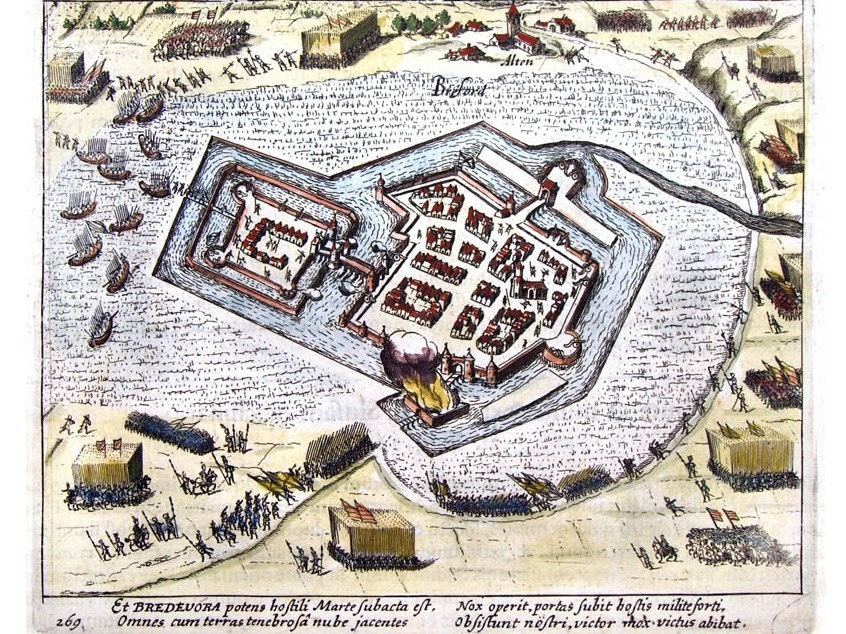
On 20 June 1572, Bredevoort opened its gates to troops of Count William van den Bergh, who was operating in the eastern Netherlands on behalf of William of Orange. The capture was not preceded by a lengthy siege, but by a period of threats, demands for surrender and negotiations. The pledge-holder Diederich van Bronckhorst-Batenburg ultimately agreed to the transfer on condition that his existing rights would not be affected.
This was during the Eighty Years' War, when Bredevoort was under Spanish authority. From the autumn of 1570, however, rumours circulated in the Achterhoek of an attack by insurgents, known as the Geuzen. Until 1572 it remained only a threat. After the capture of Brielle on 1 April 1572, Count William van den Bergh, William of Orange's brother-in-law, assembled an army of about 5,000 men at Wesel. The intention was to campaign through the Achterhoek and along the IJssel. The campaign was accompanied by the plundering of churches and monasteries, among other places.
Demand for surrender and negotiations
Pressure on Bredevoort began early in June. On 9 June 1572 the Geuzen demanded the town's surrender. A day later, pledge-holder Diederich van Bronckhorst-Batenburg wrote to the Court of Guelders about the situation and asked for help. In the days that followed, William van den Bergh continued to press for submission to William of Orange. Orange himself also wrote to the pledge-holder, asking him to accommodate Van den Bergh. Meanwhile, bailiff Jasper van Broeckhuijsen wanted to await the pledge-holder's decision.
Aalten and Winterswijk were also called upon to help defend Bredevoort, but they refused. A mounted messenger summoned officials from the lordship to Zutphen to swear allegiance to Orange. When it became clear that representatives of the Lord of Anholt were already negotiating with Van den Bergh, it was evident that the final decision was being taken above the level of the town authorities.
Diederich van Bronckhorst-Batenburg then sent representatives to William van den Bergh. The agreement stipulated that the house, town and lordship of Bredevoort would be surrendered, while the pledge-holder continued to claim his existing rights. The town could therefore be taken on 20 June 1572 without an assault.
Capture
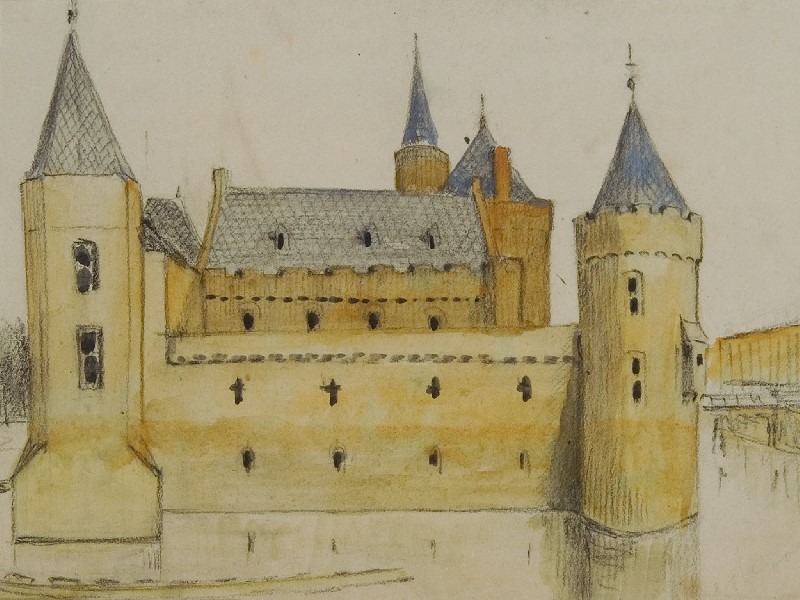
On 20 June Jasper van Broeckhuijsen opened the gates. Captain Giesbert van Heerde was given responsibility for guarding Bredevoort and took up quarters in the castle. The agreements intended to protect people and property soon proved to offer little protection: the castle was plundered and the Nazareth monastery near Bredevoort was also robbed. Broeckhuijsen was removed as bailiff shortly afterwards. Jacob van der Capellen subsequently appears again as bailiff of Bredevoort.
The Geuzen held Bredevoort for only a few months. In November, royalist troops advanced into the region again. On 19 November 1572, Jacob van Bronckhorst-Batenburg, son of the pledge-holder and serving the Spanish side, retook Bredevoort without bloodshed. Spanish troops were then also stationed in the town. In the course of a single year, the inhabitants of the lordship therefore had to contend with both warring camps and the burdens they imposed.
Already during the summer, the insurgents had removed part of Bredevoort's armament contrary to the agreements. The records mention, among other things, six metal cannon with ammunition taken to Zutphen. After the recapture in November, Bredevoort returned to royalist control. Despite changing military circumstances in the surrounding region, it remained so until Maurice of Nassau captured the fortress in 1597.

Corrections and additions
Have a correction or addition? Leave a comment below. We incorporate relevant information into the profile and then remove comments that have been processed. Your email address will not be published.
Ik ben een Aaltenaar van geboorte en ik houd van geschiedenis.
Alhoewel ik nu in Zuid-Afrika woon vind ik het leuk om te lezen wat er zoal gebeurd is in mijn geboorte plaats over de jaren.
Leave a comment