
De Graafschapbode, 23 December 1913
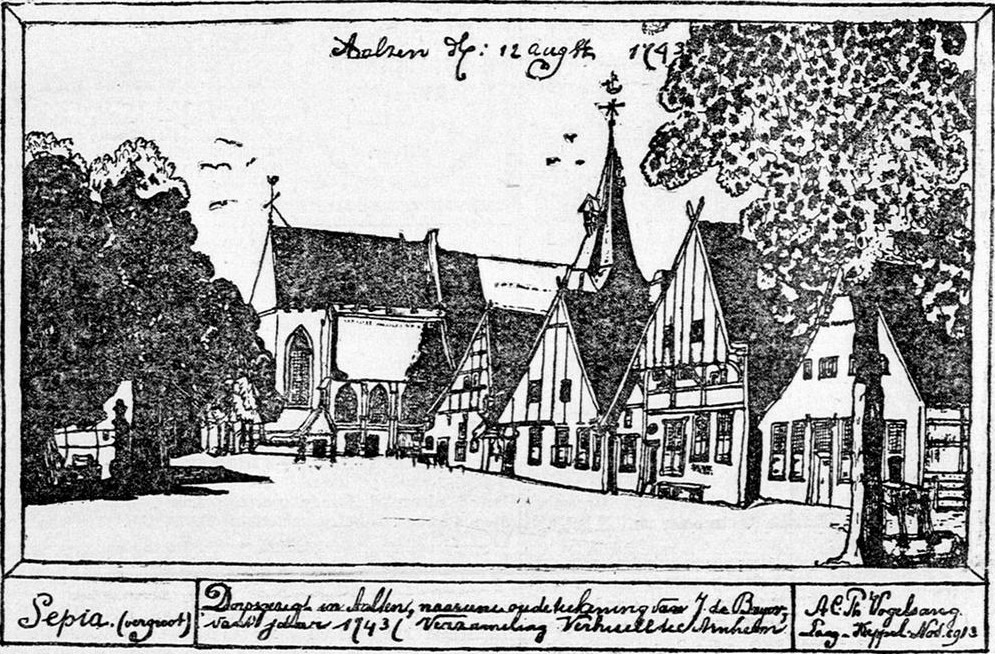
We should like to add a few words to accompany this view of Aalten’s market square from the first half of the eighteenth century, which we present to our readers.
Scholars disagree about the origin of the name “Aalten”. Because of the hill against which the village is built, some believed its origin should be sought in the Latin word altus, meaning height, supposedly given to it by the Romans. This is certainly not impossible; “Aalten” would then be related to “Elten”. Great caution is needed with such derivations, however. There was a time when etymologists first Latinised names they encountered and then presented that manufactured form as the original.
Others believe the name Aalten can be recognised in Alladna, Aladon or Alethe, names under which the place appears in earlier centuries, including the ninth and twelfth. One striking feature of Aalten is that its internal layout resembles that of a Westphalian town, in this respect like Winterswijk. Part of this character is a fairly spacious market square, of which we reproduce a view from 1740.
Anyone standing where the draughtsman once stood will be struck by how greatly the houses have changed, certainly inside but especially outside. Timber façades of that kind are now seldom seen. Some time ago, while in Bredevoort with an expert, we still found a few picturesque examples there, much to our companion’s delight. An elderly resident of Aalten to whom we sent the drawing in advance was particularly pleased with it and wrote that perhaps only one of the present houses could still be recognised from the old view. If interested readers can provide further explanations or clues, we shall be most grateful.
The “great church”, standing on the hill, bears clear marks of great age. The date of its foundation cannot apparently be given, even approximately. A stone on the west side does bear the year 1662, but this undoubtedly refers to a restoration carried out at that time. One remarkable feature is the low Romanesque tower, in which the three eighteenth-century bells will presumably still be hanging; we have heard their “splendid tones” praised.
Much more could be said about this flourishing municipality, but we are not writing a historical or geographical survey and must therefore limit ourselves.
We should nevertheless mention one historical curiosity. We read that in the middle of the eighteenth century, shortly after the well-known religious disturbances at Nijkerk, there was also considerable religious excitement in Aalten under the Rev. Kuipers. This is evident, among other things, from a work published in Leeuwarden in 1750 by Abraham Ferweda under the title The Infallible Touchstone of the New and Rare Conversion, or a Thorough Examination of the Irregularity of the Wondrous Conversion at Aalten, together with Some Observations on the Conduct of the Reverend Philippus de Roy and the Approval of the Theological Faculty at Harderwijk: Offered in Due Defence to the Reverend De Roy by Two Good Friends.
The booklet states that the conversion movement at Nijkerk was clearly said to have arisen from a sermon, and that the Rev. Kuypers recalled: “Then I prayed, then I spoke, hardly knowing myself where it came from; then a great multitude was moved and the Lord broke through.”
“The one at Aalten arose in much the same way, beginning in the catechism classes and reaching its full force in church during the preaching; according to the Reverend De Roy’s own account, the continuing changes depended on his personal addresses.”
“A certain woman in Aalten, coming to fetch her child and joining a company that had only just sat down, suddenly collapsed, was powerfully affected and was converted on the spot.” The text continues that “the spirit works chiefly in women” and lists as supposed signs of conversion: lamentation, shouting, clammy sweat, distress, choking, fainting, trembling of the limbs, gasping, convulsions, falling sickness, frenzy, struggling and collapse.
The conclusion of the booklet adds: “Those who are truly converted show love towards their fellow human beings, but these people despise and condemn everyone outside their own circle. Those who are truly converted are humble, but these are proud and puffed up because of their conversion.”
Professor Cremer of Harderwijk, whose approval had been invoked, stated that he had prayed to God “that He might unite the legalistic element revealed in this with the Evangelical.”

Corrections and additions
Have a correction or addition? Leave a comment below. We incorporate relevant information into the profile and then remove comments that have been processed. Your email address will not be published.
Leave a comment