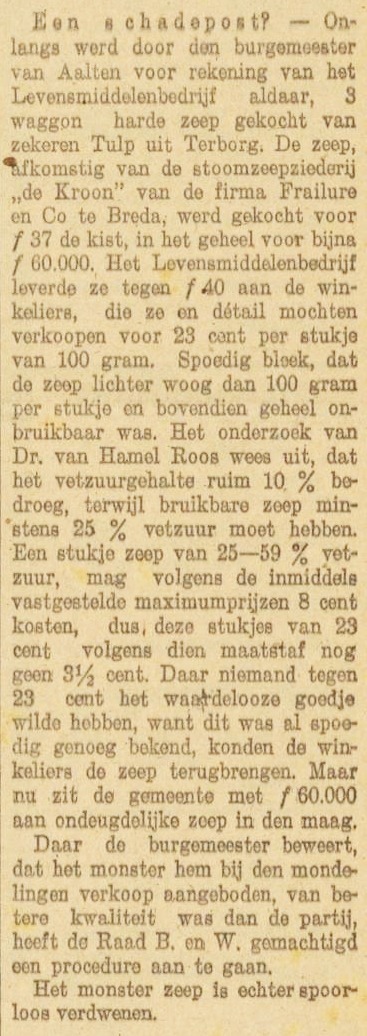
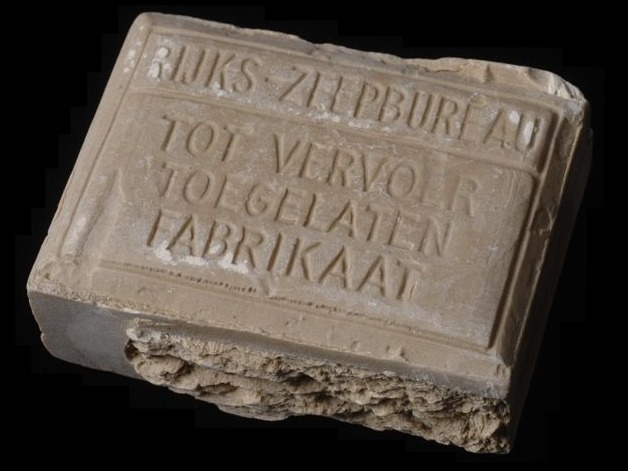
In 1918, the municipality of Aalten was defrauded of 60,000 guilders during the purchase of three wagons of hard soap that subsequently proved to be of worthless quality.
During World War I, the neutral Netherlands faced severe shortages of food, fuel, and numerous other goods. During the last two years of the war, a major shortage of soap also arose. Soap became scarce and expensive. The government intervened, partly because public health was threatened by the soap shortage. Soap factories were only permitted to produce so-called government soap. This could only be done sparingly, and therefore soap was rationed.
Soms wisten oplichters een grote slag te slaan. De burgemeester van Aalten, A.J.W. Monnik, werd een wel heel onnozel slachtoffer van een bekende oplichterstruc. Hij kocht voor rekening van het gemeentelijke levensmiddelenbedrijf drie wagons harde zeep van een handelaar. De inkoopprijs bedroeg ƒ 37 per kist. De plaatselijke winkeliers, die ƒ 40 per kist aan het gemeentelijke levensmiddelenbedrijf dienden te betalen, mochten de zeep vervolgens verkopen voor de detailprijs van 23 cent per stukje van 100 gram, wat hun een aardig winstje zou opleveren.
Worthless
But the plan fell through. It soon became apparent that the batch of soap had a very different composition than the sample the clever businessman had shown the mayor. The fatty acid content turned out to be only 10 percent, instead of the legally required minimum of 25 percent. According to the maximum prices established by the government in the meantime, such a bar of soap should only have cost 3½ cents.
It was no wonder that the housewives of Aalten left the shopkeepers stuck with their worthless goods en masse. The mayor had no choice but to take back the soap. The municipality bore the loss, which amounted to nearly ƒ 60,000.
Contradiction
Following this report, the firm De Fraiture & Co. in Breda, whose name was mentioned therein, declared that they knew neither the Mr. Tulp from Terborg mentioned as the seller nor the Food Company in Aalten. They also stated that they had never marketed bars of soap of approximately 100 grams and that, furthermore, they never manufactured soap with a fatty acid content lower than 20-25 percent. They were absolutely unaware of this matter. They suspected that a batch of their soap of the aforementioned quality or higher had been reprocessed into a poor quality by intermediaries.