
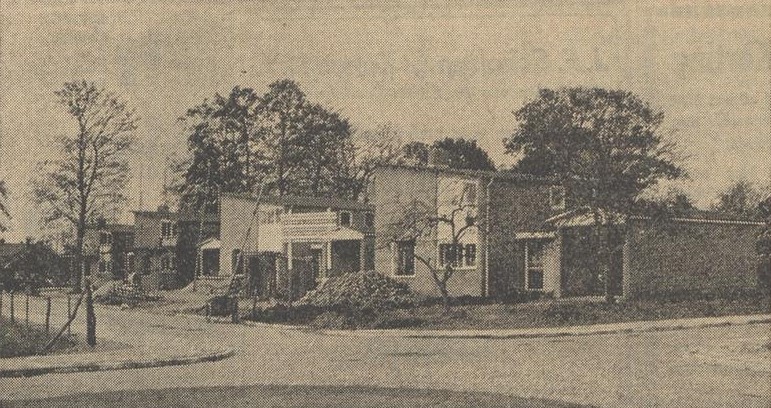
In the first years after liberation, hundreds of homes were built in Aalten, mainly by filling gaps in the existing built-up area. In the mid-1950s this began to change. The municipality started preparing larger extensions in Aalten-Zuid, on the Meiberg and in 't Dal. The newspaper article below, dated 31 October 1956, captures precisely that transition. For Old Aalten's historical timeline, 1956 therefore serves as the anchor year for the growth of new housing estates.
Dagblad Tubantia, 31 October 1956
The gaps are filling up
Housing construction in Aalten is a curious affair. “A stranger in Jerusalem” might ask: is anything actually being built here? And when given an emphatic yes, he would immediately ask: where, then? The answer can be even shorter: everywhere! That is indeed the distinctive feature of housing construction in Aalten — the hundreds of houses built since liberation have not been concentrated in one new estate, but are scattered throughout the municipality.
Aalten-Zuid, the Meiberg and 't Dal
From the outset, Aalten's municipal housing policy was aimed at gradually giving the village a more compact appearance. The built-up area contained quite a few “gaps”. Examples included Piet Heinstraat, Admiraal de Ruyterstraat and Willem Barendsstraat. They were almost crying out to be filled, and in recent years that had happened on a substantial scale.
This method of building had the advantage, among other things, that no new streets had to be laid out and no expensive sewerage works were needed. Building was therefore efficient, while Aalten also avoided the often rather unattractive uniform new housing estates seen in most other municipalities.
Three sectors
But ... “the gaps” are filling up, and in the long run Aalten will not be able to avoid the appearance of new housing estates. The plans for the municipality's expansion in the coming years are based on three sectors. First there is the Aalten-Zuid development plan. In this area south of the railway, new roads have been planned and some have already been built. More and more houses will be constructed along them in the future.
Then there is the Meiberg plan, which is attracting growing interest from the people of Aalten — and quite rightly so. Once this project has been completed, if the signs are not misleading, it should create a pleasant place to live. It will be an attractive neighbourhood, with a small park and green strips. The plan also aims to avoid excessive uniformity and rigid design through a couple of long connecting streets and several smaller cross streets.
Two of the connecting roads have already been completed: Spinkatstraat and the road towards Lichtenvoordsestraat. Spinkatstraat, where the company of that name is having several attractive homes built for employees, already gives a good impression of what the Meiberg will eventually look like. Just under one hundred homes are planned in total, although several years will probably pass before they are all completed.
Naturally, the municipality also had to look for land for private housebuilding, which should not be squeezed out. It found such building land in the development of 't Dal, for which the compulsory-purchase plan had already been approved by the municipal council. The existing Dalweg would be extended for this purpose. A gymnastics school and the Christian regional secondary school were to be built there in the near future. This part of Aalten too would therefore change considerably in appearance before long.

Corrections and additions
Have a correction or addition? Leave a comment below. We incorporate relevant information into the profile and then remove comments that have been processed. Your email address will not be published.
Leave a comment