
Nieuwe Winterswijksche Courant, 29 October 1965
Every year, three and a half million pairs of clogs are made in the Netherlands. Between ten and fifteen per cent are intended for export. Those export clogs do not leave the country merely as curiosities; they are put to the use for which clogs were originally made: they are worn.
Those three and a half million pairs are produced by around one hundred businesses. Immediately after the war there were still 550 clog makers, but that was an abnormal situation which gradually disappeared. The hundred surviving businesses are all modern in their methods.
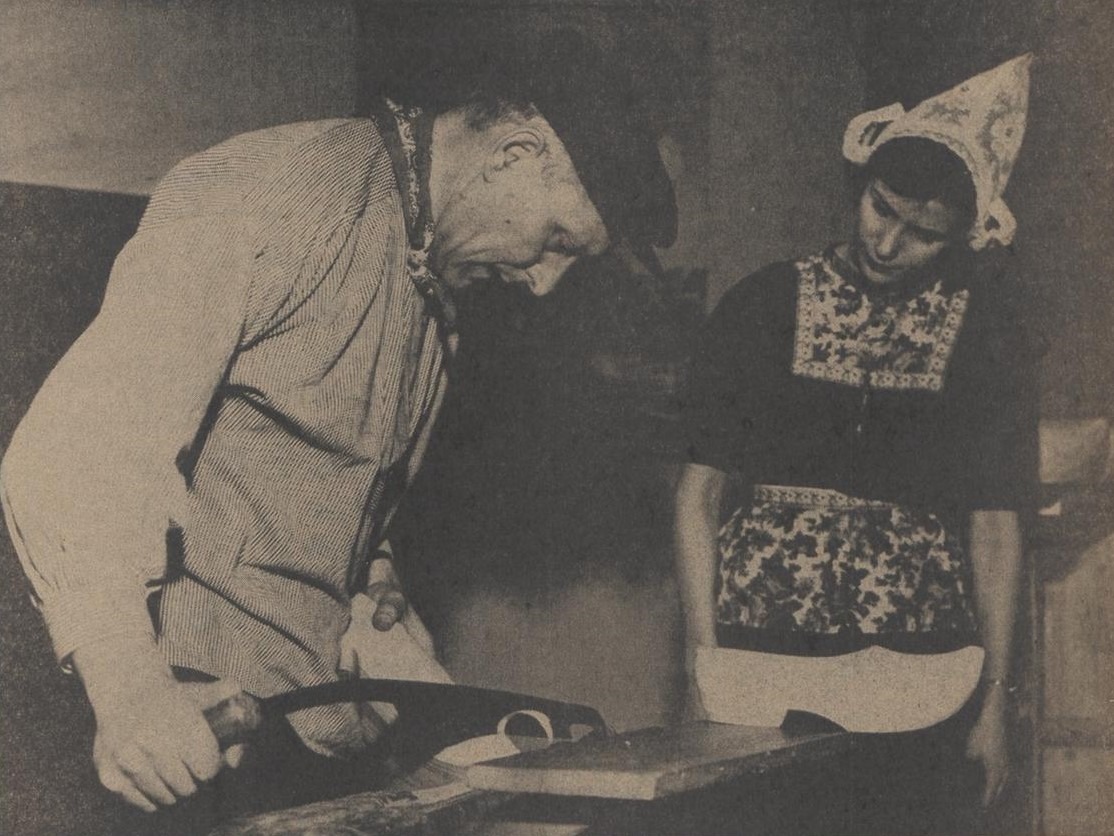
The days when a clog maker stood at his workbench and needed almost two hours to make one pair are long gone. Yet clogs are still occasionally made in the Netherlands in the old-fashioned way, entirely by hand.
G.J. Houwer of Bredevoort could tell a great deal about that. He was one of the few people in the country still able to make clogs completely by hand.
To keep his own business viable he had long since abandoned hand production for normal work. But anyone who needed made-to-measure clogs, for example because of a foot deformity, could still go to Houwer. In this way he kept the old craft alive and at the same time practised for the many demonstrations he gave each year at home and abroad.
It is difficult to explain exactly how it happened, but Houwer became an internationally known figure in traditional clog making.
He travelled to the United States several times: sometimes at the invitation of the national tourist organisation, sometimes for KLM, and sometimes for the Holland-America Line. His purpose was always to promote goodwill for the Netherlands. If some Americans believed that Dutch people all walked around in clogs, Houwer had admittedly done his bit to reinforce the image.
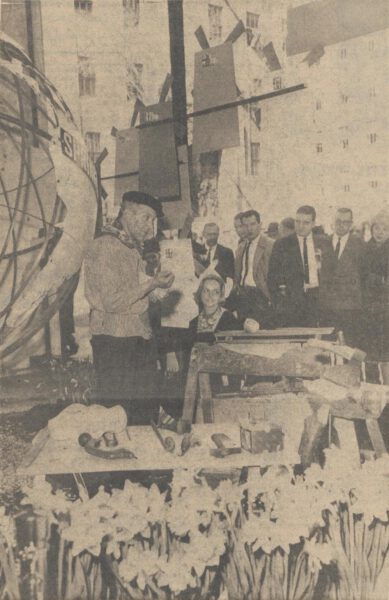
In many major American cities he made clogs by hand in the traditional manner. His demonstrations always drew large crowds and attracted attention from television, radio and film crews. Sometimes he worked outdoors in the street, sometimes at an exhibition.
He did have to change into a different costume for such events, because Americans expected Dutchmen to wear a red neckerchief and an old-fashioned cap. Houwer cared little for the show surrounding his craft, but accepted that such things were part of the performance.
Sometimes a demonstration lasted only two days, requiring him to fly there and back for the occasion. On other trips he travelled aboard one of the large passenger ships of the Holland-America Line. He preferred that to flying, because he could give demonstrations during the voyage.
For five years running, Houwer spent a week each year in Birmingham giving demonstrations during a festival. He had become a regular attraction there, and his performances continued to draw considerable interest.
He vividly remembered one exhibition in Glasgow. Beside him stood a textile company from Helmond whose director was annoyed because wood shavings landed on his fine fabrics. There was some argument. It did not last long: within an hour the director was convinced that he had the best position at the exhibition, because Houwer was such a crowd-puller. Peace was quickly restored.
Anyone who knows a craft well tends to love it, and Houwer was no exception.
“The important thing is to keep your tools in perfect condition,” he said. In his view, some craftsmen still paid too little attention to that. He had been in the trade for almost forty years and knew it thoroughly.
Houwer believed some doctors were beginning to recognise that in certain cases clogs could be better than shoes. This, he thought, explained why demand for children’s clogs had risen somewhat in recent years.
He fully recognised shoes as a serious competitor and knew it was difficult to compete with them. But, as he put it: “Our aim is to have clogs worn wherever they are more suitable than shoes.”
Clog Maker Houwer Returns from New York
At this time last week, clog maker G.J. Houwer of Bredevoort was still astonishing hundreds of curious Americans in the heart of Manhattan by skilfully chiselling and cutting a genuine Dutch clog from a block of wood. Since Monday morning he has once again been standing beside the machines in his own workshop, where mechanisation has long since made handwork unnecessary.
It was quite a transition: from the KLM shop window at the corner of famous Fifth Avenue and 49th Street in New York back to machine production on Ganzenpoelendijk in quiet Bredevoort.
Houwer admitted, still looking a little absent-minded, that it had initially been difficult to settle back into ordinary work. “But it is going all right again now.”
Mister Brevoort
One day Houwer was asked to pose in his display workshop with an American visitor. Naturally he agreed. After the photograph was taken, the man introduced himself as Mr Brevoort.
He must have been a distant descendant of emigrants who had once left Houwer’s home town of Bredevoort to settle in America. Mr Brevoort, director of a large New York bank, no longer spoke a word of Dutch, but that did little to hinder their excellent rapport.
Swedes Must Not Think We Are Merely a Nation of Farmers
Trouw, 3 March 1966
Clog maker G.J. Houwer, aged 51, of Bredevoort was going to show the Swedes how clogs had traditionally been made in the Netherlands. On Tuesday he left for Stockholm with a large group of other Dutch participants travelling to the Swedish capital for a “Dutch Week”, intended to demonstrate that the Netherlands was not populated only by farmers.
The week was due to open the following day, but by then Houwer would already have unpacked his materials.
“I take a round block of wood, split it, and then they can see how a clog grows out of a lump of timber,” he explained before departure.
Houwer had been in the clog-making trade since the age of twelve. He explained that clogs in his Bredevoort business were normally made by machine, but he still knew the traditional hand method.
“Of the more than five hundred clog-making businesses that existed shortly after the war, only about ninety remain,” he said. “Together they produce 3.5 million pairs a year. Production has started rising again recently. The clog is being rediscovered, because it can often be used to correct problems with feet and legs.”
Houwer was part of a wider Dutch delegation. Ria Viegen-Pieffers, municipal carillonneur of Doetinchem and Hengelo, was also travelling to Stockholm, since of course a carillon had to be played as well.
The Dutch Week would be opened by the Netherlands ambassador to Sweden, J. Visser. Swedish Princess Christina was due to inaugurate thirty flag standards in a Stockholm shopping centre.
The programme, under the motto Holland är här — “Holland is here” — also included an exhibition emphasising the “green coastal route”, the tourist road along the North Sea coast of the Netherlands, Germany and Denmark.
Many other attractions were intended to improve Sweden’s image of the Netherlands. And the clogs?
“Although a clog maker is coming along, the week is chiefly intended to break down the image of the Netherlands as merely a country of farmers,” Groningen tourist director H. Braber said. A trip to Sweden was surely worth it for that.
Travelling Goodwill Ambassador
Nieuwe Winterswijksche Courant, 3 January 1968
G.J. Houwer’s clog-making business stood on Misterstraat in Bredevoort. Anyone calling there hoping to find Houwer himself, however, often came in vain. In nine cases out of ten, the newspaper joked, he seemed to be travelling somewhere in the world.
Asked how all these journeys came about, Houwer explained: “They are offered to me by shopping centres, trade fairs, exhibitions and so on. I have just returned from three weeks in San Francisco, where I was at an exhibition. Such events often feature characteristic trades from different countries as attractions, and for the Netherlands the clog maker fits the bill. How organisers get hold of my name is completely beyond me.”
The first time had been at the Ahoy exhibition in Rotterdam in 1958. Afterwards invitations came from all directions.
“I have travelled through almost all of Europe, been to America, Africa and goodness knows where else. Every year I spend a week at the Open Air Museum in Arnhem. I also give demonstrations here and there, but most trips are abroad. Everything is arranged for me. Usually I fly with KLM and the ticket is delivered to my home.”
He had also made three return voyages between Rotterdam and New York with the Holland-America Line on so-called Festival Trips, serving as a special attraction aboard ship.
“That way you see quite a bit of the world.”
He had recently spent three weeks in Johannesburg.
“Fortunately I have good craftsmen at the business who can replace me completely while I am away. Otherwise none of this would be possible. I took my wife with me once, but you cannot do that every time. It would be unaffordable.”
At demonstrations the clogs were made entirely by hand, as in earlier days. In the workshop they were made by machine because hand production would be far too expensive.
Houwer remained convinced that there was still a market for clogs.
“There are particular places and circumstances where the clog is the best footwear — in agriculture, greenhouses and so on.”
At the time he was making a pair of made-to-measure clogs for a woman from Cape Town. He would have liked to make them on the spot, but had not had enough time. Instead he had taken an outline of her feet and was finishing the clogs at home; they would later be sent to her.
Annual clog production then stood at three and a half million pairs, he said, of which 80 per cent was exported. He believed the figure could be much higher if people were not prejudiced against clogs.
“People begin by saying, ‘You cannot walk in clogs.’ That is simply untrue. There is a suitable clog for every foot. They are particularly suitable for people with foot problems. With clogs, corns, calluses and similar complaints can become things of the past.”
That, he explained, was why he gave demonstrations: to show people with their own eyes how patiently every pair was worked on so that it could be made suitable for the wearer.
Every Christmas he received dozens of cards and parcels from grateful customers all over the world: mayors, bank directors and ordinary people.
“That is the pleasant thing that remains from all those journeys: friendship with people throughout the world. That is why I sometimes feel like a travelling goodwill ambassador for our country. That is what I find attractive about my work.”