
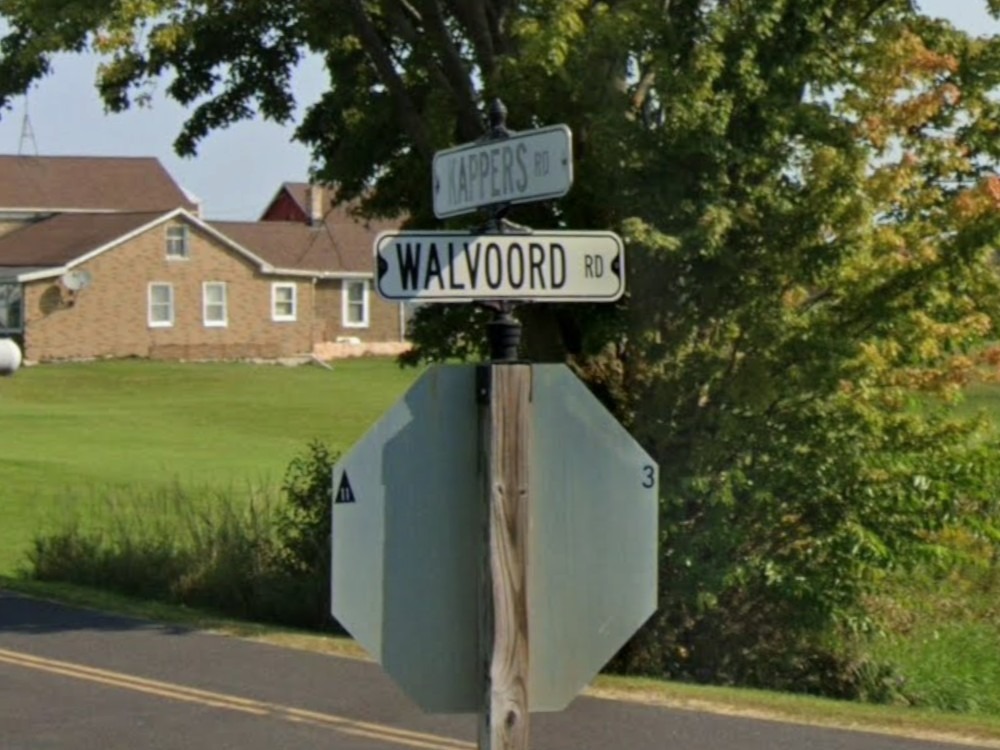
In the nineteenth century, thousands of people from the Achterhoek emigrated to the United States in search of land, freedom and new opportunities. Among them was the Walvoord family. They were among the early European pioneers who sought a new life in the fertile but still largely undeveloped lands of Wisconsin.
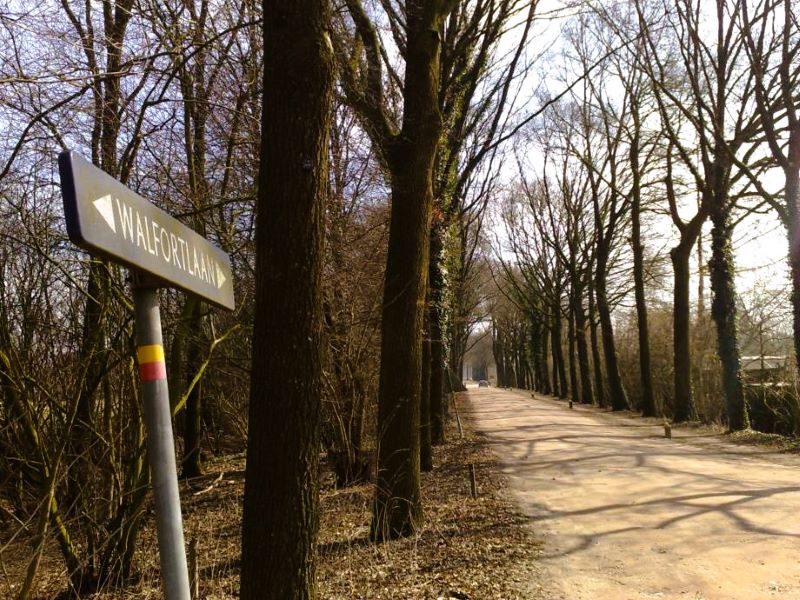
The family name Walvoort/Walvoord derives from the havezate ’t Walfort in Aalten, a historic noble manor house. Scott Anthony Walvoord, who lives in the United States and is descended from emigrants from the Achterhoek, has spent many years researching his roots. On his website he has assembled a vast amount of information about the Walvoort/Walvoord families in the Netherlands and the United States.
Most of the information below is taken from Scott Walvoord’s website.
Ancestors of ‘The Founding Five’
Scott has identified five branches of the Walvoort family that emigrated to America. He calls them the ‘Founding Five’. All five were grandsons of Derk and Janna Walvoort: three brothers and two of their cousins. Most people named Walvoord or Walvoort living in America today descend from these ‘Founding Five’.
Salomon Walvoord (Winterswijk, 21 April 1778) married Maria Elisabeth Klumpenhouwer (Dinxperlo, 21 June 1781) in 1801. They settled at Gantvoort farmstead in Barlo and had ten children there. Maria died on 6 January 1840 at the age of 58. Salomon then moved with his youngest daughter, Janna Diena (1825), to the neighbouring Leeland farmstead. On 1 May 1846 he moved again, this time to live with his eldest son Hendrik (1802), who farmed in Vragender. Salomon died there on 8 June 1848 at the age of 70.
Hendrik Walvoord (1802–1865)
As a young man, Hendrik (Aalten, 21 March 1802) was tall, dark-haired and slender. He married three times, twice to sisters, both daughters of Garrit Doornink and Dersken Wesselink. His first wife was Teunisken Doornink (Vragender, 16 February 1800). They married in 1824 and Hendrik moved in with his parents-in-law. They had two children: Gerrit Jan (Vragender, 22 January 1826) and Derk Antoni (Vragender, 24 July 1827). Derk Antoni died on 24 January 1828 at the age of six months. Five months later, on 22 June 1828, Teunisken died at only 27 years of age.
Hendrik’s eldest son Gerrit Jan was rocked in the same cradle as Hendrik’s youngest sister, Janna Diena — Gerrit Jan’s aunt, who had been born only a year earlier.
Hendrik remarried on 24 July 1829, to Teunisken’s sister Johanna Berendina Doornink (1806). They had a son, Antoni (Tonie), born in Vragender on 29 April 1830. Tonie died on 23 January 1833 at the age of two while staying with his grandparents at Gantvoort farmstead in Barlo. They may have been looking after him temporarily because his mother had died ten days earlier, on 13 January 1833 in Vragender, at only 26 years of age.
Hendrik married for a third time on 4 May 1833, to Johanna Berendina Walvoord (1816), daughter of Antonij Walvoord and Willemina Geertruid Konings. Hendrik and Johanna had two daughters, Johanna Wilhelmina (1834) and Theodora Maria (1835). Theodora died at the age of five on 29 November 1840. Her mother Johanna had already died in Vragender on 27 July 1839, aged 27.
Emigration to America
After the death of his parents, Hendrik Walvoord, by then widowed three times, left the Netherlands for America in 1849. Before crossing the Atlantic he had made several investments with his inheritance and travelled with six thousand dollars.
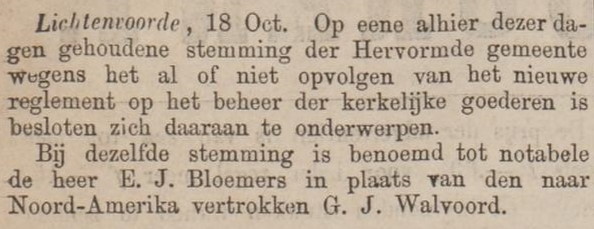
Hendrik’s nephew Gerrit Jan Walvoord (Lichtenvoorde, 1816), not to be confused with Hendrik’s son of the same name, took over the family farm in Vragender. Later, in 1870, Gerrit Jan also emigrated to America with his family, joining his son Toni Willem (William) Walvoord (Lintelo, 1843) in Nebraska. William had gone ahead of his father and had sent enthusiastic reports home about the abundance of prairie land.
Hendrik sailed from Rotterdam to New York aboard the Hector with his youngest sister, 24-year-old Janna Diena Walvoord, arriving on 16 September. In America he joined his son Gerrit Jan in Pittsburgh, Pennsylvania; Gerrit Jan had gone ahead of his father and aunt a few years earlier. Soon afterwards the whole family moved to Holland, Sheboygan County, Wisconsin, where Hendrik bought 65 hectares of wooded land and began developing a farm, which he gradually enlarged. Shortly after arriving in the United States, he also acquired 49 shares in the Holland Trading Company, which was involved in the timber trade and transport.
After settling in Wisconsin, Hendrik sold plots to new immigrants in an area he had named Amsterdam. It took some time before the authorities officially recognised the name. Every plot he sold overlooked Lake Michigan. Hendrik also became known as a timber merchant. He needed a landing pier for the boats that came to collect the timber, so he hired a government dredger and excavated a small harbour about two metres deep. Piles of timber were stacked there awaiting collection by ship.
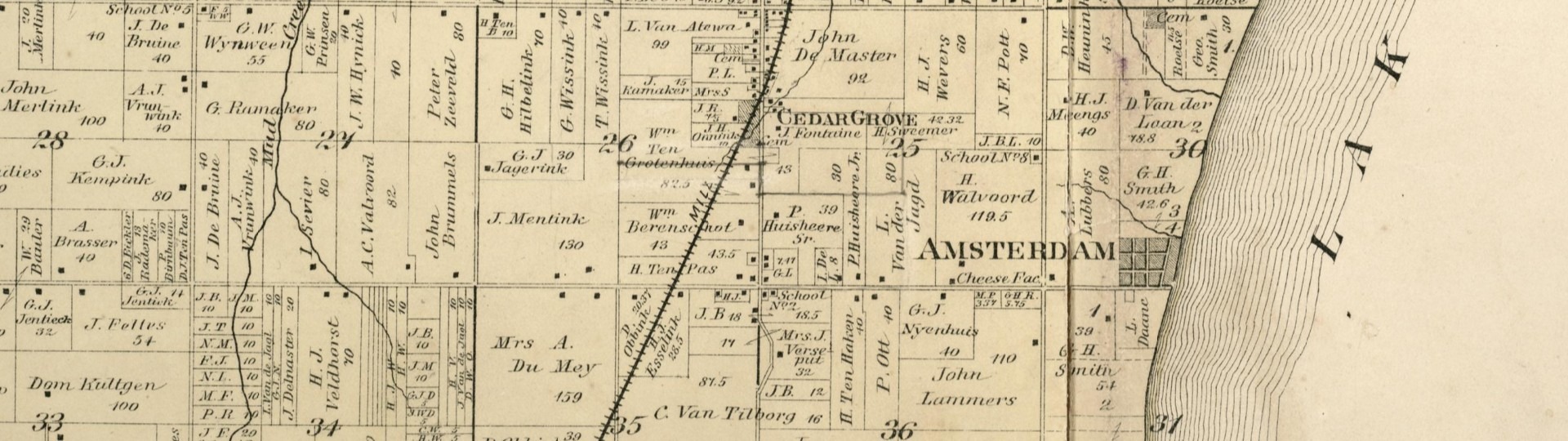
Every day, two or three ships left the pier loaded with timber. Usually four or five ships lay in the bay at the same time. Seven or eight teams of men hauled the timber to the pier — according to Tony Walvoord, then over eighty years old, who later told the story to Louise Walvoord. Although the original pier has disappeared, the wooden piles of Walvoord’s pier can still be seen. Besides owning shares in the timber company and the pier, Hendrik also owned a shop and large areas of land near Amsterdam.
Hendrik Walvoord helped found the Presbyterian Church in Cedar Grove in 1853 and served for many years as an elder. On 17 March 1855, Hendrik became an American citizen. His son Gerrit Jan did the same two days later.
On 11 July 1856, Hendrik lost his only son, Gerrit Jan, who drowned in Lake Michigan at the age of thirty. Hendrik bought a plot of land for a cemetery, now within the village of Cedar Grove (Walvoord Cemetery), and buried his son there.
Hendrik Walvoord died on 21 December 1865. After his death, his land passed to Gerrit Jan’s children: Henry, Jane, Mary, Tonia and Delia. His grandson Henry inherited 32 hectares, while each granddaughter inherited 16 hectares. Henry also received all his grandfather’s movable property: horses, cattle, wagons and furniture. Each of the four granddaughters received 15 dollars towards a cow and a further 300 dollars on reaching the age of twenty-one. When Henry turned twenty-one, he received the remainder of his grandfather’s estate — mortgages, promissory notes, securities, credits and cash. When Tonia died, her brother Henry bought her land.
Gerrit Jan Walvoord (1826–1856)
Gerrit Jan Walvoord (Vragender, 22 January 1826) was quick-witted and energetic, a man of decisive action. He was tall and slim, with black hair, and was described as good-looking. At the age of twenty, he left his native country to seek his fortune in the New World. His father Hendrik would follow later. Gerrit Jan may have sailed from Rotterdam to Baltimore aboard the Garrone. He first settled in Pittsburgh, Pennsylvania, where he farmed and also worked in the coal mines. There, in 1846, he married a German woman, Anna Maria Engel Nolten, who had emigrated to America with her brother.
Their eldest son, Henry, was born in Pittsburgh in 1847. In the autumn of 1849, when Henry was about two years old, the Walvoord family moved to Sheboygan County, Wisconsin. They settled in the small community of Amsterdam on Lake Michigan, south-east of the village of Cedar Grove. The Walvoords ran a shop there and shipped timber from the pier.
Gerrit Jan Walvoord did not enjoy his new home for long. While measuring timber on the pier, he accidentally drowned at the age of thirty. No one witnessed the accident; he was later found in the water. According to one account, Gerrit Jan heard a ship approaching while he was eating. He jumped up from the table, ran to the harbour, climbed over the timber on the pier and lost his balance. He fell into the very cold water. Although he was a good swimmer, timber that had also slipped into the water pinned him down and he drowned. Gerrit Jan died in Lake Michigan on 11 July 1856 and was buried in Walvoord Cemetery.
Gerrit Jan left a family of five children. His son Henry was eight at the time of the accident. His daughters were Jane, Mary, Tonia and Delia; the youngest, Delia, was only three months old when her father died. Soon afterwards, the business at the pier brought the Walvoord family further misfortune. In January 1857, the shop and house burned down and the family lost most of its possessions and almost everything invested there.
The elder Hendrik Walvoord had money and bought some land. Both his own household and Gerrit Jan’s family moved to a farm near Amsterdam. The house had been built for the two families, and for a time they lived there together. Henry Walvoord, Gerrit Jan’s son, later married there.
Janna Diena Walvoord (1825–1894)
Janna Diena (Jane) Walvoord (Barlo, 27 June 1825) was Hendrik Walvoord’s youngest sister. Jane came to America with Hendrik in 1849. After arriving, she married another member of the Walvoord family: Derk Antonij (Dirk Tony) Walvoord (Lichtenvoorde, 1820). Jane died on 8 October 1894 in Holland, Sheboygan. Jane and Dirk Tony had three sons: Garrett, Tony and William.
Garrett married Delia Huenink in 1886 and had six children: Jennie, Minnie, Anna, Elmer, Alice and Della. Tony married Janna Pot in 1886 and had four children: Antoinette, Mabel, Agnes and Alvin. Tony’s second marriage, to Sarah Hilbelink in 1900, produced no children. William married Jennie Flipse in 1892. Jennie was an elder sister of Mary Flipse, who later married a distant cousin of William, John Garrett Walvoord. William and Jennie had five children: Louis, Clarence, Marion, Esther and Harvey.
Walvoord Cemetery
On 11 July 1856, Hendrik Walvoord (1802–1865) lost his only son Gerrit Jan, who had drowned in Lake Michigan at the age of thirty. In his will, Hendrik reserved an acre of land — about 0.4 hectares — for a family cemetery in Section 26 of Holland Township. The will states:
“First, I give and bequeath to the children of my son Gerrit Jan Walvoord (deceased), and to any children who may be born to them, and to their grandchildren and great-grandchildren — in short, to the descendants of the said children of my son Gerrit Jan Walvoord (deceased) — one acre of land lying and being in Sheboygan County in the State of Wisconsin, known and described as follows: …” (the exact location is then described).
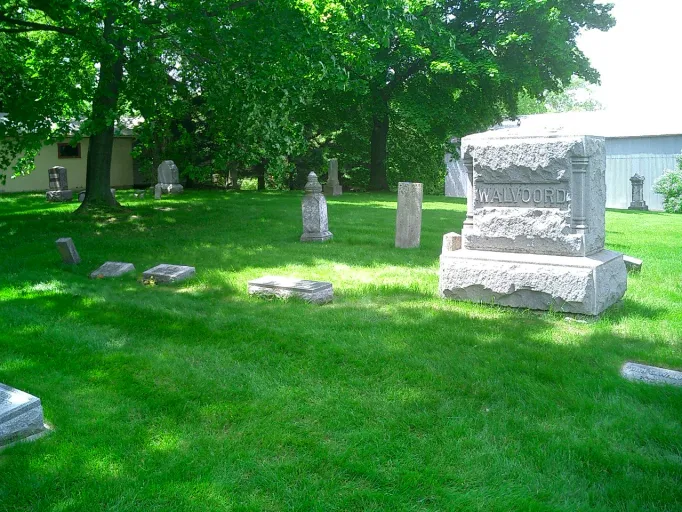
Under Hendrik’s will, therefore, any descendant of Gerrit Jan Walvoord — “down to posterity” — could be buried in this family plot. As Cedar Grove expanded, the Walvoord Cemetery was gradually surrounded by the village. Today the cemetery lies in the centre of Cedar Grove on Main Street.