
De Graafschapbode, 23 March 1934
In our Achterhoek, with its celebrated history, Bredevoort, Groenlo and Lichtenvoorde are among the few former fortified towns where the atmosphere of the previous century has remained wholly or largely intact.
Of the three, Bredevoort preserves it most strongly, and visible reminders of earlier times are therefore found there more often than in Groenlo or Lichtenvoorde.
The spirit of modern times seems to have rushed past the town rather than through it, much as modern through traffic now runs around rather than through the centre.
The whole place gives the impression that this “town”, with its picturesque façades and awkward narrow streets, where weathered little houses cluster together in irregular shapes, might continue dozing for ever in an atmosphere of cosy contentment, with concepts such as fast traffic and modern housing entirely out of tune with its surroundings.
Its inhabitants had grown up with that atmosphere over generations and seemed comfortable in their relative isolation from the hurried, nerve-racking business world outside.
Hardly anyone seemed inclined to change matters, so customs and conditions could still be encountered there that had long since disappeared from more modern society.
We discovered this vividly one Saturday evening when we broke off a conversation with a local resident because our party wished to get home in good time and be properly shaved before Sunday.
A Shave, Sir? Nowhere Better, Faster or Cheaper than Bredevoort!
“If that’s the problem, there’s no need to hurry,” our informant said. “Here in Bredevoort a shave only takes a moment. We have a properly equipped barber’s shop, but also an old-fashioned barber who shaves you in the old way. It costs you all of five cents. That might be something for you newspaper fellows to experience.”
We agreed. After being given directions through the town to the “salon” of the old barber, Gerardus Frenken, in the so-called Old Hozze, we drove there.
The sharp beams of the car headlights swept across grey façades that emerged like ghosts from the darkness. Soon, via Ambthuiswal, we reached Bredevoort’s most antique quarter, the “Old Hozze”, a tangle of crooked little streets and narrow alleys.
Our car, parked against one of the weathered old buildings, with its gleaming paint, nickel and glass, formed a striking contrast between the old world and the new.
Door handles were lifted on both sides and residents peered cautiously outside. Strangers arriving by car at such a late and unusual hour — what could that mean?
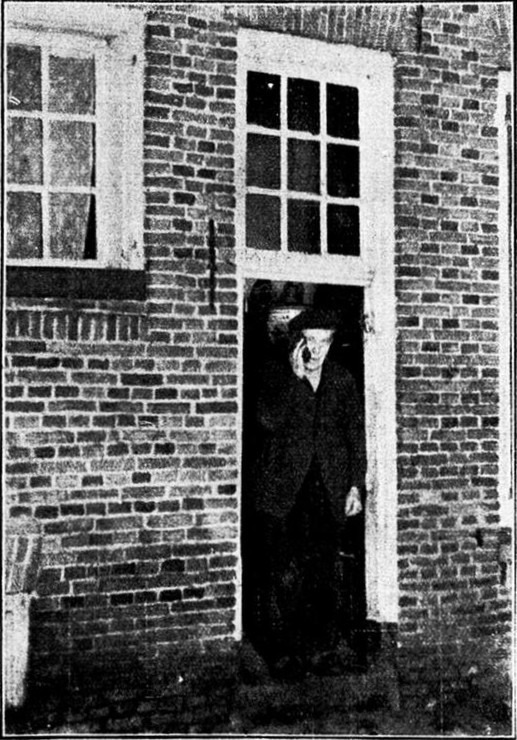
One curious resident pointed us towards the modest house we wanted: “Here, sir, that’s where he lives. Just go in and you’ll find the barber’s shop for yourself.”
A Friendly Chat in Barber Frenken’s Shop
We stepped over a fairly high stone threshold into the humble house. A small paraffin lamp on the middle of the table cast a ghostly glow through the dark room.
Through a narrow passage we reached a long, narrow shed about two by four metres in size, with a tiled floor. A burning gas lamp was the only thing reminding us of the modern age.
This modest space turned out to be the barber’s shop. At the far end stood a poor little table and a “barber’s chair”: an ordinary wooden chair without a headrest.
Nothing else suggested a hairdresser’s. There was no mirror, washbasin or any of the equipment one would expect. No white coat, no bottles of eau de cologne, no reading table — quite literally nothing that looked like a barber’s shop.
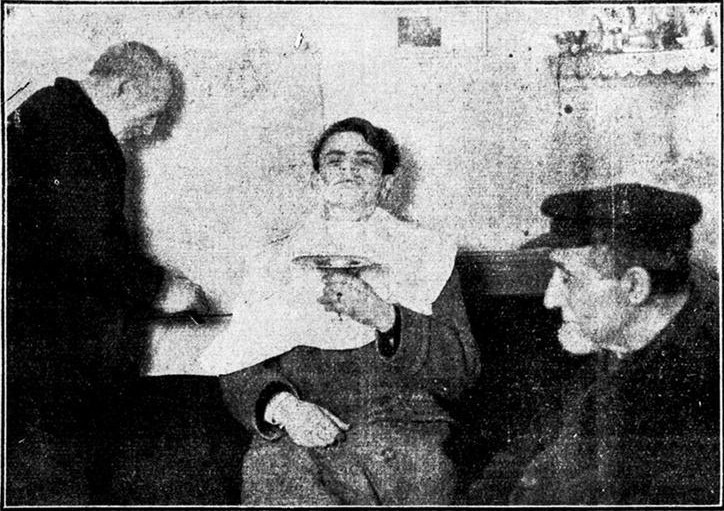
Here, the nearly 71-year-old barber Frenken ruled with his razor. We found him in a blue smock, heavy trousers and clogs, shaving one of his regular customers while three others sat on worn chairs along the side walls, chatting pleasantly while waiting their turn.
Our unexpected arrival caused everyone to look up in surprise and naturally brought the conversation to a halt after our “good evening, everyone” was answered somewhat cautiously.
A friendly remark about the weather — still the reliable way of starting a conversation in a barber’s shop — soon broke the ice and talk resumed as before.
Derk and Bearnd were discussing when to plant potatoes, whether Derk was still too early, and the merits of varieties such as Roode Star, Keizerkronen, Oelenkronen and Veldbeumers.
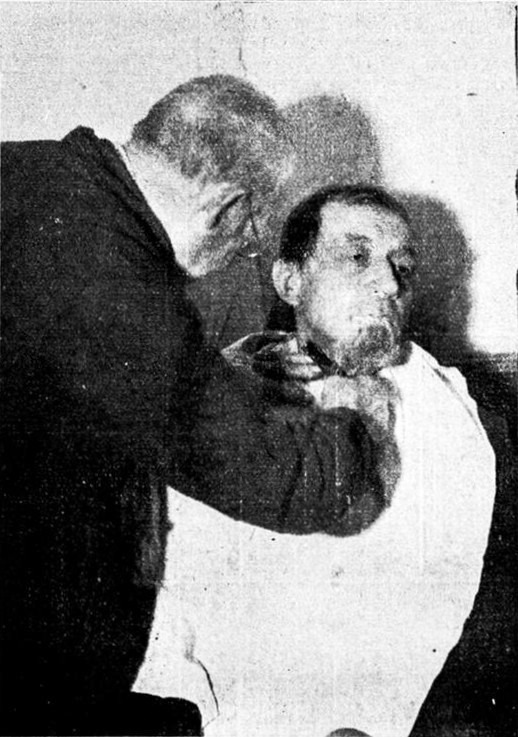
Meanwhile another three faces had been made clean, the last operation being captured on camera. Then one of the two photographers accompanying us took his turn.
The procedure began again: sit upright, hold the bowl of warm water, put a linen cloth over the shoulder — and the energetic old barber was already at work. With his bare hand he wet the customer’s face, brushed on a little soap and silently drew the razor across cheeks and neck.
Within five minutes it was finished.
“That goes quickly here,” we remarked.
One of the regulars replied in dialect that it had to: “The man knows how to handle it. Especially with you lot — there’s not much on your face to begin with.”
Our photographer stood up and, like those before him, reached for his own handkerchief to wipe the remaining soap from his face. Rinsing, alum, drying and powdering were unknown here.
“We don’t bother with those frills.”
“Don’t you ever ask customers whether the razor feels right or pulls?”
“Why should I? They can feel that for themselves.”
An old man with a beard joined in: “The barber in Zieuwent used to do it differently. He’d spit in your face, then put the soap and brush over it. There you are, lads…”
This produced general laughter.
A moment later the two older men shuffled out on their clogs, still wiping their faces and talking animatedly as they made their way back into the fresh night air.
With the final customer, for the moment at least, shaved, we spoke with the old barber, who looked scarcely sixty rather than 71.
His life had not always been easy. His original trade had in fact been weaving in a textile factory in Bocholt. During harvest time he had once cut rye in Germany from six in the morning until eight at night, paid by the area harvested. All his life he had worked extremely hard for a modest living.
He and his wife had also suffered great personal sorrow: all four of their children — two daughters and two sons — had died between the ages of eighteen and nineteen.
For 35 years, the barber’s shop, which had a good clientele, had been their main source of income. He and his wife supplemented their modest living by cultivating a small piece of land they owned.
Life remained difficult, but they faced it cheerfully and courageously. Both were healthy and content with their lot.
Old Aalten later investigated the identity of this “barber Frenken”. The newspaper article calls him Gerardus, but no barber of that name could be found in contemporary records. The author may have misheard or misremembered the name.
The article also states that the barber was almost 71 at the time, had originally worked as an agricultural labourer and weaver, that his wife was still alive, and that all four of their children had died.
Using those details, Old Aalten concluded that the barber can hardly have been anyone other than Johannes Hendrikus Frenken, born on 8 June 1863, died on 4 May 1936, and living at Ambthuiswal 24.
If you have additional information, we would be glad to hear from you.