- Type
- Association
Music society
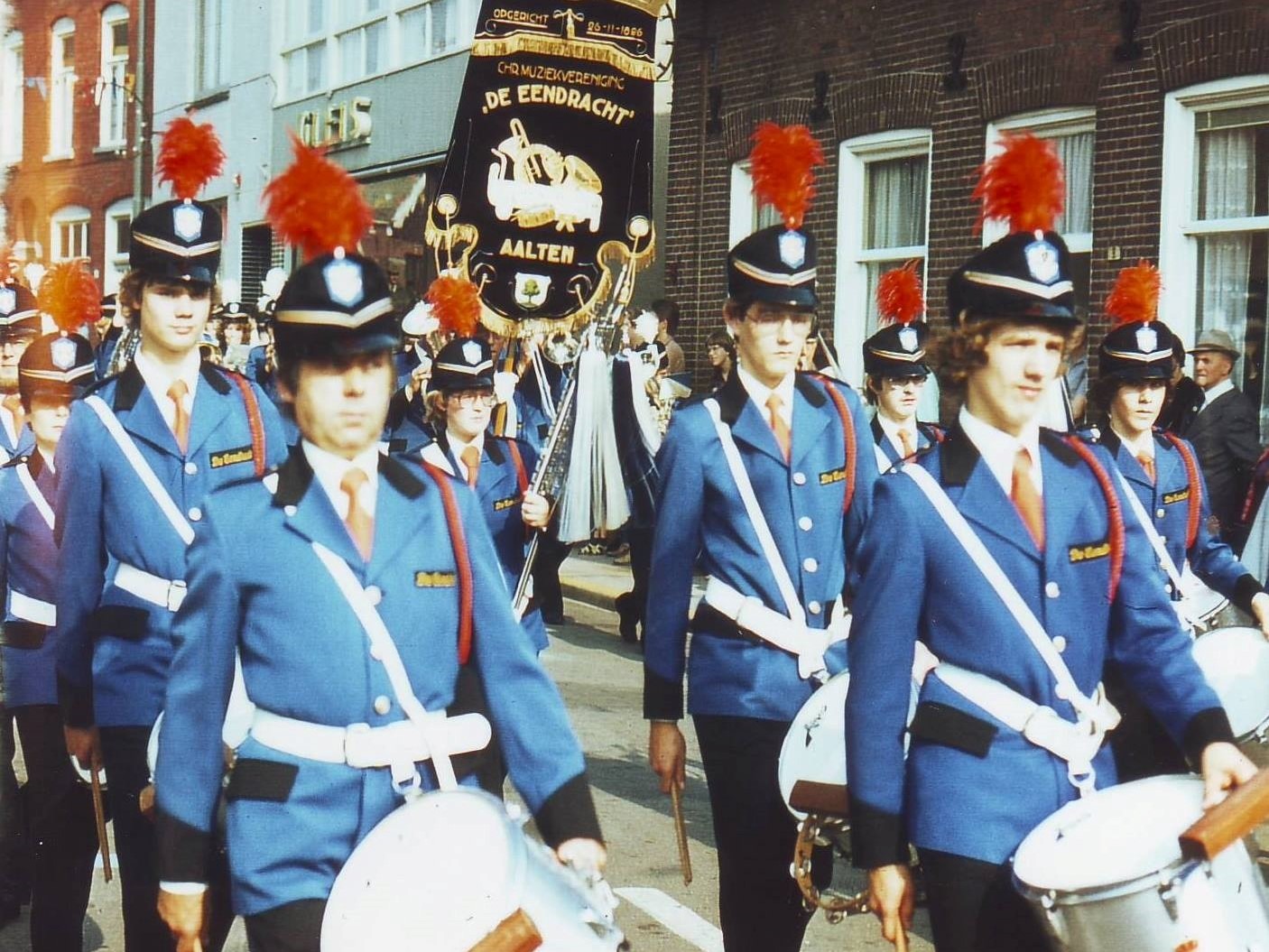
The Christian music society De Eendracht was founded in 1896, making it the oldest music society in Aalten.
Foundation
To trace the precise origins of the De Eendracht music society, we have to go back to 14 March 1896. The Aaltensche Courant (published in Aalten by Gebr. de Boer) carried a report of a performance marking the first anniversary of the Christian choral society ‘Door Oefening tot Stichting’. The report included the following passage:
“Mr Staal, headmaster of the old school on Bredevoortsestraatweg, gave an address while refreshments were being served, speaking about beauty in its various forms, but above all in music.”
This may well mark the origin of De Eendracht, because the local news in the newspaper of 31 October 1896 contained the following:
“AALTEN – The Christian choral society, under the direction of A. Rots, intends to establish a band. A subscription list for voluntary contributions has been circulating among local residents in recent days in order to raise the money needed to purchase instruments.”
And on 6 March 1897, the Aaltensche Courant reported:
“On Friday, 26 February, the choral society ‘Door Oefening tot Stichting’ marked its second anniversary with a private celebration. As readers may remember, towards the end of last year several members made efforts to raise funds for the purchase of instruments for a brass band. Their efforts have been rewarded to such an extent that, thanks to the united cooperation of the members, the guidance of the director and the support of Aalten residents, the songs performed that evening could be interspersed with instrumental music.”
De Eendracht had thus become a reality, and there was clearly enthusiasm for it: sixteen members signed up. Each paid five guilders, giving a total of 80 guilders. That provided a start, while the remainder was collected from Aalten residents. A. Rots was appointed director and conductor and used the money raised to order the first instruments: two cornets, two flugelhorns, two alto horns, one tenor horn and one tuba. There were therefore eight instruments for sixteen musicians, so they had to take turns practising.
Early years
De Eendracht began as a brass band, although in later years an attempt was made to turn it into a wind orchestra. The reason was that the band usually had only ten to fifteen members. It was thought that switching to a wind orchestra might encourage more of Aalten’s ‘well-to-do citizens’ to join; some simply felt that a wind orchestra sounded better. The experiment came to nothing, however, and De Eendracht later returned to being a brass band.
Concert programmes in those days generally featured many works with French titles; there were few, if any, Dutch composers writing for wind and brass bands. Between 1914 and 1918, De Eendracht became relatively quiet. The world was at war, and although the Netherlands was not directly involved, the conflict undoubtedly had an effect. In 1921, the band celebrated its 25th anniversary.
Gradually, De Eendracht developed an interest in taking part in competitions. In 1926, its members took the initiative in establishing a Gelderland Christian Federation of Wind and Brass Bands. The first festival was held on 2 October 1926. On Easter Monday 1929, the Reverend Stegeman presented De Eendracht with its banner.
Years of crisis
For 1939–1940, only a combined annual report survives. In it, the secretary wrote that it was difficult to keep a music society going in those times, but added: “More than ever, we must now look to the name written in gold letters on our banner, for ‘Unity gives strength’.” The minutes then fall silent for a time; only the treasurer continued his records, until 1944. Cultural associations were subsequently ordered by the occupying authorities to join the so-called Kulturkammer. Most wanted nothing to do with it and temporarily suspended their activities. In 1945, music-making resumed in earnest and De Eendracht returned to the streets.
Drum corps
In 1949, the proceeds of a bazaar were used to buy a drum major’s mace. From then on, De Eendracht marched through the streets with a drum corps at its head. By 1969, however, the drum corps was struggling: rehearsals were poorly attended and its mostly older members began to leave. In time, the corps effectively ceased to exist. A completely new group was then established, consisting mainly of younger members.
Uniforms
In 1962, De Eendracht finally acquired its first uniforms. Numerous festival weeks and the generosity of the people of Aalten made it possible to fund such equipment. A ‘music school’ was also established that year. In 1972, De Eendracht celebrated its 75th anniversary and was symbolically presented with a new banner, although the band did not actually receive it until 1973. A few years later, in 1977, De Eendracht organised a highly successful one-day fundraising campaign that raised enough money to purchase new uniforms.
Centenary
As a prelude to its centenary, De Eendracht gave a New Year concert in January 1996. The year was packed with activities, but the greatest ambition was to release a CD. It featured music by the brass band, while the drum and lyre corps — by then renamed the Melody and Percussion Ensemble — also took part in the recordings. To promote the centenary celebrations, a street band was formed from volunteer musicians. There was clearly a demand for such a group, as it was frequently invited to enliven local events, including the Gerard Tebroke Memorial Run and the Aaltendagen.
On Friday, 29 November, a reception was held at De Pol, where numerous speakers and visitors, including former members, congratulated De Eendracht on its centenary. Mayor Bouwers of Aalten presented the society with the Royal Medal of Honour on behalf of the Queen. During the reception, local fellow music societies and the standard-bearers of St Helena gave the centenarian a serenade, while De Eendracht’s street band also offered a musical salute. On 30 November 1996, De Eendracht gave an anniversary concert at De Pol involving all sections of the society.
Ten years earlier, in 1986, a booklet entitled De geschiedenis van een fanfarekorps (‘The history of a brass band’) had been published, written by A.J.A. Stronks and printed by Drukkerij Wikkerink.
A home of its own
Around the turn of the century, the wish for a building of its own resurfaced. An earlier attempt had failed because of a lack of funds. A search began for a suitable site and, after several possibilities had been considered, a plot on Nijverheidsweg was selected. This became the location of De Eendracht’s new music centre. The building was completed on 22 November 2008 and was given the name ‘De Opmaat’.