
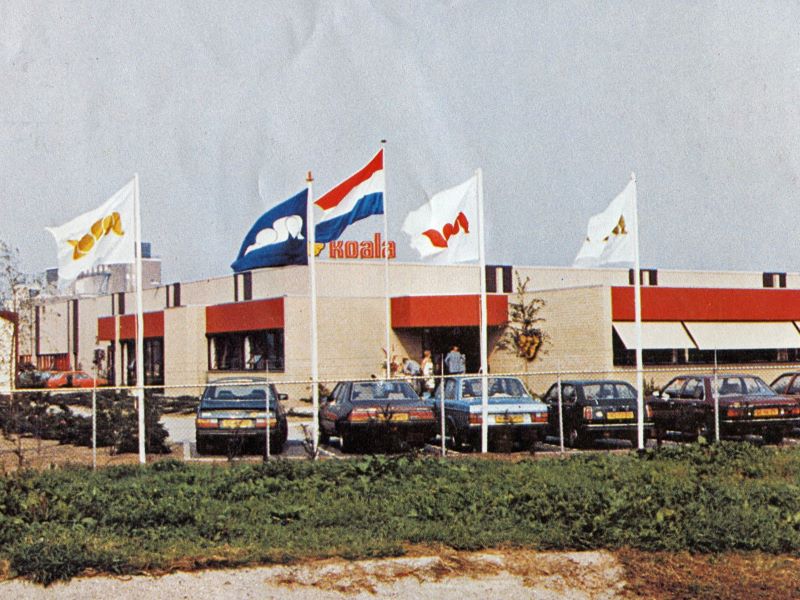
AALTEN — “Because the mood in the textile industry can hardly be described as festive, we do not want the official opening to take place with a great fanfare. Nevertheless, we do not want the event to pass unnoticed,” the management of Textielgroep Twente wrote in a letter inviting the press to attend the opening of two new factories in Aalten.
And it was no small matter. For years one setback after another had hit the textile industry. That summer alone, Schuttersveld had gone bankrupt, Spinnerij Nederland had been forced to cut 475 jobs and Van Heek Scholco 67. In the related clothing industry, Bendien Smits was facing cutbacks. Yet Textielgroep Twente was opening two new factories in Aalten: Wisselink Textiel and Koala Tricotage.
Municipality
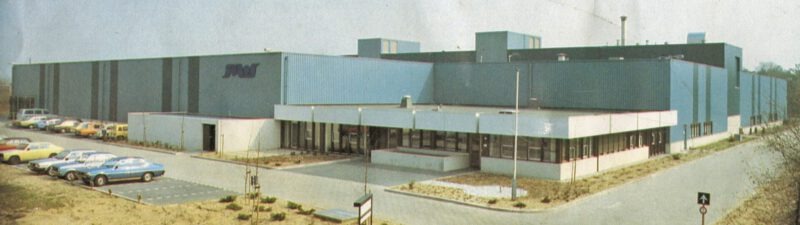
It should be said that the initial impetus for the new buildings did not come from the group management but from the municipality of Aalten. The two companies had long been based in the village centre, where they caused noise and vibration nuisance. The management was willing to move to an industrial estate, partly because production could be organised more efficiently in brand-new factories. One condition, however, was that the various public authorities would make a substantial financial contribution. Director H.J. Hesselink and Mayor Bekius therefore lobbied hard in The Hague.
Not without success. Of the total investment of 17 million guilders, ten million came from public funds, including the municipality’s purchase of the old factory sites. The old buildings had meanwhile been demolished and 122 homes were under construction on the same land.
The management was confident that the seven million guilders it had to provide for the new construction itself had been well spent. Director Hesselink attributed Textielgroep Twente’s reasonably good performance, with five operating companies and sites in Aalten, Enschede, Weerselo, Tilburg, Geldrop and Bree in Belgium, partly to the broad spread of its product range.
In a sensitive industry such as textiles, he considered it important to have several irons in the fire. If sales of certain products were poor, other activities could provide a buffer. The group’s operations were indeed highly diversified. Wisselink produced both consumer goods, such as sheets and duvet covers, and fabrics for industrial applications and tents. De Gunne in Weerselo made garden cushions, garden furniture and sleeping bags, Stilo Print in Tilburg printed T-shirts, and the Koala knitting company produced underwear and leisurewear.
Underwear
Koala also carried the long-established Jansen & Tilanus brand, a name that for generations of Dutch people was virtually synonymous with underwear. More important to Koala, however, was the Koala brand itself, which received the greatest emphasis in its presentation. That presentation mattered because the retail channels for underwear were changing while the brand was trying to maintain its position in the market. Not long before, underwear had often been bought in general textile shops. That type of shop was declining, while other outlets such as sports shops and textile supermarkets were taking its place.
For the market position of a Dutch textile company, Hesselink considered rapid delivery essential. He saw that as an advantage over foreign competitors, made possible in part by the group’s medium size: 500 employees and turnover of 80 million guilders. The relatively small scale of the operating companies allowed them to respond quickly.
This did not mean that the financial results were excellent. In 1981 the group recorded a net loss of 1.5 million guilders. A better result was expected for 1982. Hesselink also took some pride in the group’s sound capital position. That position had recently been strengthened further by a subordinated loan of six million guilders from the Nationale Investeringsbank.
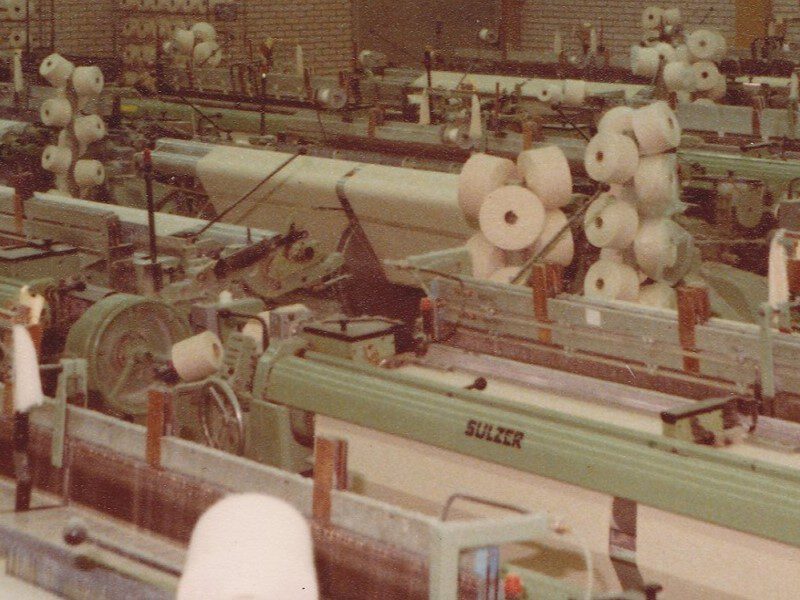
“We have always been cautious with profit distributions,” Hesselink said. Unlike many other textile companies, the group had continued to invest at a reasonable level. This was reflected in its modern looms. Visitors could hardly fail to be impressed by the ultra-light shuttles firing the weft threads through the yarn at a speed of 900 metres per minute.