
De Graafschapbode, 16 January 1933
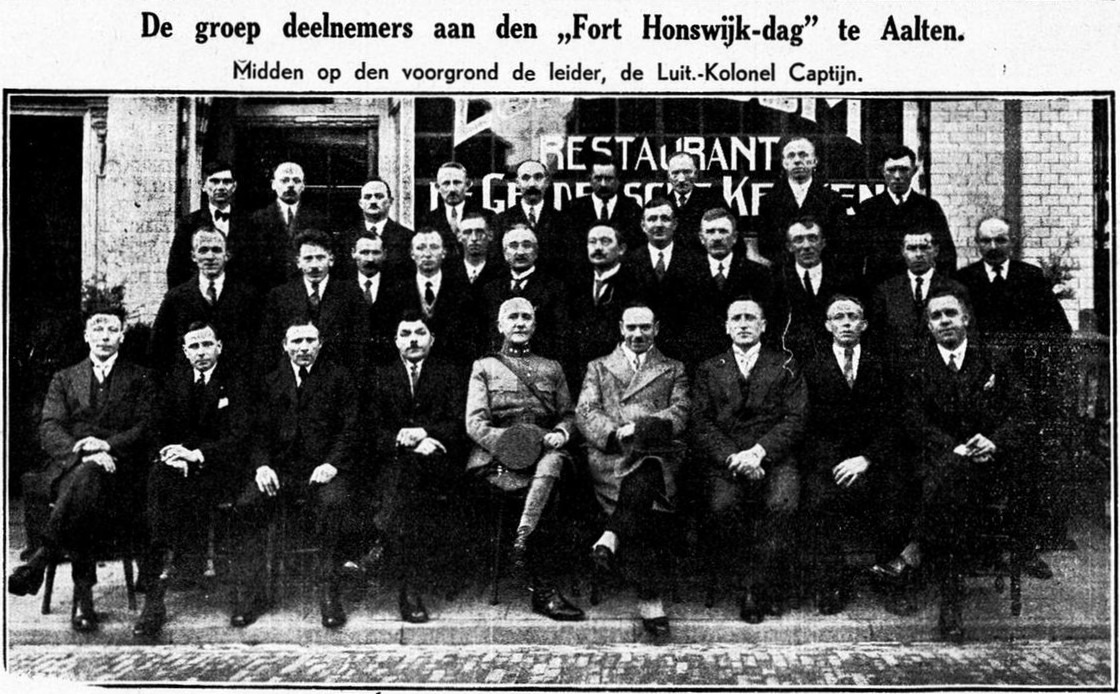
On Saturday afternoon, a gathering was held at café-restaurant De Geldersche Keuken, run by G.J.Joh. Degenaar in Aalten, for the “Honswijk men” from the Graafschap: all those who had served at Fort Honswijk from August 1914 through 1915.
The meeting was chaired by Colonel Captijn of Zeist, who had commanded the fort as a captain at the time. The spirit among the garrison had evidently been exceptionally good, creating a strong sense of comradeship between officers and men. That feeling had been so strong that they had already decided during the war years that everyone should one day meet again at the fort. Owing to the difficult war and post-war years, nothing had come of it. Now, nearly twenty years later, the comradeship still proved strong enough for plans to be made for such a reunion the following year.
After everyone had arrived and a photograph had been taken, Captijn welcomed those present. He said that as leader of the planned “Honswijk Day 1934”, he was pleased to welcome everyone to this “Honswijk house”, as he called the venue now that the spirit and atmosphere of their old Honswijk days had returned. Nearly eighteen years separated past and present, and an entire world had changed in between.
That, he said, made their joy and gratitude all the greater. He then turned to the plan developed by Honswijk comrades elsewhere in the country: a great reunion on Ascension Day 1934 for all former Honswijk men in the Netherlands. He hoped everyone present would live to see that dream fulfilled.
He also remembered those comrades who had already died. A meeting of former Honswijk soldiers in Arnhem on 5 September had decided that in the week before the reunion, a palm branch with a ribbon bearing the word “Honswijk” would be laid on the grave of every former comrade who had died. At a meeting in Utrecht on 3 October, it had also been unanimously agreed that whenever a Honswijk comrade died in future, the same final tribute should be paid by placing such a palm branch with ribbon on his coffin.
Captijn pointed out that these decisions had been taken seventeen years later by men who had long since become free and independent citizens. He was delighted that those from the Graafschap, too, still felt the same comradeship as in 1914–1915, as shown by the very large attendance, including men who had travelled considerable distances. He expressed the hope that the new plan would also provide a welcome diversion in such difficult times, when many people burdened by daily worries needed encouragement and a small ray of pleasure.
The financial arrangements had been designed so that comrades unable to contribute because of economic circumstances could still attend Honswijk Day. Arnhem and Utrecht had said that no former Honswijk soldier in the Netherlands should be left behind at a railway station. Contributions would therefore be adjusted accordingly: anyone able to pay more than the average would do so.
Honswijk Day would be a day both of reunion and remembrance. The proposed programme had already been accepted enthusiastically in Utrecht and Arnhem and was likewise greeted with cheers by those from the Graafschap.
The programme included a reception in Utrecht, followed by a gathering in the hall of the Gebouw voor Kunsten en Wetenschappen. Subject to official approval, buses would then take everyone to the fort, where a metal laurel wreath bearing the year 1934 would be fixed to the “Honswijk gate”. The dead comrades would be solemnly commemorated, if possible with one minute’s ringing of the fort bell, as had been customary at funerals of comrades in 1914–1915. The rest of the day would then be spent socially. The wives of former Honswijk men would also be welcome.
After these announcements, which were greeted with cheers, those present, through G.J.Joh. Degenaar, presented their former commander with a magnificent basket of flowers. Captijn thanked them, visibly moved. The rest of the afternoon passed pleasantly with Honswijk songs and in the old Honswijk spirit until everyone eventually had to return home.
There had also been congratulatory telegrams and letters from former Honswijk soldiers in Groningen, Friesland, Utrecht, North Holland, Zeeland and Limburg.
The newspaper concluded that it was surely unique in the Netherlands for such a spirit of comradeship still to exist after twenty years. Captijn must have been an exceptionally tactful commander who lived closely with his men and thereby fostered that spirit. The gathering in Aalten had shown that quality very clearly.