
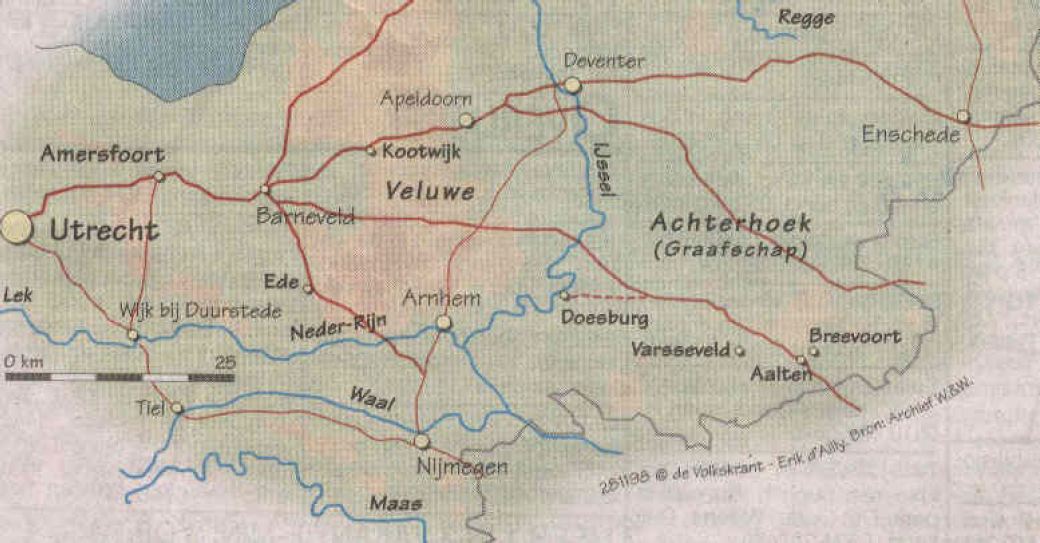
For centuries, German merchants travelled through the Achterhoek with their heavy carts along the so-called Hessenwegen: ancient trade routes connecting the region with Germany and the Dutch trading cities. One of these roads ran from Bocholt via Aalten towards Zutphen and Doesburg. The Hessenwegen were of great importance to early modern trade in this region.
The term Hessenweg has been used since the 17th century. The traditional explanation refers to merchants who came from the Landgraviate of Hesse-Kassel and the surrounding area. Etymologically, however, the name is also explained differently: it may be a corruption of hers, meaning horse. These roads usually ran over high, dry sandy ground and along ridges.
Four major Hessenwegen ran through the Achterhoek. Three followed a northern route, from Vreden and Ammeloe via places including Groenlo, Rekken and Neede to Deventer or Zutphen.
In the southern Achterhoek, a Hessenweg ran through Aalten. From Bocholt, this route crossed the present-day border at the Kesenbulte and continued via the Bodendijk, Dijkstraat, Landstraat, Berkenhovestraat and the Romienendiek to De Radstake. From there, the road continued towards Zutphen and Barneveld, with a branch between Halle and Zelhem towards Doesburg.
From the IJssel cities, the Hessenwegen crossed the Veluwe, converged in the Gooi and continued to Amsterdam. The routes had numerous branches. One of these ran near Aalten from the Romienendiek via the Koningsweg and Hessenweg, past Walfort, and via Bredevoort and Winterswijk to Vreden.
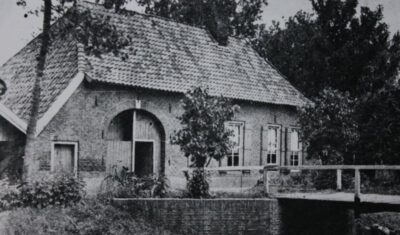
The Hessians stayed overnight at inns along the road, such as De Radstake and the Slikkertap. In Aalten, lodgings included De Leeuw, De Roskam, De Landman and Stad Munster. In Bredevoort, De Zwaan and, just outside the town, De Leste Stuver were well-known stopping places.
Hessenkeerls
For people living along a Hessenweg in the 19th century, the arrival of the Hessenkeerls was quite an event. On the windward side of the procession walked men carrying heavy clubs, dressed in their characteristic blue Hessenkiel: a shirt of fine linen, fastened with copper hooks shaped like lion heads and three small bone buttons. Decorated facings were applied to the chest and shoulders.
On the road, donkeys trudged through the loose sand, carrying a basket of woven willow filled with merchandise on either side. Once they reached a village, the men tied their donkeys near an inn or in the village square. The animals were fed and watered while the men refreshed themselves at the village pump.
The baskets were then opened and the Hessians went from house to house selling their wares. Their merchandise included light glassware and soft straw hats. The hats were popular: as soon as the Hessians arrived, customers were already waiting to buy a new summer hat. They were flexible and therefore fitted almost everyone. After a few hours, the Hessians moved on.
Pottenkeerls, musicians and hannekemaaiers
In addition to the Hessenkeerls, pottenkeerls also travelled along the Hessenwegen. They used heavy covered wagons standing high on their wheels, known as Hessenkaoren, pulled by sturdy Holsteiner horses. The carts were filled with Cologne pottery: grey or yellow-brown pots with blue decoration. The horses wore richly decorated harnesses, fitted and hung with copper ornaments, so their arrival could be heard from afar.
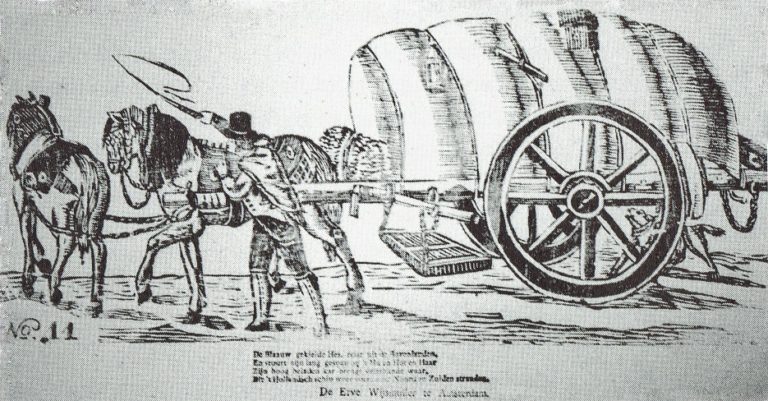
An image of a carter with his Hessenkar from around 1830, from the Popular Prints collection of Museum ‘t Oude Slot in Veldhoven, bearing the text:
The blue-smocked Hessian travels from the Uplands,
And guides his long team with ‘Hu’ and ‘Hot’ and ‘Haar’.
His high-laden cart brings many kinds of wares,
Which the Dutch ship carries on to shores north and south.
In spring, groups of German musicians travelled along the Hessenwegen to the Netherlands. Some bands were very well known in Amsterdam, Rotterdam and The Hague. Although they probably came from the same region, they were not called Hessians because they did not wear the Hessenkiel.
In summer, the hannekemaaiers also passed through: seasonal workers from Westphalia who helped in Holland with mowing grass and bringing in the harvest. Women and children stayed at home to work the land while the men earned money elsewhere for the winter.
The end of the Hessenwegen
During the 19th century, the importance of the Hessenwegen declined. In 1875, the last Hessians were seen near Zelhem, a meagre group compared with earlier times. The Franco-Prussian War of 1870 and the subsequent industrial boom in the Ruhr provided Germans with work closer to home. Many young people from the Achterhoek also went there to earn good money. The Hessenwegen had had their day.
Older origins
Although the term Hessenweg came into use in the 17th century, archaeological finds along these roads indicate that they had been used for much longer. At De Hoven in Aalten, close to the Landstraat, traces of an 8th-century settlement have been found, including remains of sunken-floor huts, refuse pits and spindle whorls. This strongly suggests that the later Hessenwegen developed from much older routes, the so-called volkerenwegen.
It therefore seems reasonable to assume that the village of Aalten partly owes its origins to this ancient route. De Hoven was a favourable location: amid a wild landscape of forest, heath and marshland stood a hill, high and dry, directly beside a through route. A stream also flowed at the foot of the hill, providing fresh water.
Hessentocht
The memory of the Hessians still lives on. In 2011, a Hessentocht was organised for the second time in the area around Bredevoort and Aalten. During this event, which recreated a historic caravan, an impressive ox cart took part: 2.60 metres wide, six metres long and four metres high. Three other wagons also took part, each pulled by three horses. Jan Oberink filmed the event and created the impression below.
Acknowledgements
The content of this article is largely based on an article by G.J. Klokman (Zelhem, 1864), published in 1937. Numerous other publications on Hessenwegen present a different picture on some points. For this article, Klokman’s account was used primarily because his memories and observations relate specifically to the Hessenweg near Zelhem, the same route that also ran through Aalten.