
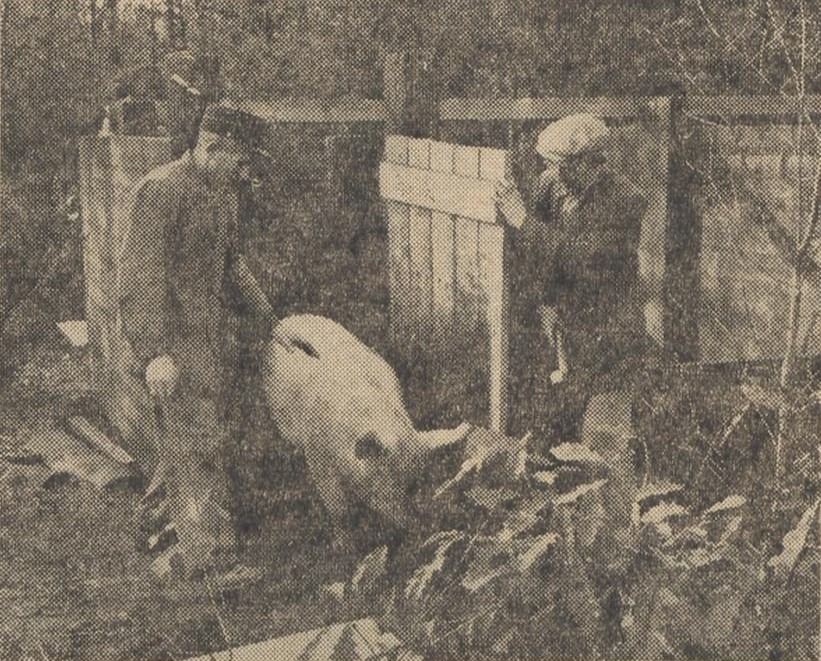
Under the supervision and protection of four National Police officers, workers from Aalten municipal works yesterday demolished a pigsty on the property of farmer G.J. Neerhof in the rural district of Dale. He had built it several months earlier without municipal permission and had refused repeated orders to remove it.
This brought, for the time being at least, the final word in one of those inevitable disputes that arise when what an individual regards as personal freedom collides with a complex set of official regulations which, though democratically established, are not always experienced as such.
The conflict had been running since the beginning of that year. Neerhof wanted to build a henhouse and pigsty on his land. The mayor and aldermen refused permission because the municipal development plan designated the site as woodland.
Neighbours Added Their Barbed Comments
Neerhof ignored what he regarded as an illogical and incorrect restriction and built anyway. In itself that was hardly revolutionary in Aalten, for throughout the municipality buildings had gone up without the responsible officials knowing anything about them. Neerhof did what many had done before him, with one difference: he had been conscientious enough to apply for permission first.
His “case” was therefore known at the town hall and gradually became notorious. Neerhof tried to win over the council, but the council had manoeuvred itself into a difficult position because it had previously approved the development plan giving his land its woodland designation. The entire council later recognised that this was unfortunate and disadvantageous to the farmer concerned, but it could no longer reverse matters easily: the planning service in Arnhem considered the designation justified, leaving councillors little choice but to accept the situation.
Neerhof’s objection was declared unfounded. He was ordered to demolish the building, but ignored the instruction. As if to push matters further, he added a pigsty beside the unauthorised henhouse.
At the same time he petitioned the municipal council, which had meanwhile indicated that it wanted to revise the development plan in his favour. The council forgot, however, that it no longer had the final say: that rested with the Provincial Executive in Arnhem.
On 21 September the council discussed the affair for hours, and at times harsh words were directed at the mayor and aldermen. In the end, however, councillors could do little but follow the executive’s advice: Neerhof, and many others in the municipality, would have to be shown that democratically adopted laws and regulations had to be observed.
What did Neerhof do? He replaced the henhouse with several movable huts, for which no permit was needed. But he left the pigsty standing, despite another municipal order requiring its demolition.
Coffee
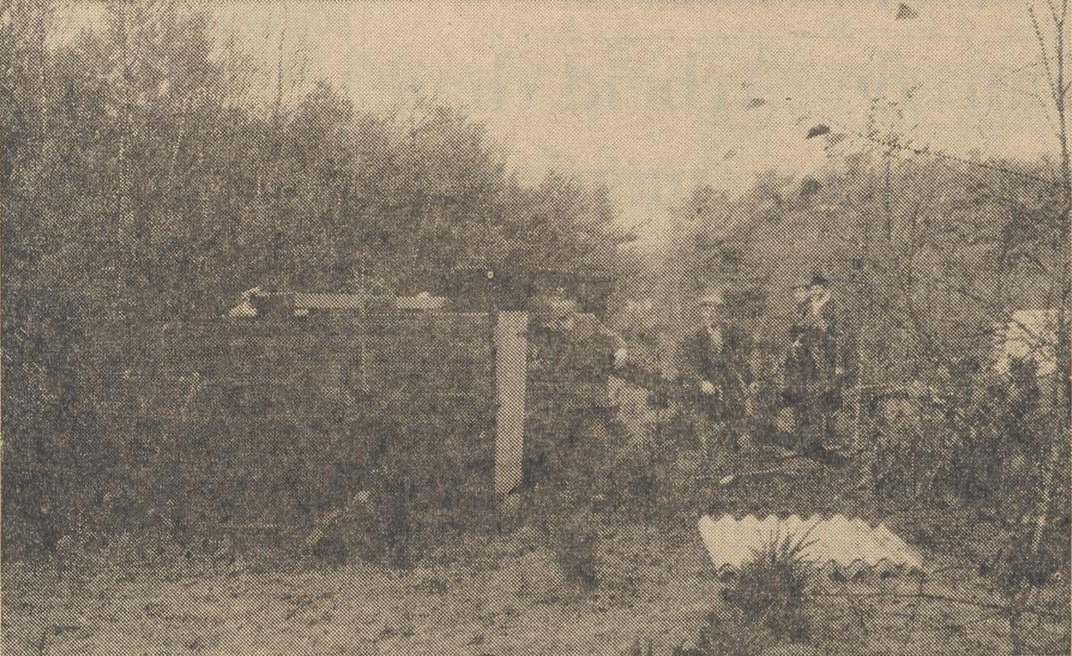
Neerhof was therefore not particularly surprised when, yesterday morning, four municipal workers, several officials and two National Police officers entered his yard to enforce the law.
News soon spread through the noaberschap, the traditional neighbourhood community. As demolition progressed, the circle of grumbling neighbours around the unhappy scene grew larger, with plenty of sarcastic remarks. Perhaps that was why the number of police officers doubled during the morning.
One farmer responded dryly: “What are you expecting? We’re not Koekoek farmers!”
The farmers were realistic enough not to blame the police. But without mincing their words they made clear what they thought of the mayor — “Why isn’t he here then?” — and the municipal works officials. Their comments were far from flattering.
Only at the very end, when the pigsty no longer existed, did a woman from Neerhof’s household who arrived carrying a pot of coffee lose her self-control. She loudly hurled reproaches and curses at the officials preparing to leave. Afterwards, apparently relieved, she poured everyone standing around a cup of hot coffee.
Neerhof also offered coffee to the police officers, but they politely declined. The workers who had demolished the shed were made to put down their tools for a moment and have a drink whether they wanted one or not. After all, the farmers remarked, they had not come for the fun of it either.
The ‘Neerhof Affair’
The first council meeting of the new year, on 16 January 1962, was largely devoted to what had by then become the well-known “Neerhof affair”. As was widely known, Neerhof had built henhouses without permission on land officially designated as woodland. The council had already discussed the case three times without finding a solution satisfactory to both sides.
This time, H.A.J. Luiten of the Anti-Revolutionary Party, supported by fellow party members G.J. Luiten and G.J. Navis, proposed a partial revision of the main development plan.
The mayor and aldermen strongly advised against the proposal. In their view, changing the plan would effectively legitimise Neerhof’s unlawful action, which both the proposer and the large majority of the council had previously condemned. It would also create the impression that the council was helping someone who had broken rules adopted by that same council to be proved right after all, contrary to basic legal principles.
Opinions were divided. H.A.J. Luiten felt that the official advice had become too personal and was insufficiently businesslike. He pointed to the error originally made when the development plan was approved and asked whether Neerhof should continue to be punished because of that mistake. The Christian Historical Union group, represented by H.L. Obbink, supported the mayor and aldermen.
‘Making It Legal’
B. Huinink acknowledged that Neerhof had acted wrongly. But now that matters had reached this point, he wondered whether there was another solution — for example, turning an unlawful situation into a lawful one. In his view, Neerhof had already been punished sufficiently by the demolition of the pigsty, and he was not afraid of the consequences of accepting the proposal.
“After all this commotion,” he argued, “no one will lightly think of doing the same thing again.” He also felt that the failure of the municipal executive to act earlier had created an expectation that the matter might eventually be resolved.
The debate continued at length. As before, the woodland designation was frequently described as “unreasonable”. H.W. Luimes argued that both the council, when approving the development plan, and Neerhof, when building the henhouses, had acted entirely in good faith.
In reply, Mayor Van Veen said he had little desire to debate the matter at length yet again. He remained convinced that the land had correctly been given a woodland designation. He therefore saw no solution other than a complete future revision of the main development plan.
The proposal for a partial revision was then put to the vote and carried by eight votes to six.