
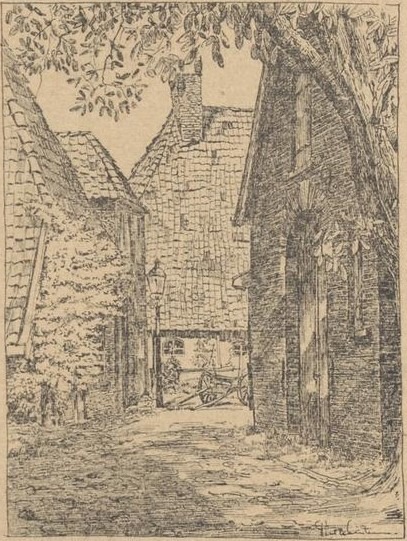
Redactionele toelichting: dit artikel is een historische krantenpublicatie uit De Graafschapper van juni 1948 en wordt als bron uit die tijd bewaard. De historische uitleg is op verschillende punten onjuist. Bredevoort werd in 1597, niet 1598, door Maurits veroverd. Het Anholter pandschap werd later afgelost en stad, huis en ambt Bredevoort werden op 17 december 1612 voor 50.000 gulden aan graaf Maurits van Nassau verpand. Frederik Hendrik veroverde in 1627 Groenlo, niet Bredevoort. De langdurige Gelderse positie van Aalten, Dinxperlo en Winterswijk gaat bovendien terug op het pandschap van 1326 en is niet ontstaan door een zeventiende-eeuwse Oranjeverovering. In 1697 werd Bredevoort wel in volle eigendom aan Willem III overgedragen, maar Gelderland besloot die gift in 1709 weer in te trekken. Voor de actuele, gecontroleerde geschiedenis zie Heerlijkheid Bredevoort.
During his visit to East Gelderland next week, Prince Bernhard will also visit the old fortress of Bredevoort. Bredevoort has been a pledged city of the House of Orange since Frederick Henry conquered it for the States, and the current members of the House of Orange still hold the title of Lord of Bredevoort. In connection with this, we recently visited Bredevoort, where we had an interview with one of the local historians, who shared interesting details about the past of this ancient town.
Van de alleroudste geschiedenis van Bredevoort is weinig bekend. Het was van oudsher een bezitting van de Heren van Anholt. Waarschijnlijk is, dat er ongeveer in de 14e eeuw een kerk is gesticht bij het kasteel, dat waarschijnlijk reeds van heel oude datum was. De streek was armoedig, hoe kon het ook anders, want geregeld trokken benden zwervende soldaten rovend en plunderend heen en weer, waarvan de weerloze bewoners van het platteland het meest hadden te lijden. Gedurende de 80-jarige oorlog, voor het 12-jarig bestand kon het zelfs voorkomen dat de bewoners van Winterswijk binnen de Bredevoortse wallen zich in veiligheid moesten brengen.
The conquest by Prince Maurice
In 1598 sloeg Prins Maurits het beleg voor Bredevoort en na een beleg nam hij het ook in, maar voor zijn aldus verkregen vrijheid moest Bredevoort een zware tol betalen, want de hele stad, behalve het Slot, dat stond op de plaats waar nu de Herv. school staat, brandde af. Voor de Kerk, die toen ook geheel afbrandde, bouwde men de Kerk, die nu nog altijd in Bredevoort staat. Een bijzonderheid van deze Kerk is, dat de toren, in tegenstelling tot die van andere Kerken niet naast de Kerk, maar op de Kerk is gebouwd en geheel rust op een eikenhouten voet. Bij de thans op handen zijnde kerkrestauratie zal men hiervoor in de plaats beton aanbrengen. De historische waarde van deze Kerk blijkt ook wel uit het feit, dat de Kerk is opgenomen in Monumentenzorg, zodat deze instelling ook zal bijdragen in de kosten van restauratie.
Frederick Henry also conquers Bredevoort
Around 1600, Bredevoort changed hands again as the Spaniards retook possession of the fortress. To them, Bredevoort was nothing more than a den of thieves from which they terrorized the region. This situation lasted until 1627, when the States commissioned Frederick Henry to reconquer Bredevoort. He performed his task in such a manner that the States, in appreciation of his services, granted him the Seigniory of Bredevoort as private property. From that time on, the House of Orange has always held the title of Lord of Bredevoort.
This also explains why East Gelderland, specifically Winterswijk, Aalten, and Dinxperlo, extends so far into Germany. This entire area belonged to the Seigniory of Bredevoort and thus came into the possession of the House of Orange, and consequently the Netherlands, with the conquest of Bredevoort.
One might wonder why Frederick Henry did not also conquer Anholt, which was also connected to Bredevoort, but the explanation lies in the fact that the Lords of Anholt were related to the House of Orange, and he likely spared them for that reason.
Seigniorial rights
Door het bezit van Bredevoort kregen de Oranjes hier Heerlijke Rechten, zoals het maalrecht. Dit wil zeggen, dat in de Heerlijkheid Bredevoort niet anders gemalen mocht worden dan op de molen te Bredevoort, de watermolen op de Pol te Aalten en de watermolen bij den Helder te Winterswijk. Over het maalrecht is bekend dat in 1868 nog een door Frederik zelf getekend officieel huurcontract in bezit van de Familie Heusinkveld te Bredevoort was, waarin hen het recht werd toegekend om van geslacht op geslacht de molen te Bredevoort te mogen huren. Het is jammer dat dit huurcontract zoek geraakt is.
Naturally, other members of the House of Orange were also Lords of Bredevoort. Well-known stewards came from the Roelvink family, which is still known today, and some of its members later served as Mayor of Aalten.
William V in Bredevoort
It is known that Stadtholder William V also once visited Bredevoort. The minutes of the Dutch Reformed Church mention that he donated several Golden Riders for the poor of Bredevoort.
The French Period
During the French period, everything belonging to the Seigniory was sold. Large-scale landownership, as it is still known today around Winterswijk, dates from that time. Entire areas were then sold for sometimes only a few guilders. Some of the new owners found themselves in difficulty with their newly acquired property because they were unable to cultivate everything, so they planted forests instead; thus, large areas of forest near Winterswijk date from that time, which is consistent with the fact that most of the Winterswijk forest is approximately 150 years old. After the French period, the House of Orange never regained these lands, so they have only held the title since then.
The House of Orange does not appear to have made any official visits to Bredevoort since that time, likely because Bredevoort is relatively poor in historical buildings and institutions. However, that the ties were never completely severed was evident in 1900 when H.M. Queen Wilhelmina made ƒ 100 available for the restoration of the Church in Bredevoort.
H.R.H. Prince Bernhard in East Gelderland
Yesterday, the final day of H.R.H. Prince Bernhard’s visit to East Gelderland flew by once again as the Prince’s open Cadillac traveled under the radiant summer sun through one of the most scenic parts of our country, past ripening grain, busy farmers, cheering and singing schoolchildren, and an enthusiastic population; once again, the Wilhelmus sounded many times, and the Prince raised his hand in greeting countless times with a charming smile on his tanned face; once again, it became a true triumphal procession.
On this third day, H.R.H. departed from Ruurlo, arriving in Zieuwent around a quarter to nine at the farmhouse of farmer Weelink, which dates from 1737. After the Prince had briefly toured the farm, he proceeded at pace to Harreveld, where a group of young people waited in suspense at the Roman Catholic Reformatory; surrounded by hundreds of pupils from the Reformatory, H.R.H. was received and addressed by the chairman of the Reformatory board.
Lichtenvoorde prepared a grand welcome for H.R.H.; many thousands, again adorned with the national colors, saw the procession arrive in the thousand-year-old town, preceded by ten motorcyclists from the local Motor Club. The Prince stepped out in front of the Roman Catholic rectory. Inside the rectory, the Prince listened for about fifteen minutes to the Pastor-Dean of Groenlo, who gave a presentation on Roman Catholic spiritual life in East Gelderland.
Preceded once again by the Lichtenvoorde motorcyclists, the procession left the old town. At the border of the municipality of Aalten, Mayor E. S. van Veen took a seat beside the Prince, and they proceeded to Bredevoort, the old pledged city of the House of Orange; the Prince stopped here for only a few moments, where he spoke briefly with baker Helmink.