De Standaard, 23 July 1936
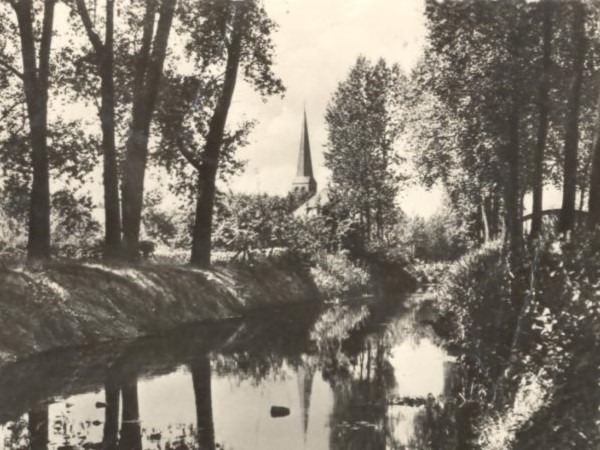
Those who are still strangers to the Achterhoek are advised to spend a holiday in Aalten, which has a character all its own and lies charmingly on the southern slope of a hill, the Aalter Es. The varied landscape of high and low ground, streams, woods and heathland, rolling cornfields alternating with meadows and cattle, old farmsteads among potato fields, makes the area particularly suitable for peaceful walks and beautiful cycle rides. You will find no fashionable entertainment here, but for walking and cycling it is a paradise.
Looking at a map of the municipality of Aalten, one notices that the village lies in the middle like a spider in its web. Metalled roads radiate from this centre. Together with the streams flowing through the municipality, these roads make orientation very easy. Between them are hundreds of sandy roads, linking one main road to another, all with excellent cycle tracks that naturally lead past the finest spots. Nowhere do you find a “No Entry” sign, and nowhere are you likely to discover that a road suddenly comes to an end.
Close to the village is the nature reserve ’t Loohuis, with pines, heathland, little meres and high arable land. It is well worth a visit and was purchased by our association at just the right moment to save it from destruction. It is now owned by the Dutch Society for Nature Conservation. Walking is freely permitted, though camping in this small natural area is prohibited. In the Wolboom, the Klooster, Walfort and all the hamlets — Haart, Barlo, Lintelo, Heurne, Dale and IJzerlo — there is natural beauty everywhere.
For lovers of plants and animals, the area is a true paradise. Many uncommon plants can be found in the woods, along stream banks and beside damp lanes in Lintelo, including orchids, marsh orchid, butterfly orchid, May lily, wintergreen, guelder rose, meadowsweet, marsh ragwort, grass of Parnassus, gentian, sheep’s-bit, marsh woundwort, hemlock, hogweed, holly, juniper, honeysuckle and enchanter’s-nightshade.
Among the animals found in ’t Loohuis are roe deer, pheasants and partridges. Birds include the black woodpecker and ortolan bunting, while notable butterflies and moths include several rare blues and species such as Limenitis sibilla and Plusia moneta.
Trade and Industry in Aalten
When speaking of trade and industry in Aalten, who does not immediately think of Joh. Lammers’ wholesale business, known throughout much of the Achterhoek for its wholesale groceries? The proprietor, Joh. Lammers op de Wehme, has expanded his business since 1923 to such an extent that every shopkeeper of standing is pleased to be supplied by the firm. Particularly in these times, he has repeatedly adjusted to changing circumstances, to the benefit of the retailer. His motto, “The customer is king”, has also contributed greatly to this success. Relations are good on both sides.
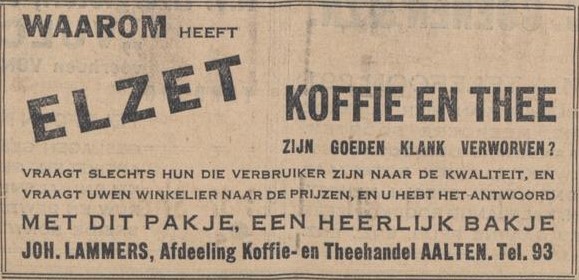
The rapid growth of this small business into a fully fledged grocery wholesaler also meant that many newly established shops chose to deal with it. Among the very wide range of goods, coffee and tea occupy a special position. A few years ago Mr Lammers therefore decided to give these products particular attention and looked for the best way to make them successful. Imported coffee and tea now travel via Rotterdam to Aalten, and who does not know the fragrant ELZET blends?
It is now July 1936. After some thirteen years of hard work, the warehouse still stands near the tram station, but a new, modern building is in sight. Within only a few months the new offices and premises on Patrimoniumstraat will be ready for use. We gladly wish the proprietor continued success.
The business of J.B. te Paske, already more than forty years old, is primarily a timber merchant with a steam-powered sawmill and planing mill. It handles spruce and pine, as well as oak, Oregon pine and all kinds of plywood and boards. Its building materials department, which has grown strongly in recent years, stocks almost every kind of article. Pipes and other concrete products are made in the firm’s own workshop. Because its storage areas are favourably situated by water, railway and tram, it can offer competitive prices.

Boekhandel De Graafschap, established in 1919 as a department of N.V. De Graafschap, printers and publishers, has been an independent business since 1 November 1935: the only recognised bookshop in Aalten operated without a secondary line of business. It is now run by Ant. Lammers, who worked for the company for around twelve years, and is housed in a relatively new building on Landstraat. Both the interior and exterior are very attractive. In addition to an excellent selection of books for study and leisure, there is a large stock of stationery, art supplies and related goods. The showroom behind the shop will undoubtedly also help sales; anyone may look around without obligation and discuss business there in peace.
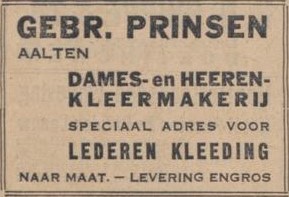
The women’s and men’s tailoring business of Gebr. Prinsen specialises in made-to-measure leather clothing, supplied wholesale. The workmanship is excellent and has earned the firm a good reputation.
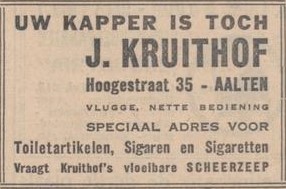
The barber’s shop run by Mr Kruithof, who took over H.J. de Lijn’s business at Hoogestraat 35 on 1 August, has changed considerably. Mr Kruithof believed in doing things properly from the start. He expanded the furnishings, improved the range of goods and obtained a tobacco licence, while professional treatment remained the main concern. The business continued to grow and Mr Kruithof now employs two assistants. Kruithof’s hair tonic and liquid shaving soap were also heavily advertised. These products are used not only by Aalten residents but are regularly ordered by post. The shop has therefore already built a good name for itself.
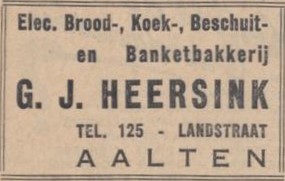
The G.J. Heersink electric bread, cake, rusk and pastry bakery has existed for around seventy years and is the oldest business in Aalten. It supplies excellent bread to the full satisfaction of its customers and has built up a good reputation over the years.
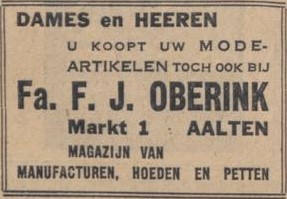
A recommended address for women’s and men’s fashion is F.J. Oberink. By supplying first-class quality, the firm has become well known while keeping its prices as low as possible.
In 1896, Johs. Peters established a business which, after he entered into partnership with Mr M. Gans, became known as Peters & Gans. It was a modern enterprise. Mr Gans left the partnership in 1900. On 27 May 1917, the factory on Gasthuisstraat was completely destroyed by fire and was not rebuilt there, but by June production had resumed in Mr Vreede’s former furniture factory, which was extended and altered to meet the firm’s requirements. Pipes were the principal product, while walking sticks were also made. Until the war, the main market for both products lay across the German border.
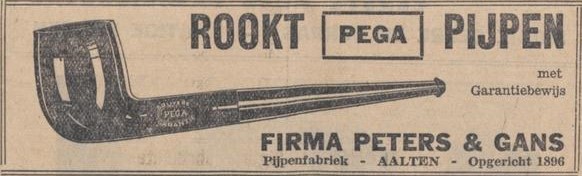
By now the situation had reversed: the business imported more than it exported and its own production had to be reduced to a minimum, in sharp contrast to the mobilisation years when demand exceeded output. Tobacco pipes were now the main product being promoted; smokers would have known the familiar briar “Pega” pipes. The wooden bowls were imported unfinished, while the stems or mouthpieces were made by the firm itself. In addition to briar pipes, so-called German pipes were still produced and continued to find buyers in certain regions.
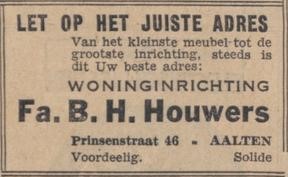
For home furnishings, B.H. Houwers was a recommended address. Despite a somewhat unfavourable location, the firm had become well known and could draw on 35 years of experience. In both expensive and cheaper ranges it aimed to supply only the best quality. In recent years it had particularly expanded in curtains and floor coverings. The firm also carried out removals.