
Build Aalten out from north to south,
In every direction, far across the land…Turn the red, rough heath
Into broad and fertile meadowland;
Turn the wildest waste
Into neat, straight fields for growing crops!
You build and dig, you plan and work,
The diligent will always prosper,
But oh, if at all possible,
Leave us the Loohuis pond!The pines sigh softly there,
Like the murmur of a distant sea;
They tell me of the olden days
When, as a child, I came to skate there.
Softly it rustled in the branches
Of an old birch tree;
It told me of long ago,
When father courted mother.You fell and build, you cut and clear,
The fruits of labour show only later;
Do what you must, but if you can,
Oh, leave us the Loohuis pond.Joh. Beernink
Aalten, 14 February 1928
Joh. Beernink published the poem above at a time when spades were being put into the ground throughout the Achterhoek to reclaim heath and other uncultivated land. I do not know who this poet was, but he was undoubtedly from Aalten. The poem can be found in the 1929 archive of the historical society De Graafschap.
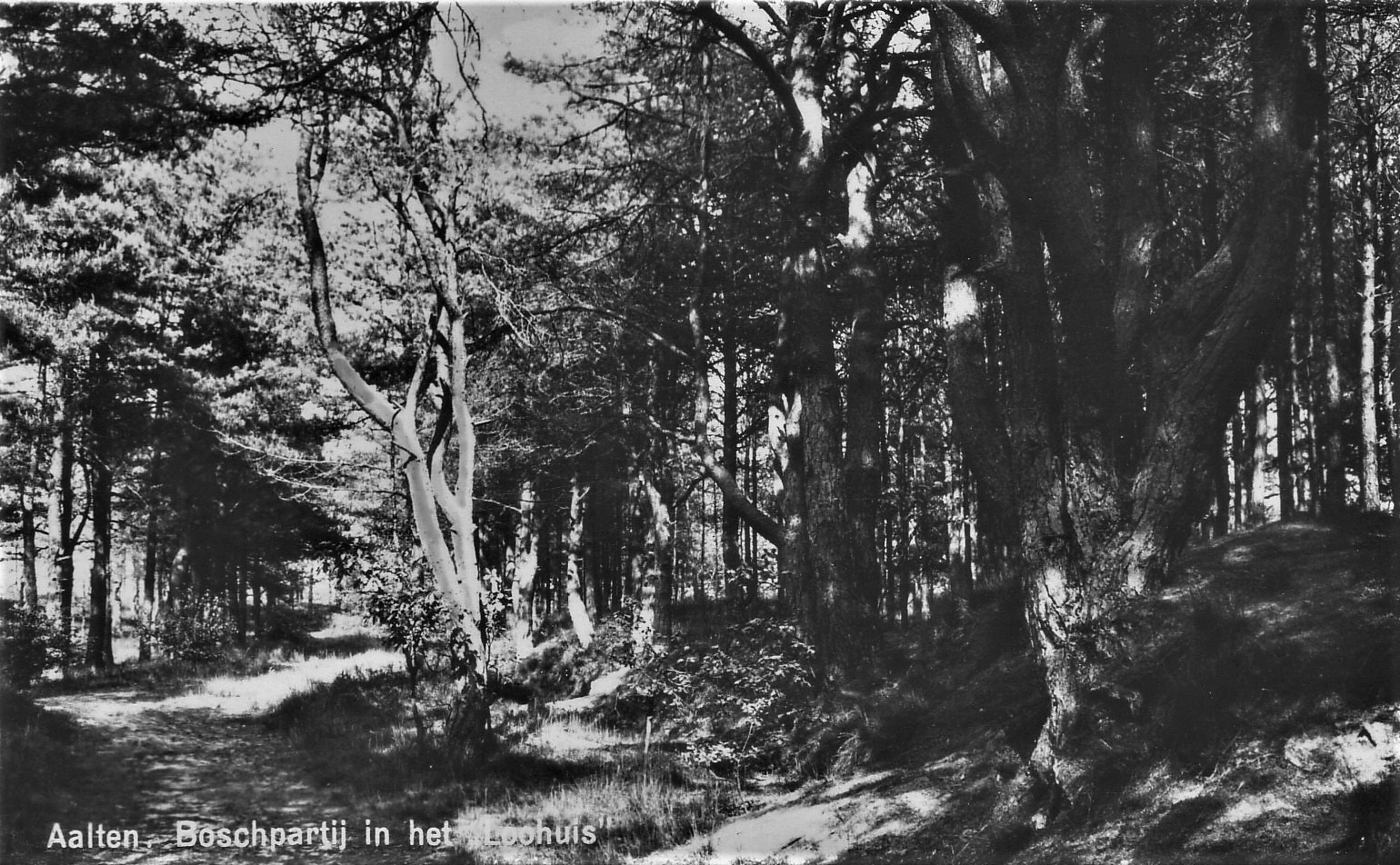
At that time, a beautiful natural area in Aalten was also in danger of disappearing. It covered 21 hectares along Haartsestraat and consisted of woodland and arable land, with a unique little mere in the woods known as the Darde Geurken ’t Lohuus. In summer it was popular with walkers, and generations of Aalten residents learnt the basics of skating on the pond.
All of this was now threatened. But Beernink’s humble plea — “oh, leave us the Loohuis pond, if at all possible” — struck a chord in Aalten. Aaltens Belang immediately recognised the need to preserve the area, and in 1929 the property was purchased. According to members of the board who later told me about it, this happened in something of an impulsive moment, because the association did not really have the money. Various Aalten residents pledged contributions, but the purchase would nevertheless become a considerable burden.
The association contacted the Dutch Society for Nature Conservation, and Mr G.J. ten Houten of Winterswijk came to have a look. This Winterswijk solicitor had also been a driving force behind preserving the Korenburgerveen and bringing it into the ownership of Natuurmonumenten. He too immediately recognised the great value of the Loohuis area. Through his mediation, Aaltens Belang was able to transfer its troublesome acquisition to Natuurmonumenten and was even able to make a substantial contribution itself. Thus, this year ’t Loohuis can celebrate its fiftieth anniversary as a nature reserve — a fact recently brought to my attention by Mr J. te Lindert of Aalten.
Early this year, the little pond in the Loohuis woods was discussed once again by Aalten municipal council. It was reported that the pond would be dredged so that it would regularly contain water again and younger children could once more learn to skate there.
The moats at Bredevoort were considered too dangerous for beginners. Because a mere derives much of its value from its distinctive, sometimes rare vegetation, Mr te Lindert contacted Natuurmonumenten to find out what was planned for the Darde Geurken. The reply was reassuring: dredging really was intended simply to restore some water to the pond.
Over the years, the Darde Geurken had filled with leaves and become overgrown with moisture-loving plants. The intention is therefore to restore the former situation — not to turn it into a skating pond, although Natuurmonumenten said there was no objection to allowing beginners to learn to skate there on a modest scale. This must not, however, be at the expense of the natural value of the Loohuis as a whole, and the Darde Geurken in particular.
The small stir surrounding the Loohuis, prompted by the report of the council meeting, was therefore settled. It is understandable that Natuurmonumenten needs to intervene. Natural succession causes the pond gradually to fill in and its vegetation to change. Rare plants disappear and the site often turns into birch woodland. A few years ago, I had already noticed that species such as hare’s-tail cottongrass were clearly declining. The same process can be seen in the Vragenderveen and Korenburgerveen.
The people of Aalten can therefore rest assured. The Loohuis nature reserve, with its Darde Geurken — the first and second Geurken have completely dried up — will remain preserved. What Aaltens Belang managed to save for the community fifty years ago will remain protected.
J.G. Vos, 28 July 1979