Profile
- Type
- Factory
- Purpose / activity
- Knopenfabriek
- Founded
- 1924
- Dissolved
- 1976
- Other names
- DBW
Connections
Places
Based at:
- Misterstraat 39 (1924–1976)
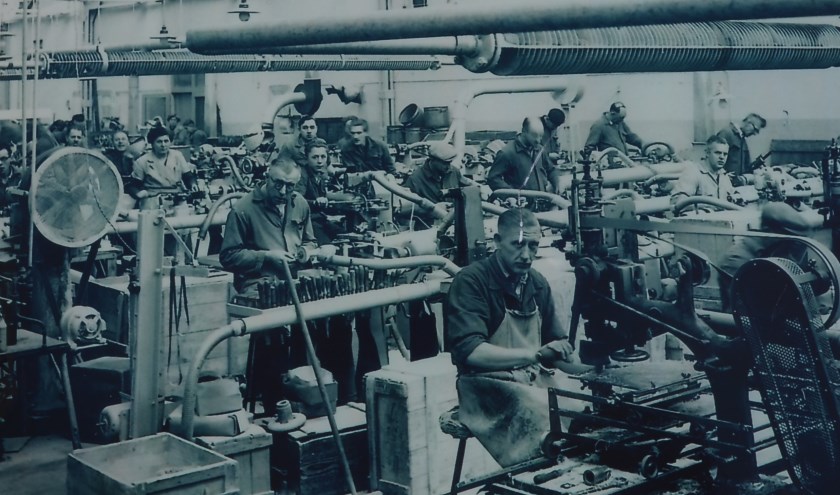
Dutch Button Works was the Te Gussinklo family’s button factory in Bredevoort from 1924 to 1976. The business traced its origins to the factory Willem te Gussinklo started in Aalten in 1884. At its peak, around 270 people worked for the company; when it closed in 1976, the workforce numbered about 44.
The Horn Industry
Several button-making industries already existed in the Netherlands in the nineteenth century. The oldest dated from 1815, but these businesses mainly produced fabric buttons, particularly linen ones. Around 1900, companies in Germany and England began producing buttons from horn. Inspired by this example, Willem te Gussinklo began making horn buttons in 1905. His was the first buffalo-horn button factory in the Netherlands. His son Willem te Gussinklo Jr, known as Piepkes Willem, soon joined the business and developed into an innovative entrepreneur.
Te Gussinklo’s first factory stood on ’t Dal in Aalten, now Willemstraat. Initially, production was entirely by hand, with the buttons made one at a time. To meet growing demand, in 1924 he purchased the former Van Eijck weaving mill in Bredevoort, where button production then began.
At that time Bredevoort still had a railway station. From time to time, a wagonload of horns arrived from India for Bredevoort’s button industry. Over the years, button manufacture became increasingly mechanised. Machines built by the factory’s own technicians made it possible to produce buttons partly or entirely automatically. The horn was sawn into small discs called rondels. Both the solid tips and the hollow sections of buffalo horn were used.
Export
The export of buttons was of great importance. Trade was primarily focused on English-speaking countries—England, Ireland, and North America—where Dutch Button Works enjoyed a fine reputation. Until the 1920s, the buttons produced were exclusively intended for men’s suits. However, when demand fell during the crisis of the early 1930s, ladies’ buttons were put into production as compensation, almost simultaneously with the manufacture of bone buttons. Bone buttons were intended for undergarments. Besides buttons, the factory in Bredevoort also manufactured walking sticks—specifically, the knob or handle and the tip were crafted from horn.
Several years after the closure of the Ten Dam & Manschot comb factory in Aalten, DBW also began making combs. During the Second World War the company started working with locally sourced horn as well. Ashtrays and bird figurines became popular products alongside buttons. Deer antler was used to make buttons for so-called hunting jackets, while slices of antler were turned into small ashtrays or candleholders mounted on rosewood bases.
Before the war, DBW also had branches in Germany: in Berlin and Bocholt. After 1945, the company experienced a peak period. The third generation, W.A. te Gussinklo, joined the management. Demand for buttons was high. Many home workers were occupied with sewing buttons onto cards. The horn buttons found their way to garment factories. Sales representatives would travel with a “model jacket” made of various pieces of fabric sewn together—a multicoloured patchwork. On each piece of fabric, the most suitable buttons for that specific material were sewn.
In 1959, the company commemorated the fact that Te Gussinklo’s business had begun 75 years earlier, in 1884. At that time, there were over a hundred employees, excluding home workers. Increasing automation made it possible to achieve a high turnover with fewer staff. In the second half of the 1950s, horn was superseded by plastics. In 1963, the management of DBW, together with an English button factory, took over the largest button factory in Germany.
Decline
The company suffered a severe blow in 1968 when director W. A. te Gussinklo died at the age of 51, six months before his father. He was succeeded by his wife, B. A. te Gussinklo-Zandbergen. A year later, her son H. J. Gussinklo Ohmann completed his studies at Eindhoven University of Technology and also joined the management. By then, production was entirely focused on plastic buttons; the company had begun making its own polyester buttons around 1960. In the long run, however, it proved extremely difficult to remain competitive. Considerable effort went into keeping the business running, but in 1976 the company was forced to close DBW.
The municipality of Aalten purchased the complex in 1977 and sold it on to the firms Van Wezel and Voltman-Riviera. For many years afterwards, the Albert ten Bruin car dealership operated on the site.
Repurposing
At a municipal information evening in July 2008, the Vereniging Bredevoorts Belang (Bredevoort Interest Association) made a plea for the preservation and restoration of this characteristic building. They stated: “This building is the only remaining, tangible, and visible intact industrial heritage that Bredevoort still possesses, providing residents with a link to its extensive textile history. The factory building, still in its original state, has a striking, beautiful facade featuring the typical elements of an industrial building built in the third quarter of the nineteenth century.” The non-monumental parts were demolished in 2019. The monumental building has since been repurposed to house apartments and a supermarket.
Afbeeldingen
Corrections and additions
Have a correction or addition? Leave a comment below. We incorporate relevant information into the profile and then remove comments that have been processed. Your email address will not be published.
Albert van der Geest is bedrijfsleider of directeur van geweest van Voltman-Riviera,enkele tientallen meters lopen van zijn woonhuis verwijdert.
Leave a comment