Minister in Aalten during the Batavian and French periods
Bartholomeus Stephanus Westerbeek van Eerten served as a minister in Aalten for almost thirty years. He came to the town in 1786 and remained there until his death in 1816. His ministry therefore spanned a turbulent period: from the final years of the Dutch Republic, through the Batavian and French periods, to the political upheaval of 1813. A story handed down from the French period shows that his role was not confined to the church building itself.
Born into a minister’s family
Westerbeek van Eerten was born in Wanneperveen. Aalten’s Register Civique gives his date of birth as 24 December 1747, while the Wanneperveen baptism register records his baptism on 1 January 1748. The two entries are readily compatible: he was probably born on 24 December and baptised eight days later. His father himself is named as a witness in the baptism register.
He was the son of Willem Jan van Eerten, also a minister, and Margaretha Wigbolda van Westerbeek. Historical sources give his own name in several forms, including Bartholdus Stephanus, Bartholomeeuws Stefanus and Bartholomeus Stephanus.
Minister in Friesland
His ministerial career began in Friesland. T.A. Romein’s nineteenth-century register of ministers records that on 9 August 1772 he was ordained as a candidate in the combined congregation of Augsbuurt or Lutjewoude and Kollumerzwaag. He was about 24 years old at the time. Romein also explicitly records that he was born in Wanneperveen and was the son of Willem Jan van Eerten.
He married during this first appointment. On 20 August 1773, the marriage register of the Dutch Reformed congregation of Ruurlo recorded:
Bartholomeeuws Stefanus Westerbeek van Eerten, minister at Luttekewolde and Collumerswaag
His bride was Antonia Johanna Aberson, daughter of Adam Aberson, collector of the land tax (verponding) in Ruurlo. After the banns had been read on three Sundays, they married in Ruurlo on 9 September 1773.
Three children are known from their marriage: Willem Adam (1774–1813), Lodewijk Frederik (1776–1855) and Johanna Catharina (1780–1843). Lodewijk Frederik later followed in his father’s footsteps and also became a minister; he eventually served for many years in Varsseveld.
In 1775, Westerbeek van Eerten was called to Burum and Munnekezijl. He took leave of his first congregation on 9 July and began his ministry in Burum on 23 July 1775. He remained there for more than ten years. On 1 January 1785, he inaugurated the new church there.
To Aalten
In 1786, he received a call to Aalten. Westerbeek van Eerten took leave of Burum on 30 April 1786 and, according to Aalten’s register of ministers, began his ministry in Aalten on 14 May 1786. He succeeded Adrianus Rudolphus de Roy, who had died in 1785.
This marked the beginning of a ministry that would last almost thirty years. In 1813 he is recorded at Aalten 35, the Dutch Reformed parsonage at the time. The present parsonage at Wehmerstraat 2 now stands on the site, but the current building dates from 1920 and was therefore not the house in which Westerbeek van Eerten lived.
On a farm cart at De Pol
His long ministry in Aalten coincided with major political change. A striking story about Westerbeek van Eerten survives in an article by G.H. Rots, published in the Aaltensche Courant in 1938, about the French period in Aalten.
Rots describes how tensions rose in 1799 after an attempt to push back French and Batavian authority in the region had failed. According to him, ministers held religious services in the open air during this period. He writes that Westerbeek van Eerten climbed onto a farm cart and encouraged his fellow believers, who had gathered near De Pol.
It is an appealing detail because it places the minister quite literally outside his church, among his congregation. It should be noted, however, that Rots did not record the story until 1938. It is therefore not an eyewitness account from 1799 but a later historical tradition. The original source on which Rots based this particular episode has not yet been found.
The refurbished church organ
A much more direct trace of Westerbeek van Eerten survives in Aalten’s church records. A transcription of the old consistory minutes contains, at the bottom of a page in the eighteenth-century consistory book, a note that he wrote himself in 1811.
On 16 June 1811, the “considerably renewed and much improved Aalten organ” was taken back into use. Westerbeek van Eerten preached on Psalm 150:2–5. The congregation was reminded of the proper use of the organ, both in support of preaching and of congregational singing.
Family and final years
His wife, Antonia Johanna Aberson, died in Aalten on 22 January 1812. A year later, on 7 October 1813, their eldest son Willem Adam also died in Aalten. Their son Lodewijk Frederik had by then become a minister himself.
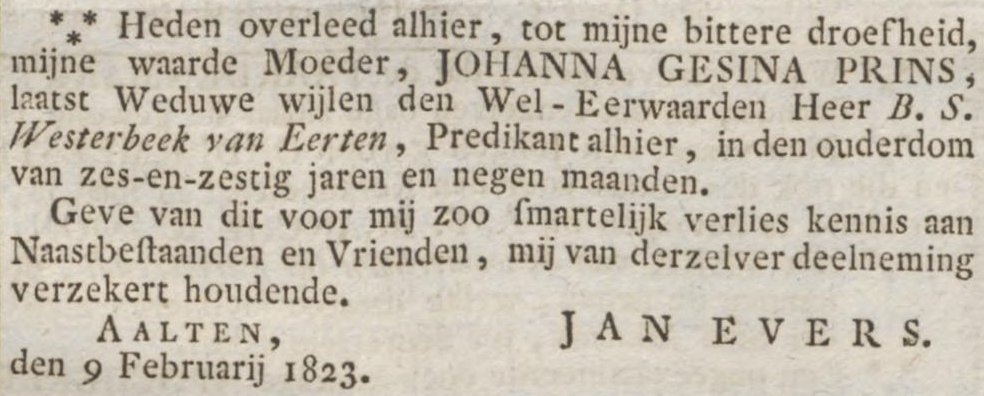
Westerbeek van Eerten remarried in Aalten on 22 September 1814, to Johanna Gesina Prins. She survived him. That she was indeed his widow is also confirmed by a death notice published after her death in 1823 in the Opregte Haarlemsche Courant, where she is described as the widow of “B.S. Westerbeek van Eerten, minister here”.
Bartholomeus Stephanus Westerbeek van Eerten died in Aalten on 4 January 1816. His date of death is recorded both in Romein’s Frisian register of ministers and in the Aalten registers of ministers. It was not until 1817 that Aalten gained a successor in Tjeerd Radsma.