For nearly two centuries, the municipality of Aalten bore a lime tree (lindeboom) in its official coat of arms. In 2005, Aalten merged with Dinxperlo, which meant a new municipal coat of arms had to be created. Nevertheless, the lime tree remains a central symbol in the local identity.
Het wapen voor de gemeente Aalten werd op 3 oktober 1815 aangevraagd door toenmalig burgemeester Christiaan Casper Stumph en moet volgens zijn bijschrift op zeer oude gerechtelijke afgiften zijn voorgekomen. Voor die tijd had de burgemeester zich moeten bedienen met zijn eigen familiewapen. De “zeer oude gerechtelijke afgiften” bleek een stempel te zijn die Aalten als municipaliteit tussen 1795 en 1798 in gebruik had totdat zij werd ondergebracht in het Ambt Bredevoort dat gebruik maakte van een zegel met daarop de letters “AB”.
Following the establishment of the Kingdom of the Netherlands, the High Council of Nobility (Hoge Raad van Adel) drew up guidelines for the registration of municipal coats of arms in 1816. On 7 October 1818, the first official coat of arms was granted to the municipality of Aalten by Royal Decree.
The description of Aalten’s first coat of arms reads:
“Of silver charged with a green tree, standing on a ground of the same.”
Origin and meaning
The origin of the tree coat of arms is unclear, although there appears to be a connection with surrounding towns. In ancient times, Bredevoort and Groenlo also bore a tree in their coats of arms, as does the nearby German city of Bocholt, which still uses a tree in its emblem today.
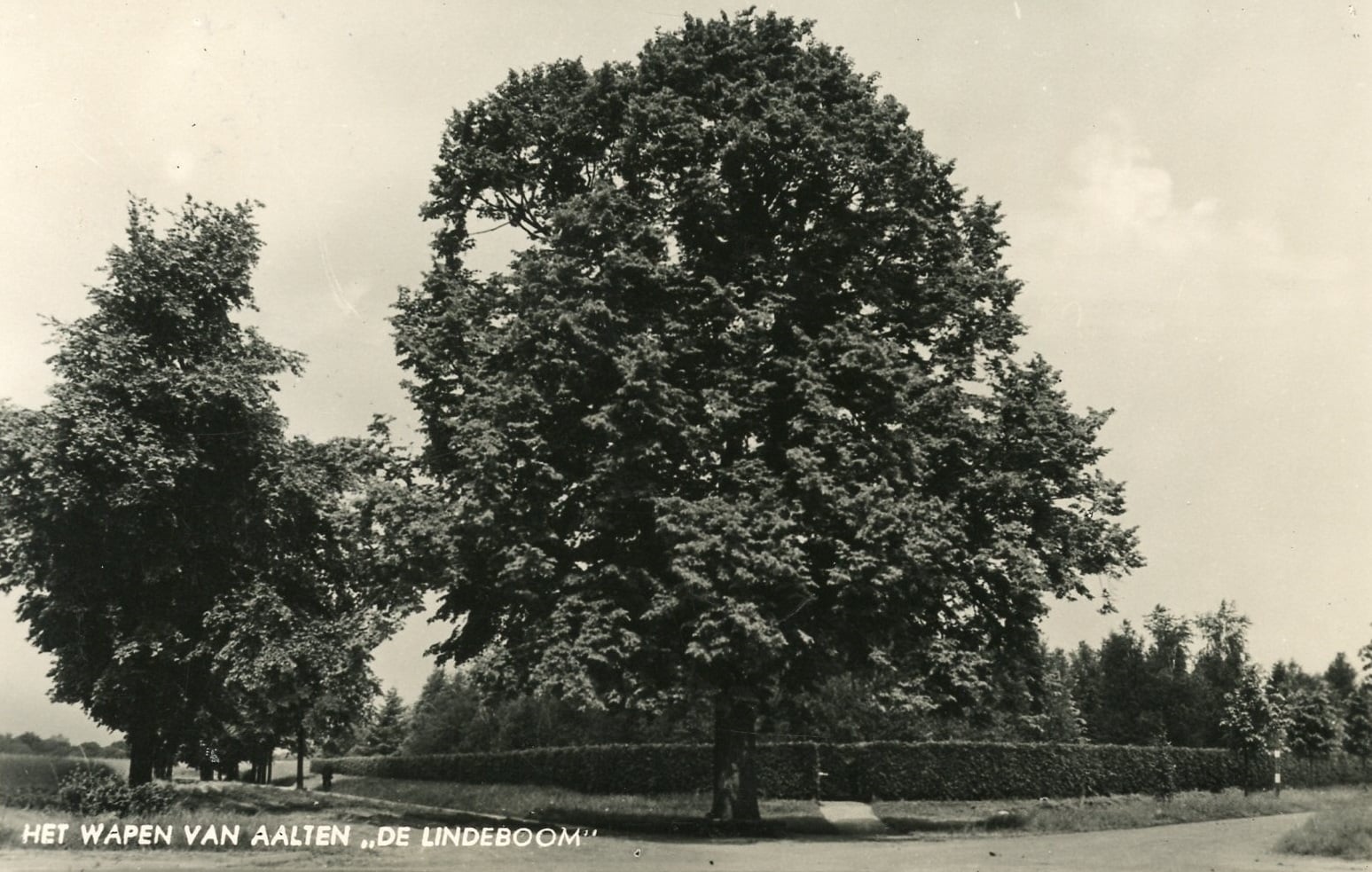
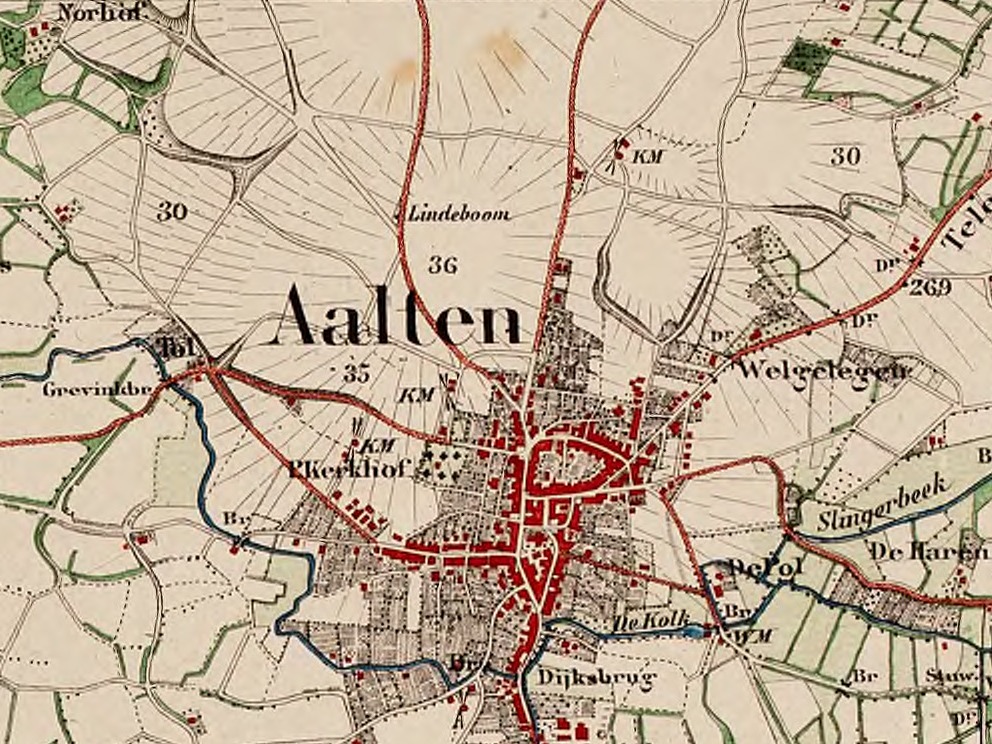
De exacte reden waarom het Aaltense bestuur begin 19e eeuw voor een linde koos, is niet gedocumenteerd. Het zou een vrijheidsboom kunnen zijn, of ontleend aan een vrijstaande Lindeboom op de Aaltense Es nabij begraafplaats Berkenhove, die daar al in de 18e eeuw stond en in de eerste helft van de 19e eeuw en na de Tweede Wereldoorlog opnieuw aangeplant werd.
The choice of a lime tree aligns with a broad Western European tradition. Since the Middle Ages, the lime tree served in many villages as a court-tree (dingboom) or justice-lime (gerechtslinde). Beneath this central tree, administrators and judges gathered to dispense public justice. The symbol thus referred directly to local jurisdiction and the self-governance of the place of origin.
The Municipal Reorganisation (2005)
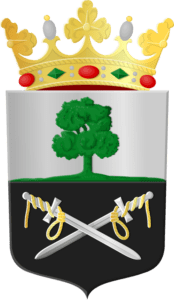
On 1 January 2005, the municipalities of Aalten and Dinxperlo merged to form the new municipality of Aalten. According to the guidelines of the High Council of Nobility, the heraldic elements of both former municipalities had to be combined into a new design.
On 8 June 2010, the new, composite coat of arms was officially established by Royal Decree. The shield was divided horizontally:
- Upper half: The original green lime tree of Aalten on a silver field.
- Lower half: The two crossed swords with golden nooses from the old coat of arms of Dinxperlo (originally granted in 1897), placed on a black field.
- Crest: Since then, the shield has been surmounted by a golden count’s coronet (three leaves and two pearls).

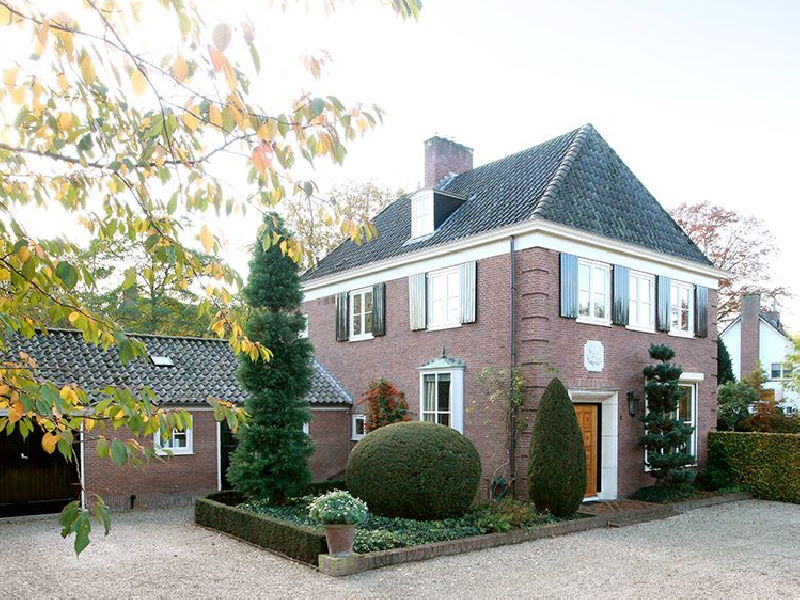
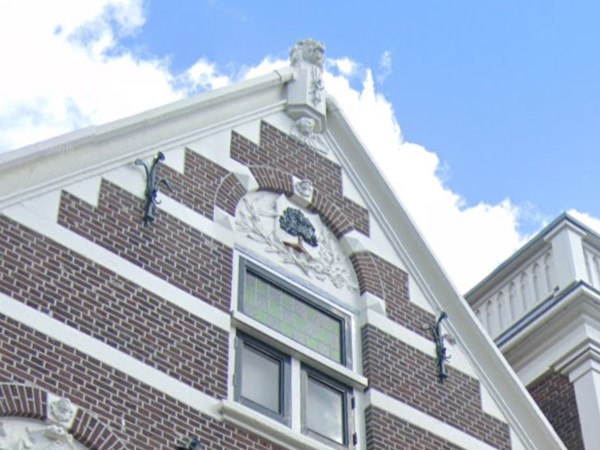
The Aalten Lime Tree in Delfshaven
An interesting example of the Aalten coat of arms outside the Achterhoek can be found in Rotterdam-Delfshaven. On Havenstraat stands a building dating from 1886, which features a gable stone depicting the old coat of arms of Aalten.