Dagblad Tubantia, 10 & 17 May 1960
Maandag komt in de sociëteit te Aalten een gezelschap dames en heren bijeen, die, hoewel volslagen onbekend zijn voor elkaar en uit diverse windstreken van het land komend, zich niet aan elkaar behoeven voor te stellen. Om de eenvoudige reden dat hun namen gelijkluidend zijn. Kort en goed: Vaags. Na jarenlang sibbekundig speurwerk en maanden van administratieve voorbereiding zal dan namelijk eindelijk de Vaags-reünie een feit kunnen worden. En waar zou die beter gehouden kunnen worden dan in Aalten, waar de stamvader aller Vaagsen het levenslicht aanschouwde?
Chemist from Geleen established family tree
That was nearly two hundred and fifty years ago. We may accept this on the authority of someone who has investigated it all in meticulous detail. A Vaags, naturally. Specifically, a certain P.B. Vaags from Geleen, a 35-year-old chemist at the state mines. This Vaags from Limburg was able to make grateful use of the oldest data when constructing a family tree, as collected at the beginning of the last war by the late Mr A.A. Vreede, whose daughter currently resides in Dinslaken.
He was busy with it for years, making enquiries at home and abroad, obtaining and processing official data from municipal registries where available, and occasionally chatting with various individuals. Thus, a booklet gradually emerged that is interesting not only to the Vaags family. A briefly described family history that reaches back centuries.
Forefather Voogedes
The forefather of all those named Vaags originally lived in Bocholt, where he was born on 8 April 1693. After his marriage to the Aalten beauty Hanna Degenaar, the couple settled in Aalten. That forefather was actually named Voogedes. Their son Jannes Petrus, born on 23 January 1718, eventually came to be called Vaags after name changes to Voegts, Vaegts, and the like. All currently living members of the Vaags family descend from this later assessor and churchwarden.
From this Dutch forefather and his marriage to Berendina Lankhof, seven branches lead through the centuries to the current generation. Two of them have already died out. There are therefore five remaining. However, by human calculation, one of these will disappear again in the short term, as the last scion of the so-called G-branch is an unmarried man in The Hague.
Then there remain the P-branch, the H-branch, the J-branch, and the B-branch. According to the research by Mr Vaags from Geleen, a respectable number of branches or twigs have emerged from these lines. Currently, there are 232 living members of the Vaags family, of whom 153 live in Gelderland (63.4 per cent in the Achterhoek) and the rest are scattered across all parts of the country, as well as 14 in Canada, 7 in Rhodesia, 4 in Norway, and 1 in South Africa. They are people from all ranks and stations of life.
Planting trees
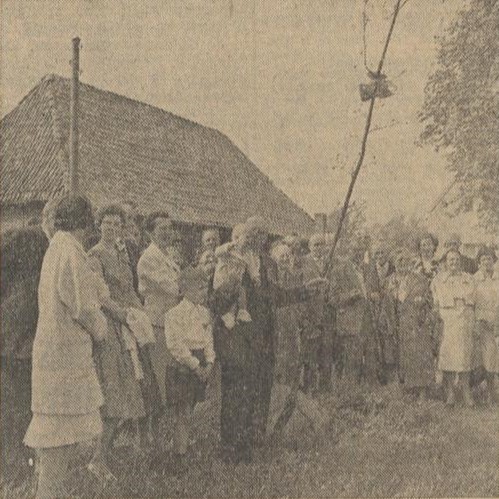
The group of reunionists who will gather next Monday at 11 o’clock in the morning for greetings and introductions will certainly be very diverse. Naturally, not all of them will attend. During the day there will be about 90, and in the evening approximately 120. After a communal lunch, four Vaags trees will be planted in the afternoon on the ‘t Walfort estate, one for each still growing and flourishing branch: these trees will be handed over to the municipal executive for maintenance. Afterwards, there will be an opportunity to walk around Aalten and, for example, take a look at the old “ancestral homes”. In the evening, there will be a more festive gathering.
Should any outsider feel the urge to infiltrate this reunion with a simple introductory murmur: “Vaags, pleased to meet you”, they should be advised that all reunionists wear a neat bow, differing in colour according to the branch to which they belong. Furthermore, Mr Vaags from Geleen has found something of a code to make the family tree clear. And that code can really only be deciphered if you are in possession of such a Vaags family book. But for that, of course, you must be a Vaags.
A week later, Dagblad Tubantia writes about the course of the reunion:
Vaags reunion became a pleasant family celebration
The reunion of the Vaags family in Aalten yesterday became a joyful and pleasant gathering. Most of the Vaagses and semi-Vaagses knew each other due to their various Achterhoek residences, yet several kinsmen had also come from afar. But soon after the reception, at eleven o’clock yesterday morning in the Sociëteit, they were what one calls “en famille”. The word “Vaags” was heard a hundred and one times during the mutual introductions. Then there was some searching and feeling amongst the foliage of the family tree to determine if they might be directly related. The bows worn by the reunionists, in the colours orange, red, white, and blue, were an excellently functioning aid in this regard.
Four trees planted at ‘t Walfort
Yesterday, during mutual conversations at the table or over a drink, there was plenty of browsing through the family tree that the animator of this reunion, Mr P.B. Vaags from Geleen, has so solidly established. The fact that everyone was related to everyone else was not enough to satisfy everyone. People wanted to know to what extent that kinship went. And for this, the booklet by the Vaags from Limburg with its handy coding was indispensable.
Quite rightly, the chairman of the working committee, Mr J.B. Vaags (from Winterswijk), outlined the merits of that work in his welcoming speech. And it did not stop there. One of the Aalten reunionists had crafted a neat miniature family tree with the four main branches in colours, and this was presented to Mr Vaags from Geleen as a lasting memento of his work and the reunion that resulted from it.
A special word of welcome was extended to Mr and Mrs Brinkmann-Greeve, the clerical couple from Dinslaken. Mr Greeve had collected the first genealogical data on the Vaags family at the beginning of the war, and Mr Vaags from Geleen built upon this data in his later research. Mrs Vreede said in her response, also on behalf of her husband, that she considered it a great honour to be able to attend this reunion.
With that, the official part was temporarily at an end. People chatted for a while and then went to the lunch table.
In four groups
The afternoon began with the second official part, the planting of four Vaags trees on the ‘t Walfort estate. With this, the Vaagses hope to have given symbolic form to the memory of their reunion for a very long time. The approximately one hundred reunionists set off on foot, by bus, or by car to the (now) municipal estate. A better place could hardly have been chosen; after all, the resident of what remains of the old castle is also related to the Vaagses.
Daar hebben dan de van een oranje, rood, wit of blauw strik voorziene boompjes (voor elke nog levenskrachtige tak van de familie één) hun bestemming gekregen, omgeven door de bijbehorende stamgenoten. Voor even viel het grote Vaags-gezin in vier groepen uiteen. Maar nadat burgemeester Van Veen de boompjes met enkele vriendelijke woorden had geaccepteerd in de gemeentelijke hoede, was de eenheid weer snel hersteld. Men heeft daarna nog gezellig in Aalten rondgewandeld, is hier en daar een oud „stamhuis” gaan bezoeken en gezamenlijk gaan eten. En ’s avonds hebben de Heikneuters de toen nog wat talrijker geworden familie met een liedje, een praatje en wat muziek een paar uur prettig geamuseerd.
“A small effort, I thought….”
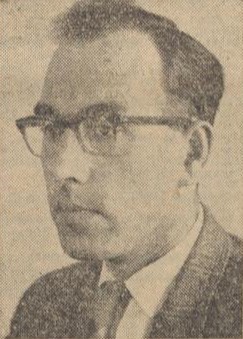
The man who essentially made the reunion of the Vaags family possible through his genealogical research, Mr P. B. Vaags, may live in Geleen in Limburg, but is a true Achterhoeker by birth. His grandfather was from Aalten, and his father and he himself come from Eibergen.
“The name Vaags has intrigued me for a long time, especially because you hardly encounter it elsewhere in the country. I thought it would be a small effort to trace all family members. But I certainly underestimated that. I began by simply examining a series of old giro and telephone directories for the name Vaags – you have to start somewhere – and it soon became apparent that the tree was growing thicker and thicker. I wrote to various people, went to talk to baker Vaags in Aalten, and once I had got that far, the work would not let me go.”
All in all, it took a year and a half before the family tree, complete with all branches and twigs, stood tall and firm. Then the organisational work for the reunion could begin. But the Vaags from Geleen did not involve himself with that. That was more the work of the VVV secretary, who is very skilled in such matters.