
23 April to 3 May 1971, Aalten
A Moon rock insured for 1.7 million guilders is the most valuable item in the “space show” opening today in Aalten, Gelderland, at Polstraat 7 and running until 3 May. The Gemini X capsule in which astronauts Young and Collins travelled into space can also be seen, along with the spacesuits of Collins and Walter Schirra and heat shields from the Gemini and Apollo capsules.
An electronic question-and-answer machine, a number of photographs and models are among the show’s other attractions, along with a continuously screened film recorded in and from Apollo XI. Tomorrow afternoon at half past two, helicopter demonstrations by the Royal Netherlands Naval Air Service are on the programme.
Moon juice
“It tastes excellent,” said Aalten mayor Faber after taking a sip of orange juice. What made it unusual was that he sucked the liquid through a kind of valve from a plastic pouch, and that the same drink had actually been intended for one of the astronauts who landed on the Moon. The orange juice consumed by the mayor — and later by his wife as well — had travelled to the Moon.
The toast between the mayor with his “Moon juice” and Mr P. van Breukelen, director of the Foundation for Scientific and Educational Exhibitions, with “Earthly juice”, marked the actual opening of the major space exhibition, which can be seen in and around Aalten’s Feestgebouw until Monday 3 May.
What makes the exhibition particularly special is the large amount of original material on display: photographs taken by the Apollo 11 astronauts, a film made by them containing footage not previously shown, the piece of Moon rock and the original Gemini capsule in which Young and Collins went into space in July 1966.
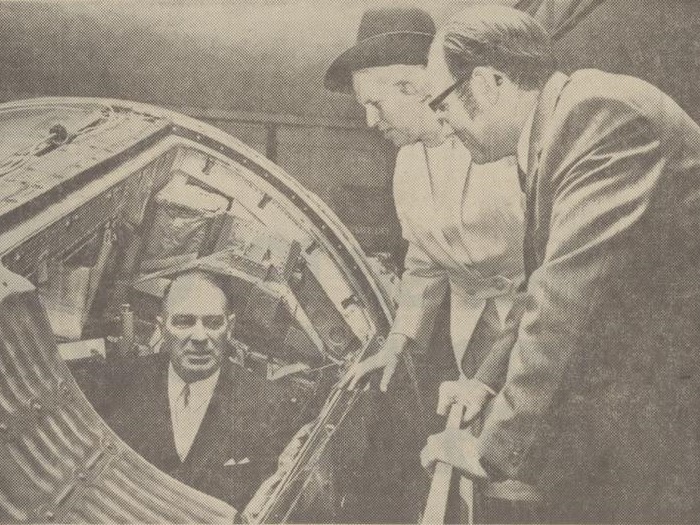
Naturally, Mayor Faber also had to take a seat in the cramped Gemini cabin. The thought alone of a person having to remain there for ten days at a time is difficult to comprehend. The cabin now on display in Aalten spent around seventy hours in space. During that time the astronauts orbited the Earth 44 times. Collins’s spacesuit, worn during his excursion outside the capsule on that same flight, can also be seen.
These are only a few parts of an exhibition that is worthwhile in every respect and is also particularly well laid out, not least because of the way in which — appropriately enough — space has been used. Nor are the astronauts the only ones to have contributed original equipment: the navy has supplied rescue equipment, while the air force is represented by items including a test set and a Starfighter jet engine.
Interest remains
In his opening speech, Mayor Faber said, anticipating what he was about to see, that the excitement surrounding the Moon flights might now have faded, but interest in how such a flight actually works had certainly remained. In that respect, he said, the show met a real need. The mayor expressed his pleasure at the initiative behind the exhibition.
Aalten could rightly be proud, he said, that it was able to fulfil a service role for its own residents, the surrounding region and the neighbouring German area, from which there was also considerable interest. “For ten days Aalten is moving in higher spheres,” Mr Faber concluded, “but also keeping both feet firmly on the ground, because we hope to show that we can be good hosts.”
Before Mayor Faber delivered his opening address and the invited guests toured the various stands — also watching a film about the Apollo 11 Moon landing containing previously unseen footage — Mr Van Breukelen explained the exhibition after a brief opening word from B.G. Wilms, chairman of co-organiser VVV-Aaltens Belang.
The indoor exhibition is open Monday to Saturday from 9 a.m. to noon and from 1.30 to 9 p.m. On Sundays it is open from 2 to 9 p.m. Further information is available from the Aalten tourist office on 05437-3052.