Interest Association
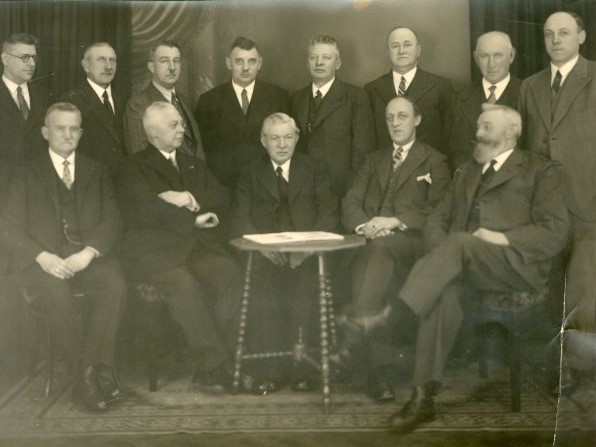
The association Aaltens Belang was founded on 14 December 1898 by a number of local dignitaries. The association’s objectives included campaigning for a better connection with Bocholt, the improvement of public transport, the installation of urinals on the Market Square and at the edges of the village, and improvements to both the postal service and housing.
The board consisted of thirteen members, matching the number of seats on the Aalten municipal council at the time. “Why,” it was argued, “should Aaltens Belang make do with fewer?”
The board took a broad view of its objectives. They also dedicated themselves to matters such as the operation of a commercial evening school and a tourist information office (VVV), the management of the local Loohuisbos nature reserve, and the organisation of trade fairs or the annual outing for the elderly.
Merged into the VVV
In its early years, the association was instrumental in establishing both the first refuse collection service and the Museum Frerikshuus. In later years, the association focused primarily on organising activities and providing information regarding tourism and recreation. When these tasks were professionalised and transferred to a new VVV (Tourist Office) organisation, the association merged into it in the mid-1980s.
Bench, Loohuisbos, and Nannielaantje
To mark its 25th anniversary in 1923, the Aaltens Belang association presented the local community with a stone bench. This bench can still be found today along the footpath by the Slinge stream, near the bridge on Polstraat, behind the De Slinger primary school.
In 1928, Aaltens Belang saved the Loohuisbos (‘Loohuis Forest’)—an area of 21 hectares—by purchasing it before it could be cleared for cultivation. However, the association could not raise the necessary funds and subsequently sold the property to the Society for the Preservation of Nature Monuments (Vereniging tot Behoud van Natuurmonumenten). As a result, it was preserved as a piece of the historic Achterhoek landscape.
When the farmstead Het Smees was sold by the heirs of Slichter van Bath in 1934, Aaltens Belang entered into discussions with the buyer. There were fears that the “well-known and naturally beautiful” Nannielaantje (Nannie’s Lane) would disappear. Thanks to the efforts of Aaltens Belang, this popular lane was fortunately preserved.