Overview
H. van Eijck & Zoon was founded in 1834 by Henricus van Eijck (Helmond, 2 April 1780 – Sint-Niklaas, Belgium, 8 April 1846). It was the first textile factory in Bredevoort. Van Eijck was initially refused permission by the Netherlands Trading Society, but personal intervention by King William I ensured that approval was eventually granted.
Henricus came from Sint-Niklaas in Belgium with his family because the textile industry there had stagnated following the Belgian Revolt, which began in 1830. As the situation dragged on, many Belgian manufacturers saw relocation to the northern Netherlands as a solution.
Home weaving meant the people of Bredevoort were already familiar with the trade, but Van Eijck nevertheless brought master workmen over from Belgium. The first soon left for Doetinchem. Peter Lavinus van den Broek, however, remained in Bredevoort with his wife and children until his death.
Development
The factory stood on Misterstraat near Bekendijk. H. van Eijck & Zoon was primarily a cotton weaving mill. At first it operated with a 4 hp steam engine and boiler. Its peak came in 1839, when 225 weavers worked here. The outbreak of the American Civil War caused a downturn because imports of American cotton virtually ceased. Business revived in 1865, and two years later a steam engine was purchased. Operations stopped in 1878 following the death of Jean Leander van Eijck’s wife.
There may have been a dispute over the inheritance, as a new factory opened that same year. Half of the original family business was bought by Josephus Godefridus Henricus (‘Sjef’) van Eijck, who continued it with his partner J.H.J. Müter of Amsterdam under the name J. van Eijck & Co.
Strikes
A strike broke out in January 1903 after workers were told they were no longer allowed to spit on the factory floor, and a local branch of the Unitas trade union was formed. Factory workers at Aalten’s pipe and comb factory showed solidarity and contributed 30 guilders to the strike fund. The strike had ended by late January.
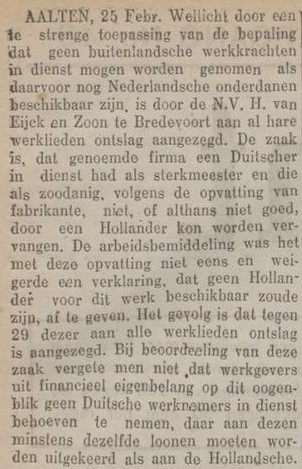
In September 1903, another bitter dispute arose over the payment of wages in Dutch currency; workers had usually been paid in German money. From 1 October, the workers stopped work. Leaders of the Unitas union included the minister Johan Henri Ledeboer, parish priest Joannes Mulder and W.W.M. Moll. The company ignored the strike and recruited replacement workers. Police intervened to keep the strikers and the ‘outside workers’ apart. Mayor W.C. Tack ordered police intervention when a mocking song was performed during Bredevoort’s Volksfeest.
At the end of December, 109 factory windows were smashed. On 15 January 1904, thirteen people appeared before the cantonal court in Groenlo for singing the song; another four appeared a week later. The fine was five guilders or two days’ detention. Two people were acquitted. After a year of strike action, half of the strikers had found other work, while the remainder received support from the strike fund. It is not known whether the strikers ever returned. In any event, the strike was over after seventeen months. Afterwards, only ten men and ten boys remained employed.
Closure
In 1905, H. van Eijck & Zoon employed 29 men, six boys and five girls. During the First World War, Van Eijck replaced the 8 hp engine with a 45 hp engine, later enlarged to 60 hp. The factory closed in early 1924. Dutch Button Works bought the complex and converted it into a button factory.
J. van Eijck & Co continued in existence until the Second World War.
Images