
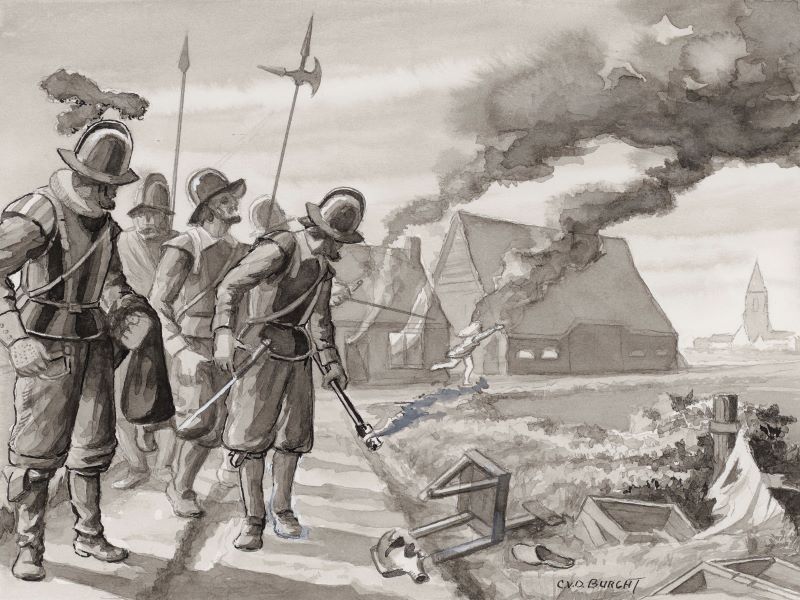
Seen from Bredevoort, the Eighty Years’ War is often a story of sieges, fortifications, bailiffs and military commanders. For most people in the Bredevoort district, however, war meant something different. Farmers, craftspeople and villagers struggled to support their families as soldiers passed through, requisitioned livestock and supplies, took people captive and were billeted in local homes. Particularly in the final decades of the sixteenth century, the effects of war could be felt on the farm and around the kitchen table.
A vulnerable border region
The Bredevoort district comprised the town of Bredevoort and the parishes of Aalten, Dinxperlo and Winterswijk. It lay in a border region where different armies and armed groups were active during the Dutch Revolt. From 1572 onwards, the military situation changed repeatedly. Bredevoort itself was a strategically important fortress, but the surrounding countryside was almost impossible to protect.
The manorial court book provides direct evidence of this. In 1584, the annual manorial court session could not take place because the unrest was so severe that, according to the clerk, the ‘poor people’ of the District of Bredevoort had fled and scattered. Court sessions were also postponed because of unrest in 1587 and 1588. In 1588, the court book specifically mentions passing cavalry as a reason for the delay. War disrupted not only farming but also ordinary administration and the courts.
This placed an especially heavy burden on local people because farms depended on precisely the things an army needed: horses, draught oxen, cattle, grain, hay, carts and food. A stolen horse meant more than the loss of valuable property: without it, a farmer might struggle to work the land or transport the harvest. Anyone who lost their grain also lost part of the household’s food supply and the seed grain needed for the following season.
Some inhabitants were bound to the lord and particular farms through manorial dependency (hofhorigheid). In Aalten, several dependent tenants and manorial properties belonged to the Hof te Ahave; the Hof te Miste played a similar role in Winterswijk. The manorial court books show that even during the war years marriages, inheritances, releases from dependency and transfers of farms continued. Manorial dependency was not a simple division between free and unfree farmers: free people could sometimes enter into it voluntarily, while freedom could be secured for a child. The war did not replace everyday life; it added another burden to it.
Friend and foe
For local inhabitants, the distinction between the opposing sides was not always as clear as it appeared on a political map. Drawing on the extensive Anholt archives, historian J. N. Bakhuizen van den Brink described how, around 1580, the lords holding Bredevoort in pledge were scarcely able to protect the people under their authority. According to his account, their rural inhabitants were repeatedly plundered by friend and foe alike.
An entry in the manorial court book from 1601 illustrates this vividly. In the Aalten section, the record of Gerdt Snoijenbusch’s death states that all the livestock he left behind had been stolen: some by Spanish troops and some by the forces described in the source as the ‘Rijksvolk’. A farming household could therefore suffer losses at the hands of more than one side.
Spanish and Dutch Republic forces operated in eastern Gelderland during these years, alongside English, Scottish, Walloon and German soldiers. Many units consisted of professional soldiers and mercenaries. When pay and supplies failed to arrive, the surrounding countryside became an obvious source of food, horses and money. The war therefore consisted not only of battles and sieges, but also of countless smaller raids, requisitions and hostage-takings.
Livestock, horses and ransom
An unusually large number of accounts of such raids survive for Aalten. In 1938, G. H. Rots compiled in theAaltensche Courant a long series of incidents from 1582 to 1588. He described how local people were taken prisoner and released in return for ransom, and how soldiers carried off horses, cows and other livestock. Sometimes stolen property could be bought back; sometimes it disappeared for good.
The series is detailed enough to convey the uncertainty in which farmers lived. On some days only a few animals were taken; on others, according to Rots, soldiers seized dozens of horses and large numbers of cattle. In July 1584, hundreds of animals were reportedly driven away and several inhabitants taken hostage. The exact figures in this newspaper reconstruction have not always been traced to the original archival records. They should therefore be treated cautiously, although other historical research also supports the broader picture of repeated plundering.
An entry in the manorial court book from 1624 shows that such losses were far from abstract. In the section relating to the Hof te Miste, the estate representatives and other members of the manorial court stated, following the death of Johan Tenckinck the Younger, that shortly before his death all his livestock had been taken by the warring parties. The court book does not identify which side was responsible: for the household concerned, what mattered most was that the animals were gone. This brief administrative note shows how directly the war could affect a farm.
A more detailed, source-critical account of plundering, hostage-taking and the burdens of war is available in Forced Contributions in Aalten.
Farmers feared harvesting their crops
The damage was not limited to what soldiers actually took. If farmers expected troops to steal their crops, putting time and effort into the harvest could seem pointless. War thus became a self-reinforcing problem: smaller harvests meant less food and fewer reserves, while taxes and other obligations continued.
An unusually personal account of this situation comes from Jan Holstein, then bailiff’s representative in Aalten. In June 1588, he wrote to Godfried Gerardi, an adviser to the lady holding Anholt in pledge, about the hardship suffered by the population. According to Holstein, farmers were ploughing with the cows they had left, working as hard as they could and deeply in debt. He also feared that the coming harvest could not be gathered safely.
Such a letter shows what the loss of draught animals meant in practice. A cow that would normally provide milk or a calf sometimes had to do the work of a missing horse or ox. Behind military terms such as extortion and forced contributions lay very practical questions: how could the fields be ploughed, the grain harvested, and enough left to feed the family?
Soldiers billeted in homes
Even when no plundering took place, the presence of soldiers could place a heavy burden on the population. Barracks of the kind that later became common scarcely existed, so soldiers were often billeted in local homes. Around 1580, the lords holding Bredevoort and Anholt in pledge maintained a small garrison to protect themselves against roaming troops. Bakhuizen van den Brink explicitly describes this as billeting soldiers with inhabitants who had already suffered heavily.
A billeted soldier needed shelter, heating, food and sometimes fodder for a horse. Protection itself therefore became another burden. This made the population’s position difficult: people needed soldiers to keep other soldiers away, yet had to help support those protecting them.
Bredevoort in the line of fire
For the inhabitants of Bredevoort itself, the war came close in a different way in 1597. Prince Maurice besieged the fortress in October that year. After the assault and capture, a major fire broke out, almost completely destroying the town and also consuming St George’s Church. The population had to cope not only with a change of rulers but also with rebuilding homes and essential facilities.
But the war was not over. Spanish troops took Bredevoort again in March 1606; their occupation ended on 22 March. They then left the town under the watch of the Dutch Republic’s army led by Frederick Henry. Bredevoort remained a garrison town afterwards. The fortress offered protection to the region, but also brought soldiers, military expenditure and ongoing maintenance costs.
A respite, not an end
The Twelve Years’ Truce, which began in 1609, brought a period in which major military operations subsided. For farmers and townspeople, this offered more scope to rebuild their livelihoods and replenish their supplies. Local society nevertheless remained closely connected to the fortress and the army, and after the truce ended in 1621, eastern Gelderland once again became a war zone.
A surviving list from 1627 shows that the population was still paying directly for its safety in the 1620s. On 21 September that year, the costs of a so-called sauvegarde (a paid safeguard) and other expenses were apportioned among Bredevoort’s inhabitants. The costs were distributed across different residents and households. It is a rare document showing the price of protection at the level of individual inhabitants.
In the same year, Frederick Henry captured nearby Groenlo, removing an important Spanish stronghold from the immediate area. The continuing threat of raids launched from fortresses in the region subsequently diminished for the Bredevoort district, although Bredevoort itself remained a military town until the end of the war.
Everyday life continued
At the same time, the archives show that inhabitants were more than victims. People married, land changed hands, debts were settled and farms passed from one generation to the next. In 1608, for example, a record set out which Bredevoort inhabitants could graze their livestock in the Swanenbroek; in 1612, land was divided among residents. Such documents show how people continued trying to organise local life after years of uncertainty.
The manorial court books from Aalten and Winterswijk also continued to be kept. They record farmers appearing before the manorial court to establish rights to farmsteads, settle matters relating to marriage and inheritance, or confirm their status as dependent tenants. Behind the history of princes and military commanders stood a much larger group of people repeatedly trying to hold together their land, families and livelihoods.
Soldiers became neighbours too
In a garrison town, soldiers were not merely passing through. Some lived in Bredevoort for years, married and started families. The Bredevoort marriage register provides concrete evidence of this from 1639 onwards. In 1641 and 1642, it records drummers, soldiers, a surgeon and other military men marrying women from Bredevoort, Aalten, Lichtenvoorde and more distant places.
The garrison thus became part of local society. A soldier might also be a tenant, husband, father or neighbour. The military presence brought not only hardship and danger but also changed the make-up of the population, connecting Bredevoort with people from England, Germany and other parts of the Dutch Republic.
1648
The Peace of Münster formally ended the Eighty Years’ War in 1648. For the inhabitants of the Bredevoort district, this did not mean that every burden and difficulty suddenly disappeared. Taxes, manorial dependency and the presence of a garrison remained part of everyday life. What did disappear was the prolonged uncertainty of life in a border region where almost every passing army posed a new threat.
Seen from a farm, workshop or village home, the war tells a different story from a succession of sieges. For most inhabitants, the greatest challenge was not winning or losing but carrying on: keeping enough livestock to plough the fields, bringing in the harvest safely, paying debts and hoping the next group of soldiers would pass them by.