
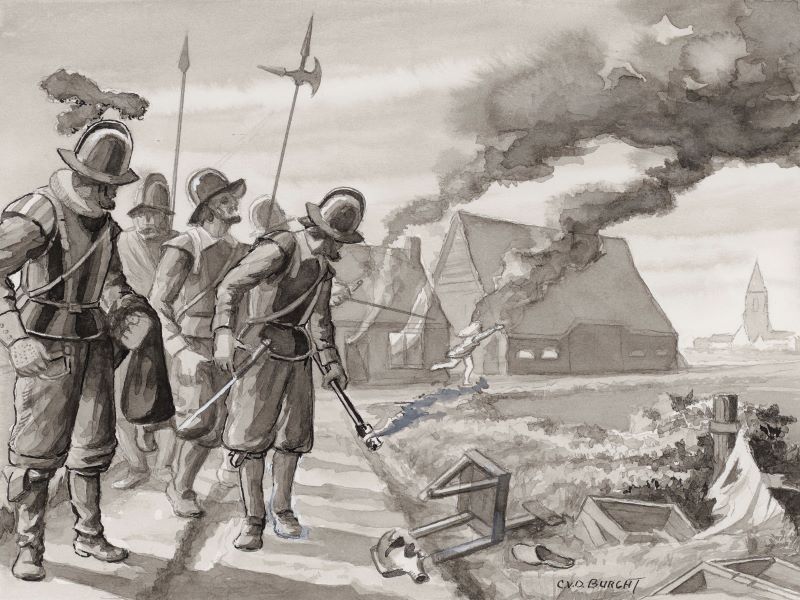
For the inhabitants of Aalten, the Eighty Years’ War meant far more than battles for fortified towns such as Bredevoort and Groenlo. Passing soldiers took horses, cattle and food, inhabitants could be seized and held for ransom, and farmers could not always be sure that they would be able to bring in their harvest. The countryside was repeatedly affected, especially during the 1580s.
War on the farm
Aalten lay in a border region in which several armies operated. Bredevoort and Groenlo were military strongpoints and States, Spanish and other troops moved through the surrounding countryside. For a farmer, the difference between the opposing sides could matter little when soldiers needed food, money, horses or cattle.
The problem was made worse because soldiers were often paid and supplied irregularly. Armies therefore lived to a considerable extent from the territories through which they passed. Sometimes goods were formally requisitioned or a contribution was imposed; at other times it amounted simply to robbery.
What was a forced contribution?
A brandschatting was a forced contribution demanded by armed troops in return for sparing a village, rural district or group of inhabitants from burning or plunder. Those who paid hoped to prevent destruction. In practice, payment offered no guarantee that another military unit would not appear later and demand money or goods again.
Even smaller losses could be serious for farming households. A horse was not merely valuable property but also provided the power needed for ploughing and transport. Losing cattle reduced both food and income. Grain taken by soldiers could affect the winter food supply as well as the seed required for the following year.
The years 1582–1588
A remarkably detailed sequence of reports about Aalten survives for the years 1582–1588. G.H. Rots published them in the Aaltensche Courant in 1938. He described numerous incursions in which inhabitants were taken prisoner, horses and cattle were driven away and ransom was paid to recover people or animals.
Rots gave very precise numbers and sums. He stated, for example, that sixteen inhabitants were captured in March 1582 and released for 2,000 guilders. For July 1584 he mentioned fifteen prisoners, hundreds of stolen animals and 1,100 guilders in ransom. These details are historically valuable, but the original archival references behind every individual figure have not yet all been identified. They are therefore presented here as figures from Rots’s reconstruction, not as independently verified totals.
That the disruption in 1584 was indeed very severe is confirmed directly by the Bredevoort court book. The annual court day could not take place that year because hostile unrest had become so serious that, according to the writer, the “poor people” of the Ambt Bredevoort had fled and become dispersed. Court days also had to be postponed because of unrest in 1587 and 1588; in 1588 the court book mentions passing cavalry.
Not only ‘the enemy’
The population could suffer at the hands of several parties. Historian J.N. Bakhuizen van den Brink, using material from the Anholt archive, described how the pledge-holders of Bredevoort around 1580 were scarcely able to protect their subjects. Country people were plundered by friend and foe alike, while the small military forces at Bredevoort and Anholt also had to be quartered among local inhabitants.
A later court book provides a very concrete example. When Gerdt Snoijenbusch died around 1601, it was recorded that all the livestock he left behind had been stolen: some by Spanish troops and some by what the source calls the ‘Rijksvolk’. For his household, the practical result was simply that the animals were gone.
Jan Holstein’s letter
One of the clearest voices from this period is Jan Holstein, the warden of Aalten. On 9 June 1588 he wrote to Godfried Gerardi, adviser to the Lady of Anholt, about conditions in Aalten.
The surviving account of his letter shows how exhausted the population had become. According to Holstein, farmers were ploughing with the cows they still possessed, there was hardly any opportunity left to borrow money and he feared that the coming harvest could not be brought in safely. People from Aalten were also being held prisoner elsewhere, while there was no money available to ransom them.
Even troops intended to provide protection placed a burden on the population. Soldiers needed somewhere to sleep and eat, while their horses required fodder. In an age without modern barracks, this often meant that soldiers were accommodated in the homes of townspeople and farmers.
For a household that had already lost livestock or provisions, billeting could increase the pressure further. The war therefore entered people’s homes quite literally: not only through plunder, but also when friendly or allied soldiers had to be supported.
The war remained visible after 1600
The violence of the 1580s was not an isolated episode. The Bredevoort court book records at the court day of 1624 that Johan Tenckinck the Younger had lost all his cattle to the warring parties shortly before his death. The note is brief and administrative, but it shows exactly what warfare could mean for a farm.
In 1627, inhabitants of Bredevoort also had to contribute towards the costs of a sauvegarde and other expenses connected with protection and military burdens. In the same year Frederick Henry captured Groenlo, after which direct military pressure in the eastern Achterhoek gradually diminished.
Why source checking matters
Rots’s articles remain valuable for local history because he brought together many older records that are otherwise difficult to trace. At the same time, he wrote more than three centuries after the events and did not always specify which archival document supported each individual detail.
Old Aalten therefore checks his reconstruction wherever possible against court books, judicial records, letters and other contemporary sources. Sometimes those records directly confirm the general picture; sometimes an exact number or sum remains known only from the later reconstruction. Making that distinction explicit keeps the story readable without presenting uncertainty as fact.
Another side of the Eighty Years’ War
The history of the Eighty Years’ War in this region is therefore not only the history of the captures of Bredevoort and the sieges of Groenlo. For most inhabitants, war was experienced on fields, farmyards and roads: a missing horse, an emptied store of grain, a relative held hostage or soldiers who had to be fed and housed.
Such records explain why years without a major battle could nevertheless remain years of war for the local population. The broader perspective on everyday life is explored in Farmers and citizens during the Eighty Years’ War.