
De Graafschapbode, 11 November 1987
Perhaps because his father taught him rhythm from an early age by tapping out the beat with a poker on the edge of the stove, Jan Kappers of Aalten always had a strong sense of rhythm. His father taught him a great deal about music, for which Jan remained grateful. By then he had already been teaching others music for more than forty years, and still had not had enough of it. ‘Music and flowers give sound and colour to life. I could not do without either,’ said the man who had become a well-known figure in the regional music scene.
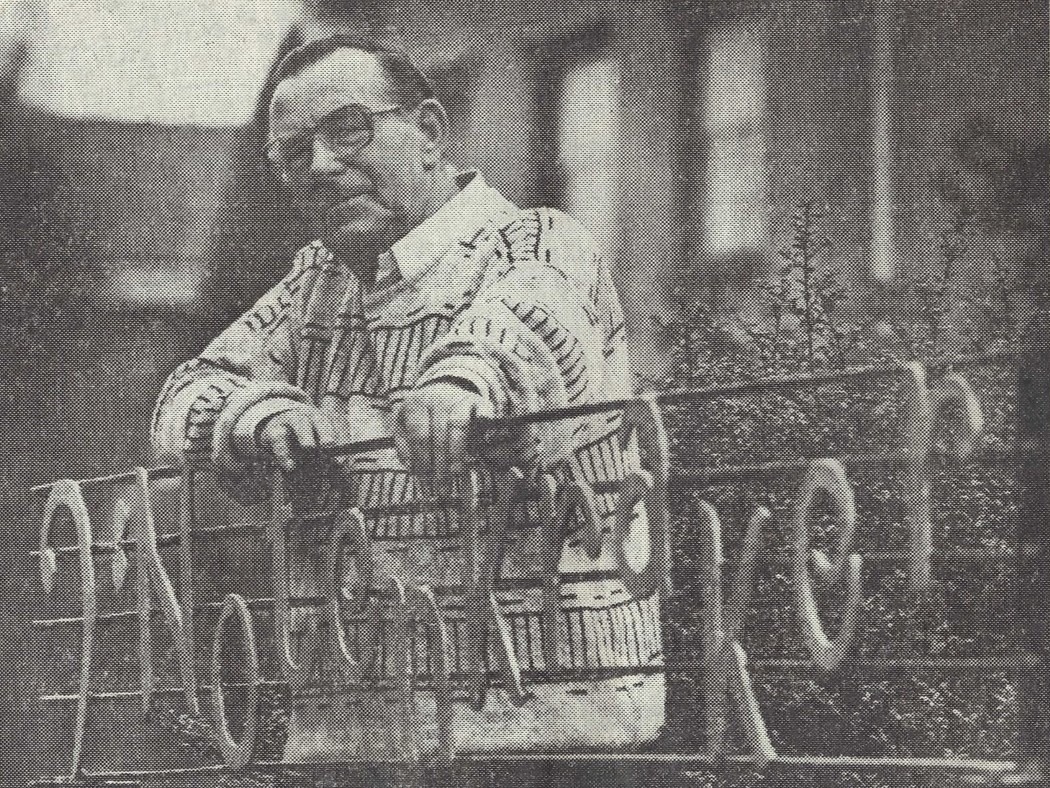
‘Music is important to me. You make friends through it, and playing together and creating a harmonious whole is the finest thing there is. In my view, flowers and music are closely related, so flowers have my love too,’ saidJan Kappers at his home onSlingelaan in Aalten.
He had already helped many people in the region on their musical way. ‘That has given me a large circle of friends. I used to be busy with it almost day and night, but in recent years I have taken things a little more quietly.’
When Jan listed everything he was still doing in music, it was clear that it was no small amount. He was responsible for several bands, and almost every afternoon and evening children as well as adults came to him to learn the finer points of music-making.
‘Music was in me from an early age. My father was very involved with it, and then you pick it up naturally. If I want to keep going as long as my father did, I still have some way to go,’ Jan Kappers laughed. His father was still playing the bass part at the age of 78 withDe Eendracht.
Jan recalled that he received his first music lessons at the age of nine from Bram te Loo, and later from the renowned Bredevoort conductor Willem Wensink. ‘I remember that Wensink would hang the trumpet from a cord. You then had to play it with your hands behind your back. I only managed it after a great deal of practice,’ he added.
During and after the war
After completing military service and during mobilisation, Jan ended up at Aalten’sdistribution office. There he did everything the German occupiers forbade. He was arrested, and for a time music disappeared from his life. After the war, however, he picked up where he had left off and began setting the pace himself. He helped establish a youth band and drum corps with De Eendracht.
There was great enthusiasm for it in the immediate post-war years. Rehearsals were held in the thenPatrimonium building but in fine weather they went outdoors. The drum corps was not always received with equal enthusiasm there.
‘Sometimes it was almost unbearable to listen to,’ Jan Kappers admitted, recalling that in spring the young cattle in the fields would bolt when the drummers passed by.
In the post-war years Jan achieved considerable success with his youth band and drum corps. His success did not go unnoticed, and he became much in demand. In succession, he served as conductor or instructor with bands in Dinxperlo, Varsseveld, Silvolde, Groenlo, Zieuwent and Bredevoort.
Jan continued his studies and qualified as a teacher. Many of his pupils also went on to achieve a great deal in music, building careers as conductors or instructors.
Discipline
One thing Jan considered very important in music was discipline. ‘It is essential, especially at concerts and competitions. Even though young people have much more freedom now than they did in the past, that discipline still has to be there,’ he said. Teaching young musicians suited Jan well. ‘Especially when there is talent, the enjoyment comes naturally and they become good musicians.’ Jan also trained drum majors. ‘They have a very particular and far from easy task,’ he said.
The tambour-maître must have self-control. Jan illustrated this with a story about one of the first times he entered a competition with De Eendracht’s drum corps. ‘That was in Ermelo. There were three judges walking around the corps. The order came to begin, but one of the judges was standing in the way and the drum major kept firmly silent. Only when the judge moved aside did he start. We did win first prize, though.’