
Aalten’s history does not begin with a charter. Long before the name Aladna was written down in 828, people were already active in the area of the present municipality. Archaeological finds take that history back to the end of the last Ice Age.
This does not mean that a single village stood here continuously from the Stone Age onwards. The landscape was used again and again in different periods: first by travelling hunters and gatherers, later by farmers and eventually by inhabitants of early medieval settlements. The soil preserves separate chapters from that long history.
Hunters at the end of the Ice Age
The oldest known traces of human presence within the municipality of Aalten date from the Late Palaeolithic, at the end of the last Ice Age. Archaeologist Peter Schut described two sites attributed to the so-called Tjonger culture, now more commonly called the Federmesser culture.
At one location a small flint scraper was found together with flakes. Another site produced a Tjonger point and other worked pieces of flint. Such finds fit travelling hunters and gatherers who stayed in the area temporarily. There is no evidence of permanent settlements from this period.
From hunters to farmers
Finds from the Mesolithic and Neolithic are also known in and around Aalten. From the Neolithic onwards, the way people used the landscape changed: farming and livestock became increasingly important and people remained in one place for longer periods.
The archaeological inventory of the municipality contains several Neolithic sites. During research at De Hoven in 2024, a flint scraper dated to around 4000 BC was also found. That object was thousands of years older than the early medieval settlement traces investigated on the same site.
Traces from the Early Bronze Age are known as well, including settlement material and a bronze spearhead. As we approach the end of the Bronze Age, the archaeological picture becomes clearer.
The urnfield at Barlo
One of the most important prehistoric sites lies in Barlo. Several urns and other remains were found near De Kamp farm during the twentieth century. The site contains traces of an urnfield dating from the Late Bronze Age and Early Iron Age.
During this period, the dead were cremated. Their burnt remains could be placed in an urn or directly in the ground, often beneath a small burial mound and close to earlier graves. The Barlo site is of national importance and was designated an archaeological national monument in 2003.
Iron Age finds are known elsewhere in the municipality too. At the Ringkampsbulten, an unusual elevation was even suspected in 1932 of being a prehistoric burial mound. Research by Albert Egges van Giffen showed that the ring-shaped bank itself was natural. A grave from the La Tène period was, however, identified nearby.
A rich grave on Damstraat
For the origins of later Aalten, the early medieval finds are especially important. From the late nineteenth century onwards, several graves and grave goods were found along today’s Damstraat.
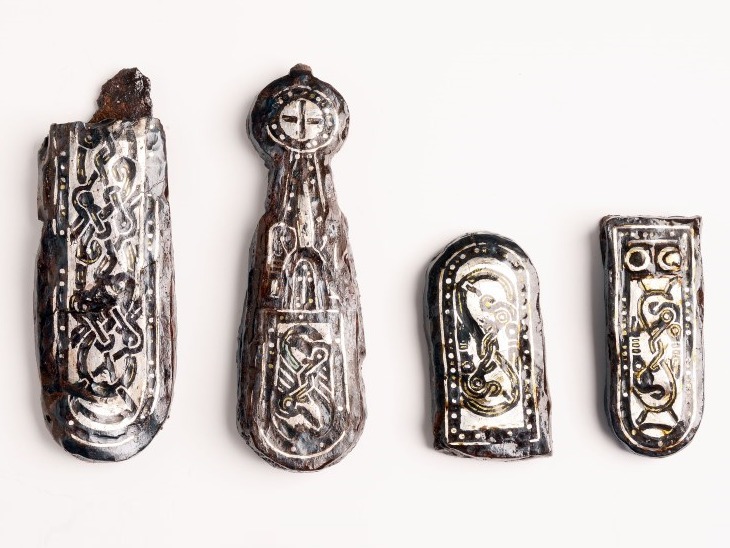
Research in 1932 uncovered an exceptionally rich grave containing, among other objects, a sword, shield boss, stirrups and an ornamented belt fitting. Comparative archaeological research dates the belt fittings to around the middle of the seventh century. The equipment suggests that a person of status was buried here.
The grave is important because it proves that people lived in the immediate vicinity of the later village centre well before 828. It does not tell us how large that community was, but it does show that the area was not empty in the early Middle Ages.
Settlement at De Hoven
At De Hoven, a short distance from the burial ground, several early medieval settlement traces have been investigated since 1982. These included the remains of sunken-featured buildings, partly dug into the ground and mainly used as work or storage spaces.
A second sunken-featured building, discovered in 1992, probably dates from the eighth century. Finds suggest that weaving took place there. New investigations in 2024 again revealed sunken-featured buildings, postholes, pottery and evidence of craft activity, including iron slag and loom weights.
The combination of the burial ground on Damstraat and the settlement traces at De Hoven makes it plausible that there was a settlement in this part of present-day Aalten in the early Middle Ages. Archaeology cannot, of course, tell us what that settlement was called.
And then Aladna appears
On 7 February 828, a charter names a place called Aladna. Historical place-name scholarship generally identifies Aladna with Aalten, although the original charter has not survived and the text is known through later medieval copies. Archaeology cannot settle the name question on its own.
What the archaeological finds do show is that a place or settlement in this area in 828 is historically entirely plausible. People had used the Aalten landscape for thousands of years, and in the centuries immediately before 828 both burials and settlement are demonstrable close to the later village centre.
So 828 is not the beginning of human presence here. It is the point at which archaeology and written history may first meet.