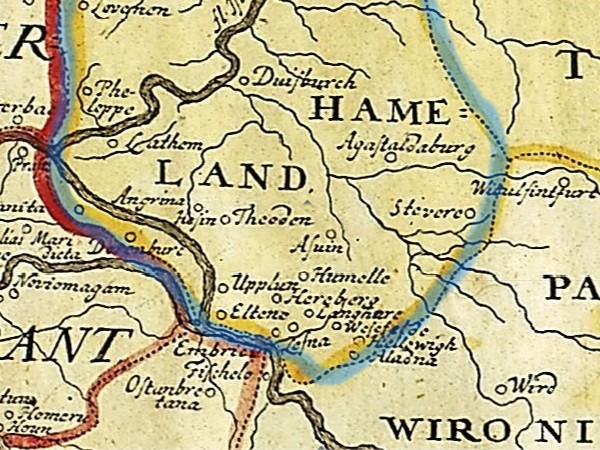
From historical sources, we know that Aalten was mentioned in 1152 as the parish of Aladon.1 However, there are indications that the village may have been mentioned much earlier, namely as Aladna in a charter from 828.2 Whether this mention actually refers to the current Aalten is still a subject of discussion. Nevertheless, archaeologists consider such an early dating certainly possible. Indeed, traces of human habitation from that time have been found both at De Hoven and on Damstraat.3 In this article, we delve into this ancient mention and examine two different theories.
The deed of gift of Geroward
The charter from 828 describes how, on February 7 of that year, a certain Geroward donated all his possessions, including those in Aladna, to the St. Martin's Church in 'Traiectum Veteri' (Utrecht). Little is known with certainty about Geroward's identity or position. The extent of the property he donated suggests substantial wealth, but the charter itself does not show that he served Emperor Louis the Pious.
The original charter has not survived. The text is known from medieval copies. Maurits Gysseling's Toponymic Dictionary records a tenth-century copy and another from the late eleventh century for the form Aladna. The charter was later published in the Oorkondenboek van het Sticht Utrecht tot 1301.
Below are the Latin text and the English translation of the charter in question.
Source text
Dum unusquisque presens seculum inhabitat, necessitate nimia cogitur, ut finem suum Dei solo judicio previdere et preoccupare bonis operibus studeat, ne eum inopinata et improvisa mors inveniat.
Idcirco ego Gerouuardus, filius Landuuardi, trado ad ecclesiam sancti Martini, in Traiecto Veteri constituta[m], quicquid mihi hereditatis jure accessit in villa Langhara et in Ellenuuih et in Aladna et in Uuazefelde et in Humelle et in Theodon et in Hesim et in Asnon, cum omnibus adjacentiis, pratis, pascuis, silvis, aquis aquarumve decursibus, necnon et mancipia, quorum hec existunt vocabula: Feginuuard et uxor ejus Liutburn, Meginrauan et uxor ejus Vuerinhild, Albuuard et mater ejus Sigiuuih, Uulfbald et Hadagrim, Grimbald et uxor ejus Adaluuih, Garoberd et uxor ejus Folcuuihc, Arnolf et uxor ejus Adalgard, Saxani et uxor ejus Harduuih Vuerinbald et mater ejus Gerild, Heiegbrath et uxor ejus Meginfrid, Vuarbald et uxor ejus Geruuih, Adalgod et Marcuui, Saxini et Radini, Vulfini et uxor ejus Liuduuar, Odilgard et filius ejus Heriman, Aldric et filius ejus Landric, Gelo et Marcrad, Hungrim et uxor ejus Liuduuih, Aluuih et Seolo, Egbald et Tadhild.
Acta est autem publice in villa Embrici, anno XV imperii domni Hludouuici imperatoris, incarnationis vero Dominice anno DCCCXXVIII, die VII Idus Februarii, coram testibus, qui hanc traditionem presentialiter confirmatam viderunt similiter et vestituram, quorum nomina subter notantur.
Signum Gerouuardi, traditionem hanc peragentis.
[The signs of] Hrauanuuardi, Egisgeri, Sigiberti, Gerberti, Theodansi, Albrici, Albuuardi, Ildiradi, Odilbaldi, Otberti, Roduuigi, Uuerinherdi, Friduberti, Vuibodonis, Ledradi, Geroldi, Gerici, Vuendilberti, Gerharii, Hildirad, Reinheri, Rodberti, Uuarmundi, Aldgeri, Vualonis, Rodhardies, Meinhardi, Hrauaningi, Egelberti, Gerbodi.
Ego Geraccarus jubente domno meo Friderico episcopo scripsi et subscripsi.
Translation
While every man dwells in this earthly life, he is driven by a great necessity to foresee his end only through God's judgment and to prepare for it through good works, lest death overtake him unexpectedly and unprepared.
Therefore, I, Geroward, son of Landward, transfer to the church of Saint Martin, located in Old Traiectum, everything that has come to me by hereditary right in the villages of Langhara, Ellenwih, Aladna, Wazefelde, Humelle, Theodon, Hesim, and Asnon, with all associated lands, meadows, pastures, forests, waters, and watercourses.
Likewise, I transfer the serfs, whose names are as follows: Feginward and his wife Liutburn, Meginravan and his wife Werinhild, Albward and his mother Sigiwih, Wulfbald and Hadagrim, Grimbald and his wife Adalwih, Garoberd and his wife Folcwih, Arnolf and his wife Adalgard, Saxani and his wife Hardwih, Werinbald and his mother Gerild, Heiegbrath and his wife Meginfrid, Warbald and his wife Gerwih, Adalgod and Marcwi, Saxini and Radini, Wulfini and his wife Liudwar, Odilgard and her daughter Heriman, Aldric and his son Landric, Gelo and Marcrad, Hungrim and his wife Liudwih, Alwih and Seolo, Egbald and Tadhild.
This transfer took place publicly in the settlement of Embrici, in the fifteenth year of the reign of Emperor Louis (Hludowicus), and in the year 828 after the incarnation of our Lord, on February 7, in the presence of witnesses who confirmed this transfer and the associated settlement. Their names are listed below.
The mark of Geroward, who performs this transfer.
[The marks of] Hravanward, Egisger, Sigibert, Gerbert, Theodans, Albric, Albward, Ildirad, Odilbald, Otbert, Rodwig, Werinherd, Fridubert, Vuibodo, Ledrad, Gerold, Geric, Vuendilbert, Gerhari, Hildirad, Reinher, Rodbert, Warmund, Aldger, Vualo, Rodhardies, Meinhard, Hravaning, Egelbert, Gerbod.
I, Geraccarus, have written and signed this by order of my lord, Bishop Frederick.
Where was 'Aladna' located?
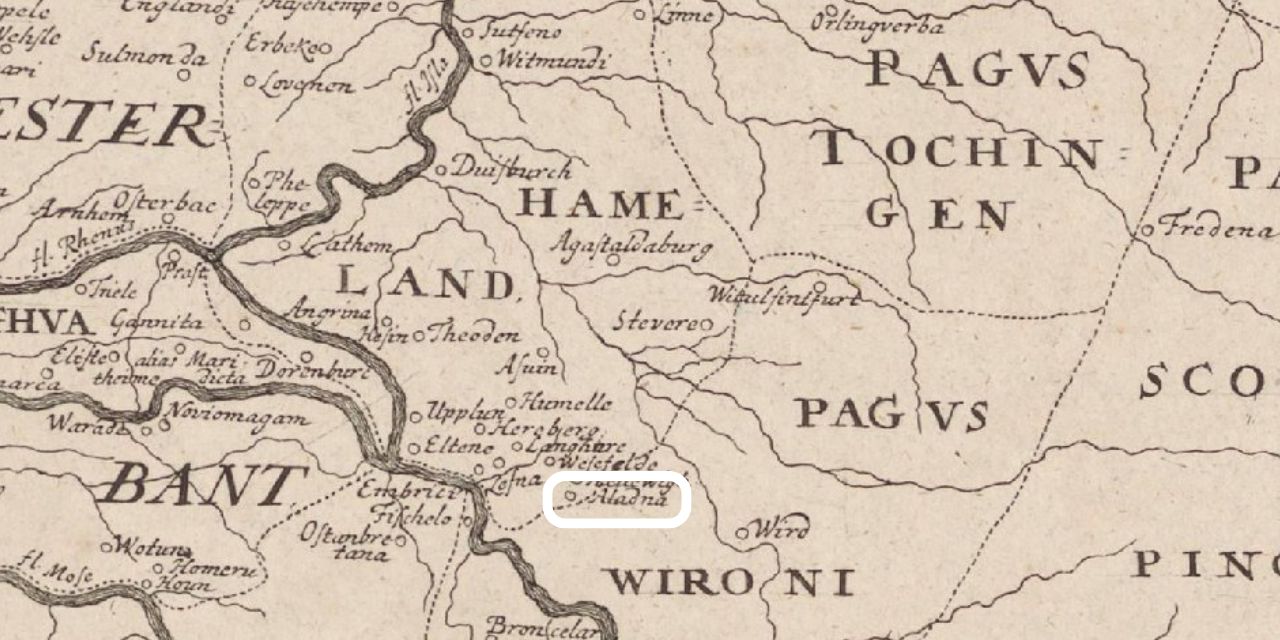
Historical place-name scholarship generally identifies Aladna with Aalten. An alternative North French interpretation also exists, best known from the work of Albert Delahaye:
- The Hamaland theory: According to this view, Geroward's possessions were located in the area that would later become known as the Carolingian county of Hamaland. The place names mentioned in the deed are linked by historians to contemporary locations in the Liemers and the Achterhoek. Within this theory, 'Aladna' is identified as the current Aalten.
- The North French theory: Another interpretation suggests that the mentioned places were not in the Netherlands, but in Northern France. In this scenario, Aladna would refer to the current Alette, a place in the Pas-de-Calais department. The other place names from the charter would also be located in this area.4
Interpretations of the place names in both theories:
| Latin name | Hamaland theory | Northern-France theory |
|---|---|---|
| Traiectum Veteri | Utrecht | Tournehem-sur-la-Hem |
| Langhara | Langerak (near Doetinchem) | Longuerecque |
| Ellenwih | Heelweg | Herlincourt |
| Aladna | Aalten | Alette |
| Wazefelde | Varsseveld or Dwarsfeld near Anholt | Nesles |
| Humelle | Hummelo | Wimille |
| Theodon | Didam | Todincthun/Thérouanne |
| Hesim | the Kniphees farmstead near 's-Heerenberg | Hées |
| Asnon | Azewijn | Assonval |
| Embrici | Emmerich | Embry |
The identification with Aalten is not merely a local tradition. Modern historical toponymy explicitly records the 828 form Aladna under Aalten, including Maurits Gysseling's Toponymic Dictionary and the digital database based on that scholarship. Delahaye's North French localisation is therefore an alternative interpretation rather than a second, equally established standard identification. The Aladnaweg locally preserves the old name form.
Conclusion
The charter of 828 unquestionably names a place called Aladna. Historical toponymy generally identifies that name with Aalten. Absolute certainty is difficult because the original charter has not survived and the text is known only through later copies. Archaeology cannot prove the name, but it does show that settlement in the immediate area of later Aalten in this period is entirely plausible.
Origin of the place name
Several theories circulate regarding the origin of the name Aalten. But what are they based on and how credible are they? Old Aalten delved into history to discover more about this.
Read the full article: Origin of the place name Aalten.

Corrections and additions
Have a correction or addition? Leave a comment below. We incorporate relevant information into the profile and then remove comments that have been processed. Your email address will not be published.
. In de Aaltensche Courant van vrijdag 4 februari 1938, no 11 wordt daar het volgende over geschreven: "Er zijn meerdere benamingen van Aalten geweest, n.l.Aladon of Alethe.. Anderen zeggen dat de naam ontleend is aan "Altus", "aan den heuvel".
Leave a comment