After liberation on 30 March 1945, Aalten entered a new phase. Reconstruction here was not only about repairing war damage. At least as important were the housing shortage, neglected public services, employment and the question of how a growing municipality should develop.
This did not happen through one grand plan. Step by step, a different Aalten emerged in the years after the war: houses and new streets were built, the municipal council tried to attract more varied employment, and investment was made in education, healthcare and infrastructure.
From liberation to recovery
The final months of the war had also caused casualties and damage in Aalten. After liberation, ordinary government and daily life had to get moving again. At the same time, problems that had remained unresolved during the war were far from solved.
A municipal annual review for 1947 shows how broad the recovery had already become. Housebuilding repeatedly came before the municipal council, several roads were improved and street lighting was tackled. Public transport connections also improved. At the census of 31 May 1947, the municipality had 13,585 inhabitants.
Homes for a growing population
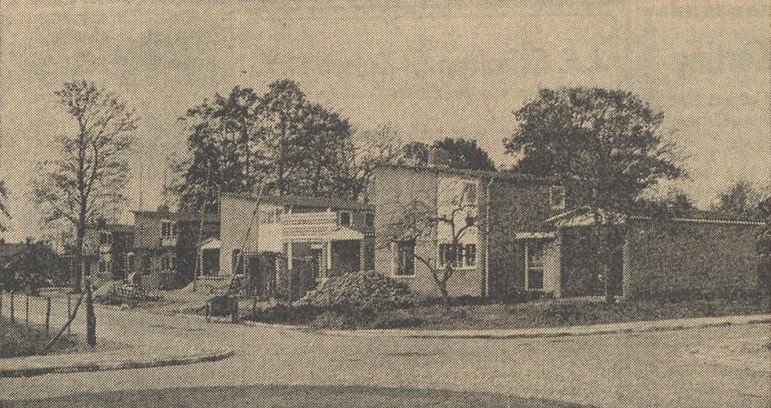
The housing shortage remained one of the most important post-war problems. New houses initially appeared not in one large development, but spread across Aalten. Existing streets were extended and gaps in the built-up area were filled.
By the mid-1950s, hundreds of homes had been built in this way since liberation. But the available space within the existing built-up area was running out, so the municipal council began preparing larger extensions.
In 1955, plans were drawn up for about one hundred homes on and around the Meiberg. New streets and building sites also came into view in Aalten-Zuid and ’t Dal. The new neighbourhoods were not intended to contain houses alone: the plans also allowed for green space, playgrounds, schools and homes for older people.
Jobs and new industry
Reconstruction also meant employment. Aalten’s traditional textile and horn industries had existed long before the war, but the municipal council wanted the local economy to be less dependent on only a few sectors.
New industrial activities arrived in 1947, including Van Katwijk’s paper and cardboard processing business. A year later, work was under way to establish a machinery and equipment factory in former industrial buildings on Polstraat. Mayor E.S. van Veen explained that the municipal council was deliberately seeking different types of industry so that employment would become less one-sided.
This economic development was also necessary because the population was growing. Not everyone could find work in Aalten; in the first post-war years, families once again emigrated, including to Canada.
Schools and healthcare
During the 1950s, renewal became increasingly visible in new facilities. By 1951, plans were ready for three major building projects: a Christian technical school, a health centre and a new agricultural domestic science school.
The health centre was intended to bring several forms of medical care together, including space for doctors, district nursing and maternity care. The technical school was to train young people for trades and industry. The agricultural domestic science school developed into a regional educational facility.
Building and expansion also continued elsewhere. In 1956, attention was drawn to new nursery schools, the development of the HBS secondary school and further plans for primary schools and agricultural education. Reconstruction was increasingly about shaping a modern municipality.
From reconstruction to expansion
Around the middle of the 1950s, the nature of development changed. The first wave of post-war housebuilding had mainly filled gaps in the existing town. After that, genuinely new expansion districts came into view.
Meiberg, Aalten-Zuid and ’t Dal were early examples. Larger plans followed in the 1960s, including Kemena. Housing, schools, green space and room for businesses were increasingly designed as parts of one whole.
Aalten’s reconstruction therefore had no single end date. It was a development that began immediately after liberation and, during the 1950s, flowed into a broader period of growth and modernisation. Many streets, residential neighbourhoods and public facilities created in those years still shape Aalten today.