
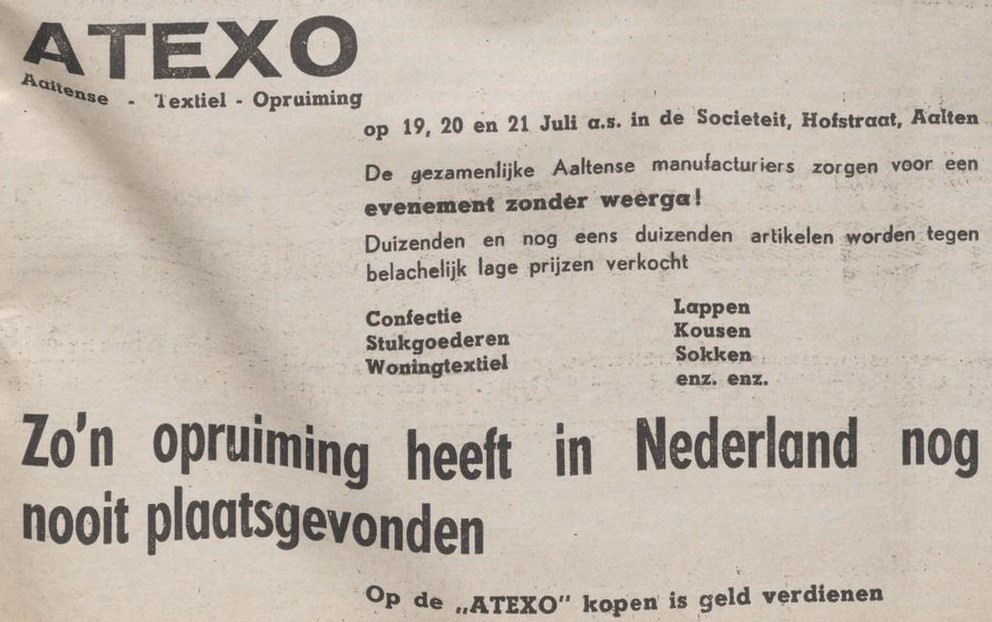
De Telegraaf, 20 July 1950
Shopkeepers hold joint clearance sale
AALTEN, 19 July — All Aalten’s textile retailers have brought their clearance stock together in an association hall and turned it into one huge sale. Women from the town and the surrounding area are flocking to this novelty and thinking: hurrah, now we no longer have to trudge from shop to shop.
A first for the Netherlands
Aalten has a first. A clearance sale in this form has never before taken place in the Netherlands. It almost seems as though the shopkeepers have become brothers — during sale time at least — and are jointly calling out: come and buy. Our goods are all equally good and equally cheap. At least during these three days of reductions.
It was a success and proved very popular with the women. The white building known as “De Sociëteit” was surrounded by a hedge of black ladies’ bicycles. A sale is attractive enough as it is — and then one like this. “Stop, no more inside,” said the two policemen, handing out numbered tickets and allowing only fifty people in at a time. A short wait, and then: off they went.
Publicity
“But why do it this way?” a curious visitor asked the enthusiastic board of the Textile Retailers’ and Tailors’ Association. “All my life, during sale time, I’ve gone from one shop to the next. And now you’re holding a ‘sociëteit’.” “Publicity, miss,” said the organiser. “Besides, it keeps our own shops quieter and improves the good relations between the textile retailers.”
Three thousand guilders’ worth had already been sold on the first morning. That was encouraging. But there were goods worth fifty thousand guilders, so customers still had plenty to choose from. Underwear and fabric remnants sold best. A special fabric display had been created on the stage, and rarely had shopping women seen such a brilliant scene. Who cares about Shakespeare or the opera Faust when there are fabrics to be had?
At first the shopkeepers faced a difficulty, because the law did not permit a sale of this kind. Two retailers, however, agreed temporarily to close their own businesses: a letter was sent to the Chamber of Commerce, and then the “De Sociëteit” store could open. The law is the law, even if not everyone immediately understands it. And perhaps they thought the customers would come round the back anyway, because the arrangement worked both ways: ordinary sales in the participating shops continued as usual.
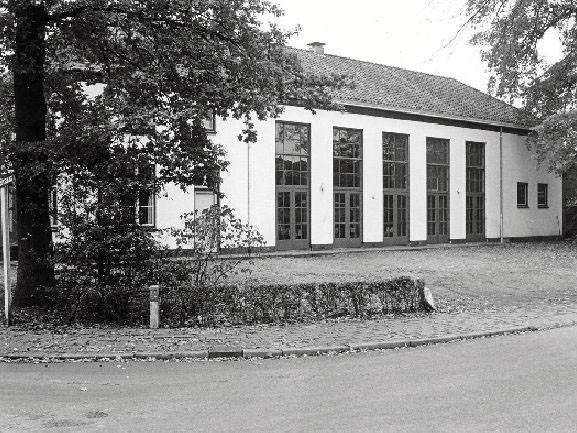
Police helped with the packing
The packing table was initially understaffed. But the police lent a hand, and for two hours the local constabulary stood wrapping petticoats and baby clothes. Two special coaches arrived too, carrying women’s clubs from Groenlo and Dinxperlo. Together with the others, they descended on the large stocks laid out on long tables. Customers and shopkeepers all enjoyed themselves. The competitors drew even closer together. “Jan,” one of them called, “I’ve sold another piece of your fabric.” For hours the women rummaged through the remnants. At one point a four-metre length of dress fabric became completely tangled and the salesman had to untie it; it was as though the women were searching for buried treasure.
Great interest
The experiment attracted considerable interest within the trade. The sector organisation followed the results closely, as did the shopkeepers’ associations. The Retailers’ Association sent a telegram wishing the venture success. Many would-be customers tried to find other ways in, and a couple of women even made a dash through the billiard room in an attempt to reach the two sales areas. Another small group found themselves in a room containing nothing but cabinets of silver cups and medals. These, however, were trophies belonging to the “Alles of Dalles” club. The women had ended up in the skittles room and were later put back into the queue outside.
Before the sale began, the participating shopkeepers checked the prices themselves: they had to be genuine clearance prices. For most goods this was indeed the case. Rugs that had cost one hundred guilders were sold for twenty, and a few coats that had once been displayed at eighty guilders went for fifteen. These were exceptions, however. On average, prices were about thirty per cent lower than before. Customers could not tell which shopkeeper they had actually bought from, because the goods carried only a number. It did not matter — as long as they were cheap and to their liking.
An original move
The Aalten shopkeepers certainly came up with an original idea with this joint clearance sale. The public responded enthusiastically. They liked the new system and showed it through the enormous turnout. The building bears the name “Association for the Promotion of Social Intercourse”. Well, it was certainly sociable. Even outside, curious onlookers stood examining this unusual store with its sign reading “Full Licence”. A loudspeaker could be heard in the surrounding streets urging: “Ladies and gentlemen, please make your choice quickly. You must leave the hall shortly because another group is waiting. But don’t forget to visit the clothing department before you go — there are some tremendous bargains there.”