
Aalten and Bredevoort
On 6 September 1898, the Netherlands gained a new sovereign: Queen Wilhelmina. She had turned eighteen on 31 August 1898 and with that reached the age at which she could assume the reins of government. Her inauguration took place a week after her eighteenth birthday in the Nieuwe Kerk in Amsterdam. The occasion was celebrated enthusiastically throughout the country, including in Aalten and Bredevoort.
On the occasion of the Queen’s fortieth jubilee in 1938, the Aaltense Courant looked back at the coronation celebrations for Wilhelmina:
Now that the recent festivities marking Her Majesty the Queen’s fortieth jubilee are still fresh in the memory, it may be of some interest — and our older readers, particularly those who experienced those celebrations at close quarters, will surely appreciate it — if we relate something about the coronation festivities which were celebrated here in Aalten, as elsewhere, with the same enthusiasm as the present fortieth jubilee. For reasons of space we must confine ourselves mainly to the municipality of Aalten. Our newspaper archive is of excellent service here.
We begin on Wednesday evening, 5 January 1898: a meeting of the committee organising the coronation celebrations at the Sociëteit on the Blik. Our issue of 8 January 1898 reported:
“Under the chairmanship of Mr A.P. Slicher van Bath, the committee for the coronation celebrations met. The various rural districts were also represented, but no delegates had been chosen from one part of the municipality, namely Bredevoort, because it was expected that a separate celebration would be held there. It soon became clear that opinions differed, and a lively debate on several points followed. It was eventually decided that, provided music could be arranged, celebrations would be held on 31 August and 1 September. The municipal authorities would be asked for a contribution towards a children’s celebration for all schools in the municipality and towards distributions to the poor and elderly.”
The committee’s request to the municipal council for a grant towards the festivities was favourably received, although at the meeting of 12 February the council could not agree on the amount to be awarded, so the matter was postponed until the next meeting. There was greater agreement then. Our issue of 12 March 1898 reported:
“At this morning’s council meeting it was unanimously decided to grant the Coronation Committee a subsidy of 300 guilders, of which 150 guilders is intended for the schoolchildren and 150 guilders to provide the poor of this municipality with a cheerful day as well.”
The committee was more than satisfied with this amount. Such a sum meant a great deal in those days, and at the committee’s next meeting Mr Slicher van Bath surely spoke for the entire population when he conveyed heartfelt thanks to the council for the grant. It is not known whether contributions were also requested from residents by means of subscription lists to help cover the cost of the celebrations; we found no information about this.
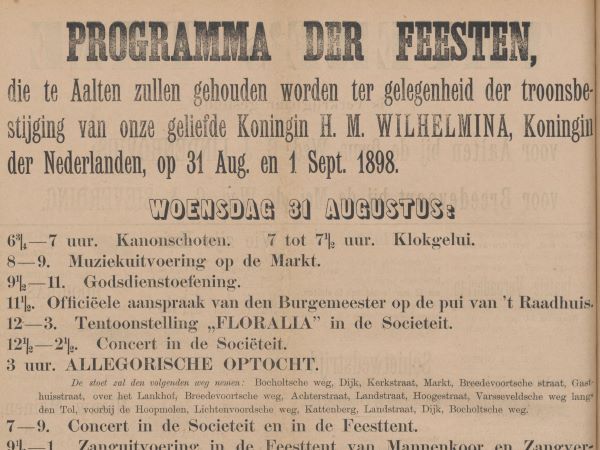
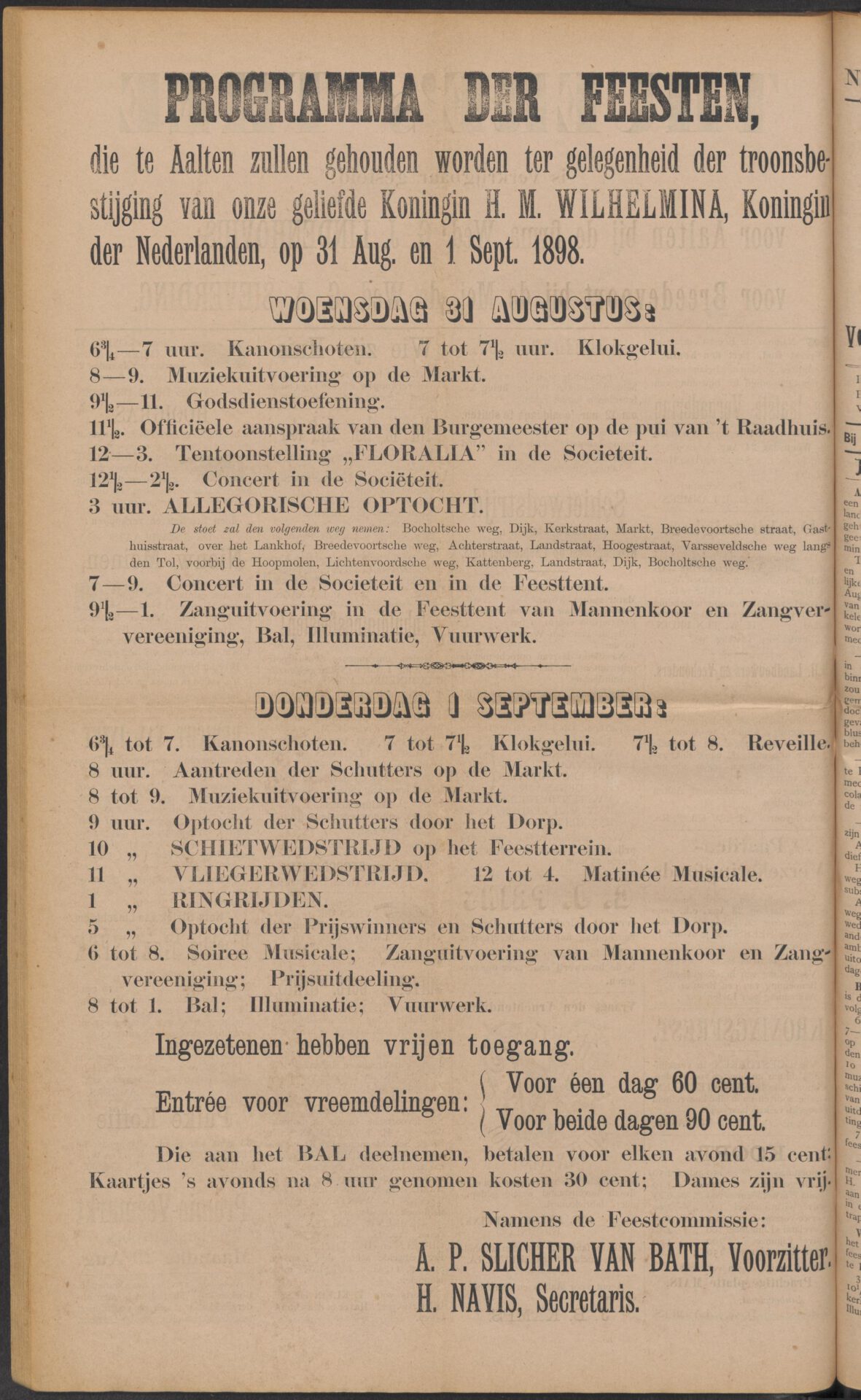
We cannot provide further details of the committee’s other activities because they are not known to us. We can, however, conclude that its organisation of the festivities succeeded to everyone’s satisfaction and that Aalten held a celebration which people could look back on with pleasure for many years. The programme alone speaks for itself:
See the image on the right (click to enlarge).
Report of the festivities
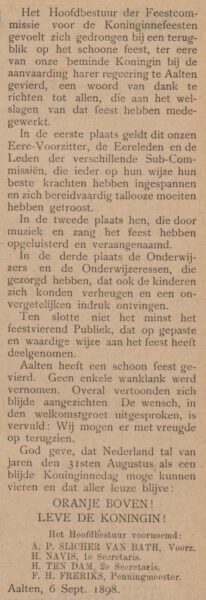
Finally, we reproduce the report of the festivities published in our issue of 3 September 1898:
“After all the bells had been rung for half an hour from seven o’clock, a musical performance was given on the Market Square at half past eight. Services then took place in the various churches, where God’s blessing was invoked for the welfare of the young Sovereign and her Mother, so highly esteemed throughout the Netherlands. The mayor’s address, much of which was unfortunately inaudible, was followed by a performance by the choir formed specially for the occasion under the direction of Mr Veldkamp. The songs carried well across the square and their words were well suited to stirring enthusiasm.”
From noon until three o’clock, the “Floralia” exhibition was held in the Sociëteit and attracted hundreds of visitors. First prizes went to Dirk Wiggers, J. Hoogenkamp, D.J. Heinen and J.W. te Hennepe; second prizes to Derk Mijnen, Toon Schepers, E.J. Vreeman and J. Oberink; third prizes to Jan te Sla, H. Winkelhorst, G.J. Hoitink and Bern. te Brake; and fourth prizes to Mrs Wechgelaer-Doornink, Mina te Loo, Hendrik Koelman and Chr. Hoens. Seventy-two prizes were raffled among the 105 exhibitors. As a surprise, Derk Mijnen and Derk Peters were each presented with a silver remontoir watch because they had won the greatest number of first prizes during the previous eleven years.
The procession received almost as much praise as the illumination in the Sociëteit garden. People competed to praise the finely decorated wagons and bicycles and the neat costumes of the two heralds, the boys and the girls. In a word, it was magnificent and certainly exceeded many people’s expectations. The procession ended with the children of the public village and rural schools, who were entertained in the festival tent and took turns enjoying the roundabout on the grounds.
The second day was devoted more to competitions, including shooting, kite flying and ring riding. In the morning, 228 members of the Aalten shooting association, many of them on horseback, marched through the village preceded by heralds, music and the festival committee. They halted outside the homes of the mayor and Mr Slicher van Bath, where the standard-bearer performed the traditional salute with the flag.
The shooting competition winners were: 1st prize, a regulator clock, A.J.G. Beernink; 2nd, a Flobert carbine, G.W. van Eerden; 3rd, a watch, W. Meerdink; 4th, a paraffin stove, J. Probst; 5th, a porcelain dinner service, H. Hoopman; 6th, two boxes of cigars, H.J. Degenaar. The visitors’ prize, a walking stick, went to H. Weenink of Bocholt. Mr Slicher van Bath had made a medal available for each of the first two prize-winners; these had to be defended by winning again over a period of three years. Twenty people took part in the ring-riding contest: 1st prize, decided by lot, 12 guilders, J. Berendsen; 2nd, a bridle bit, H. Berendsen; 3rd, a saddlecloth, B. Westerveld; 4th, an alarm clock, M. Bongers; 5th, a watch, H. Bouhuis. In the kite competition, W. Huinink won three prizes: a watch chain for the finest kite, a purse for the largest and a watch as first prize for the highest-flying kite. Second prize went to E. Fles and third to Chr. Mengerink.
As far as we know, the festive spirit in Aalten was not disturbed by a single discordant note. Everything proceeded in good order at both festival grounds. The tricolour flew from virtually every house, but there was little decoration of houses or streets. The decoration of the town hall was also rather modest, and its illumination left much to be desired.
Coronation celebrations in Bredevoort
Bredevoort too had an extensive programme. Its festivities took place on 6 and 7 September.
6 September: 6 a.m.: reveille; 7–7.30 a.m.: bells rung; 7.30–8 a.m.: music from the tower; 8.30 a.m.: planting of the Wilhelmina tree; 9 a.m.: procession; 10 a.m.: shooting competition; noon–12.30 p.m.: music on ‘t Zand; 2–6 p.m.: various popular games, including a three-legged race; 7 p.m.: illumination of ‘t Zand; 8.30 p.m.: torchlight procession.
7 September: 2 p.m.: school celebration.
The report of the festivities included the following:
“At nine o’clock in the morning the procession was assembled on ‘t Zand. With its horsemen, schoolchildren and banners it made a very colourful and handsome sight. The honorary members, the Reverend B.S. Mulder, Roman Catholic priest, and the Revd A.J. Wartena, Protestant minister, were collected first, after which the procession made its way to the Market Square for the planting of the Wilhelmina tree, donated by Mr Bulten of Aalten. After a short address by the chairman of the festival committee, Mr Stöcker, the honorary members, Father Mulder and Revd Wartena, explained the significance of the Wilhelmina tree, after which it was planted. A cry of ‘Long live the Queen!’ concluded the ceremony.
In the afternoon the shooting competitions took place. The winners were: 1st prize, J. Piek H.J. son; 2nd, J. Piek J.D. son; 3rd, J. Thomson; 4th, H. den Hartogh; 5th, H. Veldkamp A. son. Prizes for decorated triumphal arches were awarded as follows: the arch at Landstraat–Prinsenstraat, near Mr J.B. Voltman’s house, 1st prize; Landstraat–Markt near Mr B.G. Lammers, 2nd; near Mr Van Heerde at Hosse, 3rd; at the parsonage on ‘t Zand, 4th; and near Mr ten Barge at Ganzenmarkt, 5th.”