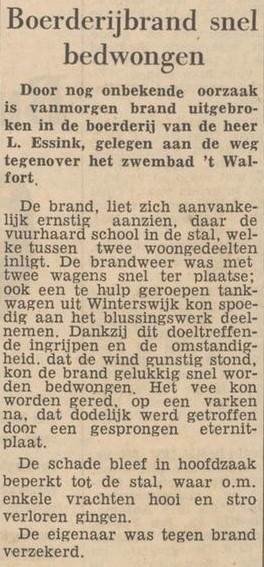
In 2012, seven dialect stories appeared in the Achterhoek Spreukenkalender under the pseudonym Hollenbargs Jan, born and raised at the Hollenbarg. This is one of the stories with which it all began.
I slept in a box bed together with my unmarried uncle. Fortunately, we had a little window in it as well, so it did not get too stuffy. My grandfather still slept in a completely enclosed box bed with little doors at the front. He even had straw for a mattress. When the rye had been threshed, he got fresh straw. Yet he lived to be nearly eighty-five.
At that time, I think it was around 1957 or 1958, we were all being frightened with the idea that the Russians might come. They had already invaded Hungary and, who knew, perhaps they would come straight through Germany and then it would be our turn. It was the Cold War, as they called it.
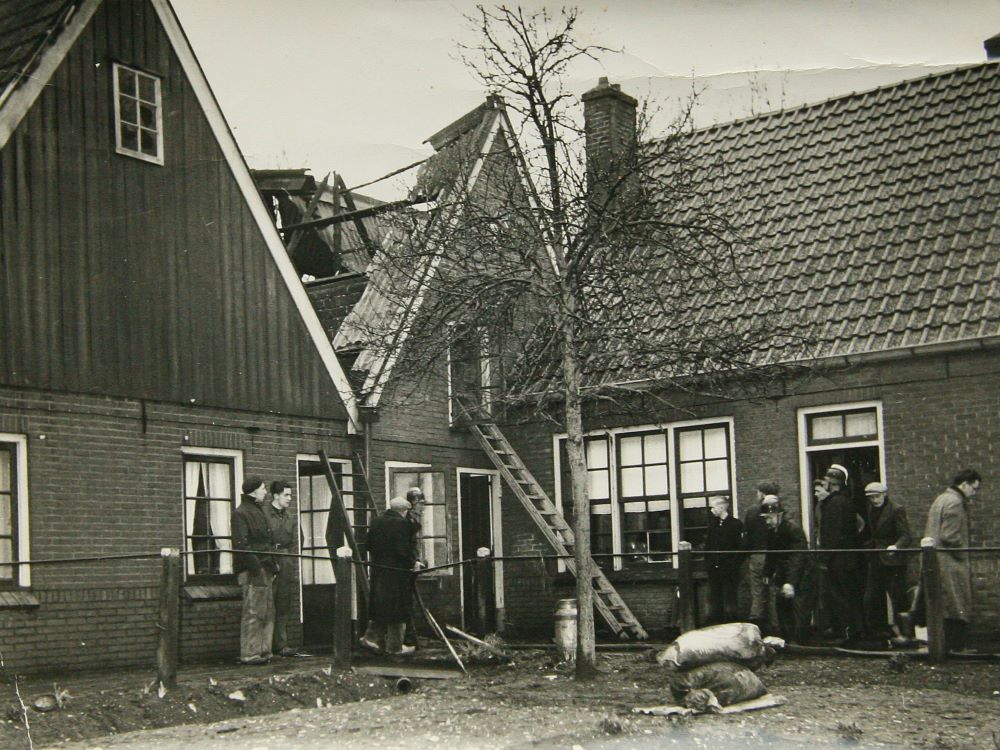
On a Saturday morning — 16 March 1957 — while we were still asleep, there was suddenly a tremendous cracking noise outside. My uncle flew upstairs shouting: “Here come the Russians — now we’re for it!” What a commotion. Once we had recovered from the first shock, we looked out of the little window and saw that the neighbours’ barn was on fire. The cracking came from the asbestos sheets on the roof. The heat of the fire made them burst apart.
When it was all over and the fire brigade had gone, we went to inspect the damage. What a stink. And now I sometimes wonder whether asbestos particles might not have been blowing through the air.
The pigs that had got pieces of asbestos in their backs were quickly slaughtered by Betsken ter Maot from Aalten. The meat tasted fine and nobody worried about the asbestos. People simply did not know any better then.
But I still wanted to say this: we never did see any Russians — at least, no soldiers. Later, Russians, both men and women, did come to Aalten for the festival organised by De Klepperklumpkes. By then, of course, we were no longer afraid of them at all. Times change. And that is probably just as well. Though even now, you sometimes get the feeling that Russia is starting to stir again…
“Hollenbargs Jan” (Jan Oberink)