
At the latest district leaders’ meeting in Arnhem, we had agreed to hold a large Easter camp in Aalten with the group from Winterswijk, the Burchtlanciers from Aalten, Dodo from Doetinchem, Zutphen and the Duno group from Oosterbeek — all old friends from Woestduin.
The staff consisted of Scoutmaster Post, Assistant Scoutmaster Beskers and myself. At about two o’clock on Good Friday afternoon, the Duno group arrived by bicycle from Oosterbeek, having picked up four Dodo patrol leaders on the way.
These first guests were triumphantly met by several Aalten Scouts and escorted to the old Scout headquarters in the centre of Aalten, where several local Scouts were already waiting. Some of us then rode out to meet the Winterswijk group, which arrived just outside Aalten together with the Zutphen contingent. We all returned to the headquarters, where Scoutmaster Post formally opened the camp in the great hall.
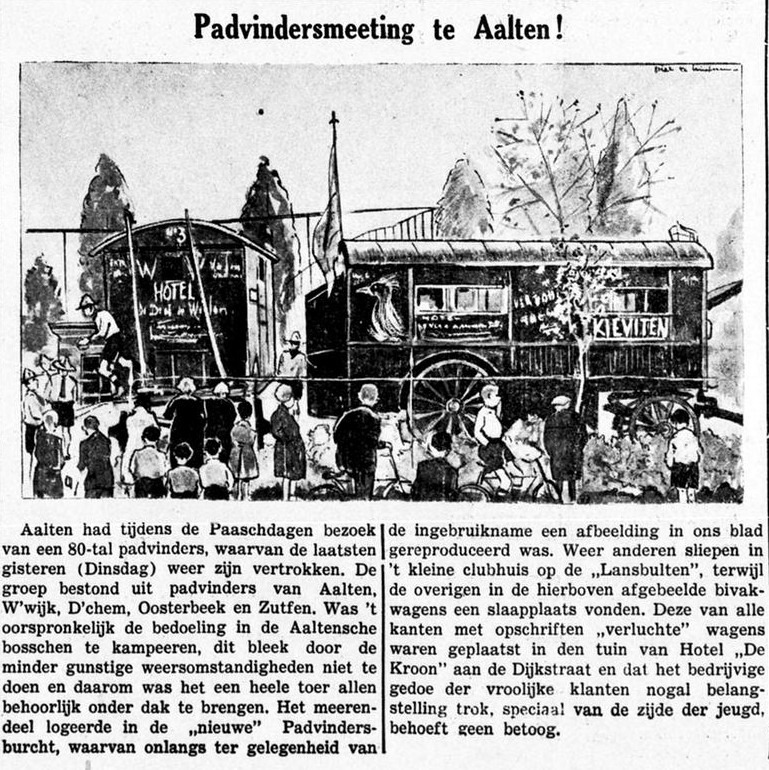
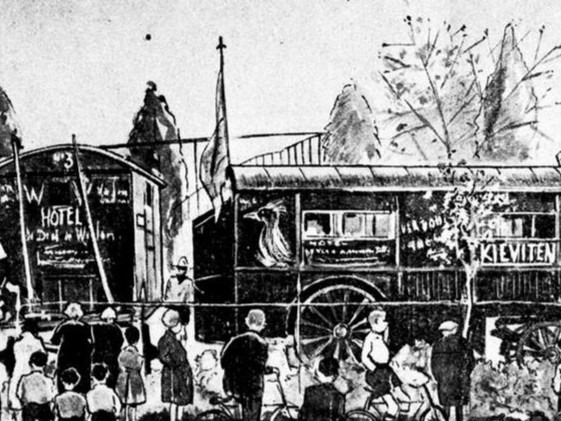
The Scouts could then find their sleeping quarters and prepare them for the night. The groups from Winterswijk and Zutphen were housed partly in the headquarters, partly at Lansbulten, the summer centre used by the Winterswijk Scouts in Aalten, and partly in two site huts. The Duno and Dodo groups would spend the nights in the old headquarters. At half past three, some of the participants left for Lansbulten for several games. I cannot say much about these, as I was busy with several of my Scouts and senior Scouts making futile attempts in Aalten’s maze of streets to obtain a celeriac and other provisions.
Because we had no key, we had to force our way into the old headquarters like burglars. After dinner, a campfire was held at Lansbulten, attended by Old Scoutmaster (Akela) Kreit. The various troop entertainments amused us greatly, and the singing and yells — especially the Bospaadje and the Cuirassiers’ yell — went extremely well. After the campfire came the bicycle ride back and then the night. The staff held a final discussion in the office, but everywhere else deep silence reigned.
Early the next morning, Scouts in flannel shirts were already running along the street carrying washbasins to the pump and then racing back again. There was washing, dressing and morning exercise, followed by plans for a large publicity march through Aalten at ten o’clock, complete with flags, drums and horns.
Imagine Assistant Scoutmaster Beskers’ indignation when the Aalten police refused permission. There was intense discussion in the office, after which it was decided to hold a parade instead, riding bicycles at walking pace with flags unfurled and horns sounding. This was duly done, and the fact that the route happened to pass the police station twice — where the procession attracted particular attention — was, of course, sheer coincidence.
That afternoon, a large joint exercise was held in the surrounding woods. Mixed patrols were formed and divided into two sides, the Suebi and the Saxons, who had to battle one another. The assignments were issued by the priest in the cellar with appropriate speeches, after which the patrols set out in search of vague clues, hidden urns and ultimately the Priest himself.
The exercise was a great success. Besides deduction and tracking, it involved map work and knowledge of nature, making it a proper Scout game in every respect. That evening the camp was formally closed in the great hall. Winterswijk and Zutphen returned home, while Dodo and Duno remained at the Scout headquarters together with several Scouts from Winterswijk.
On Sunday morning we did very little, and in the afternoon we played new Scout games at Lansbulten. We also had the opportunity to put out a small fire. That evening we spent around the blazing hearth on a Scout quest. Monday morning was reserved for church attendance, and in the afternoon the troop went to Winterswijk, where we visited its splendid troop headquarters and that evening attended the Easter bonfire, accompanied by a witty Scout revue.
The event drew a large public and can certainly be called a success. Beside the dying remains of the Easter fire, long after the boys had departed under their troop leader, Scoutmaster Post and I said goodbye. Afterwards we sped by car along the fine road through Bredevoort back to Aalten and brought the day to a close.
The Scouts went to rest and we held a short review of the camp. Then it was time to say goodbye to Assistant Scoutmaster Beskers as well. The night passed, and before dawn we were already busy loading the cart, which left half an hour ahead of us. At half past seven the vehicle set off towards Oosterbeek, followed at eight by the Scouts, fighting a strong headwind.
It was a hard journey home, but we carried with us the great joy of this wonderful Easter camp — and what did a little headwind matter then? At around half past three we reached our village again.
Let me finish by saying that the camp put Article 4 of the Scout Law into practice. The seeds sown at the Jamboree had borne fruit and the friendships formed there were greatly strengthened.
Finally, an honourable salute to Assistant Scoutmaster Beskers, who is working with such energy to establish an Aalten Scout troop of its own and is already acting there as both Akela and Assistant Scoutmaster. The camp will certainly have made Scouting more popular in Aalten, and I have no doubt that Beskers will succeed.
Scoutmaster VAN DER VELDE