
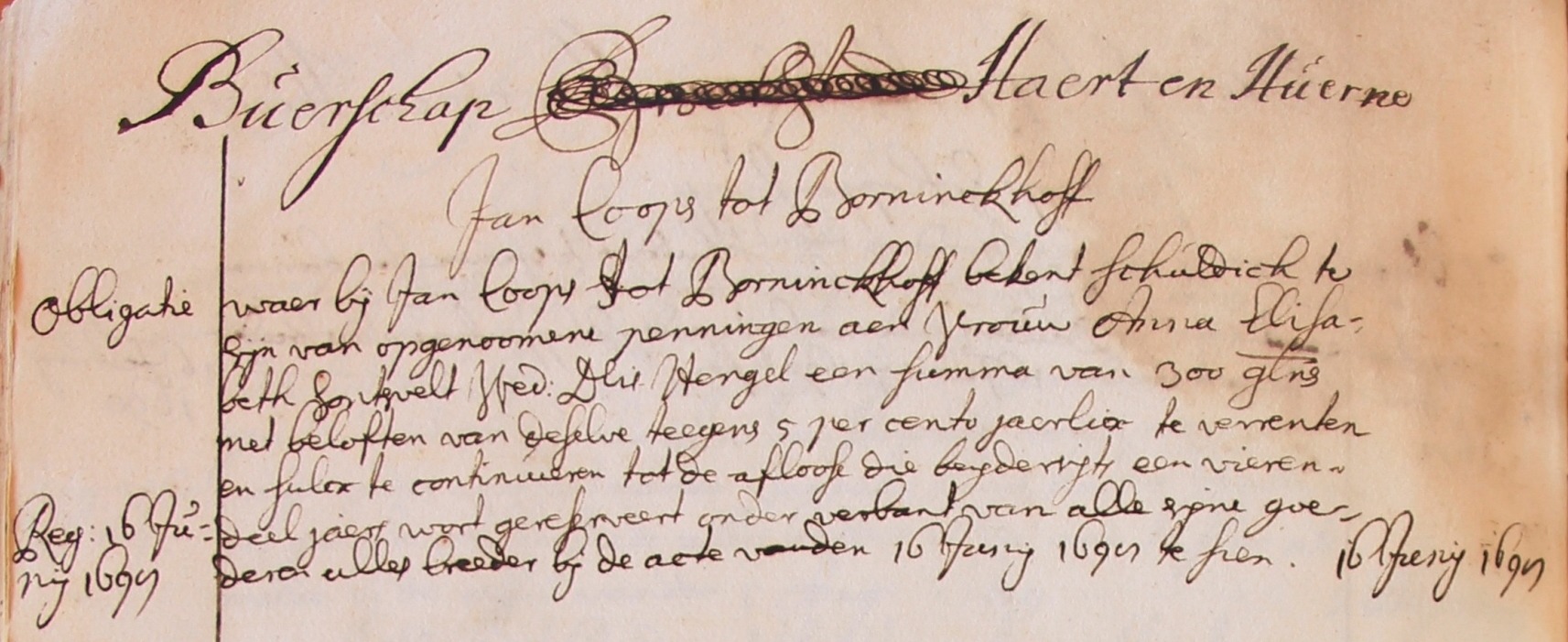
For centuries, some of the farmers in the Lordship of Bredevoort were serfs. This did not mean that they were slaves, but their personal freedom and rights to their farms were subject to the lord’s rules. Many records of this system survive, particularly for Aalten and Winterswijk. The manorial registers show how serfdom affected marriages, inheritance, farms and family relationships.
What was a serf?
Serfdom was an old legal relationship between a lord and people attached to a manor and often to a particular holding. A serf farmer could live on and cultivate a farm for generations, enjoying important rights of use. At the same time, the farmer was not entirely free in dealings with the lord. Certain changes in a person’s life were subject to rules and payments.
Today, the word serf may suggest someone with virtually no rights. That would be an oversimplification. Serf farmers could own property, incur debts, bring legal proceedings and pass their farms down through their families. Their position also varied according to region, manor and period. They were nevertheless subject to a system of longstanding obligations that did not apply to free farmers in the same way.
Two manors for Bredevoort’s serfs
The Lord of Bredevoort held manorial properties chiefly in Aalten and Winterswijk. The serfs in Aalten came under the Hof te Ahave, while the Hof te Miste was the centre for the holdings in Winterswijk. This division is clearly reflected in the surviving manorial registers of the sixteenth and seventeenth centuries.
A manor was more than a single farm: it was also a legal community. At manorial court sessions, representatives of the dependent holdings gathered and changes were recorded. The registers therefore contain long sequences of information about families and farms: who took over a holding, who married, who died, which children acquired rights and who was released from serfdom.
The earlier register shows that these court sessions were a regular part of the year. Serfs were required to attend on the appointed day; for Aalten, the Hof te Ahave and the scholten (manorial officials) of Ahave and Borninkhof are mentioned. Absence without a valid reason could have consequences upon a death or succession. Serfdom was thus not merely a rule on paper, but a system regularly encountered in everyday life.
Farm and family were closely connected
For a farming family, it was important that the holding could continue after an occupant died. Succession to a dependent farm was therefore not regarded solely as a private family matter: the lord had rights in it too. The manorial registers recorded who continued to run the holding and which obligations applied.
The name of a farm could consequently remain important for generations, even when the family living there changed. That makes these registers especially valuable for historical and genealogical research: they can link people to a particular farm at a time when ordinary farmers appeared much less often in other written sources.
Marriage was not always a purely private affair
Serfdom was not tied solely to land. The personal legal status of those involved also mattered. When a serf married someone belonging to another legal jurisdiction, it had to be decided which manor the couple and their children would belong to. Sometimes a person was released from serfdom in order to marry; in other cases a free person entered serfdom.
An illuminating example is Berendeken Hesselingh from the parish of Winterswijk. The convent of Vreden granted her a deed of release on 3 October 1620. Some years later she appears in the Bredevoort manorial register as the wife of Thonis Willinck. At the court session of 1625, it was recorded that she had voluntarily entered the serfdom of the House of Bredevoort from her former free status, while freedom was reserved for one child. Such entries show that serfdom was not an abstract idea: it was directly connected with marriage, family life and inheritance.
Freedom came at a price
In certain circumstances a serf could be released, but a payment might be required. On 27 September 1625, for example, Aeltgien Giesinck received permission to be released from the serfdom of the House of Bredevoort. She had to pay 21 daalders to the steward of the Bredevoort estates. The register thus provides a very tangible example of the financial side of personal freedom.
Release ended the personal bond of serfdom, but did not automatically remove other burdens attached to the land or farm. Old rents, tithes or other property rights could remain in force afterwards.
What obligations did serfs have?
The exact obligations differed from one holding to another and changed over time. Generally, they could include fixed payments, deliveries in kind and services. The lord could also claim rights on marriage, transfer or death. The manorial registers existed to record these rights and changes.
It is important, however, not to treat all farmers in the Lordship of Bredevoort as if they occupied the same position. Not every farmer was a serf, nor did every dependent holding have precisely the same obligations. Alongside serf farmers, the region was home to freeholders, tenants, smallholders and other users of land. Rural society consisted of several distinct legal and economic groups.
Serfdom during the Eighty Years’ War
Entries continued to be made in the manorial registers during the Eighty Years’ War. Even as armies passed through the region and farmers sometimes lost cattle, horses or crops, marriages, inheritances and transfers of farms continued to be recorded. This makes the sources particularly valuable: they show that everyday life and longstanding legal relationships persisted even in unsettled times.
The registers therefore complement accounts of sieges and plundering. They reveal not only what happened to people but also how, despite their circumstances, families sought to keep their farms and family lines going.
From personal dependence to longstanding rights
The meaning of serfdom gradually changed during the seventeenth and eighteenth centuries. Personal dependence increasingly lost its former character, while financial obligations and property rights attached to dependent holdings could survive for longer. The Bredevoort manorial registers and the records of the Nassau Domains Council therefore continued to contain information about serfs and their holdings for a considerable time.
The Batavian period marked a fundamental break with the old system of lordly jurisdiction. In 1798, the lords’ administrative rights were abolished and many feudal legal relationships were also dismantled. This did not, however, mean that every private-law burden on a farm or every old property right disappeared overnight. Questions concerning land, income, compensation and the legal meaning of earlier claims could continue to give rise to disputes.
The manorial registers themselves show principally how the system operated in the sixteenth and seventeenth centuries. Together with later documents of the Nassau Domains Council, they reveal how long old rights concerning people and dependent holdings remained administratively significant. Today, the surviving registers offer an exceptional insight into the lives of farming families in Aalten and Winterswijk.
A source for family and farm history
For Old Aalten, the manorial registers are particularly interesting because they can directly connect people, families and farms. They are especially valuable for the period before the introduction of civil registration, containing information often unavailable elsewhere. By linking these entries to the Historical Network, it may eventually become possible to show which families lived on which farms and how those relationships changed over the centuries.