
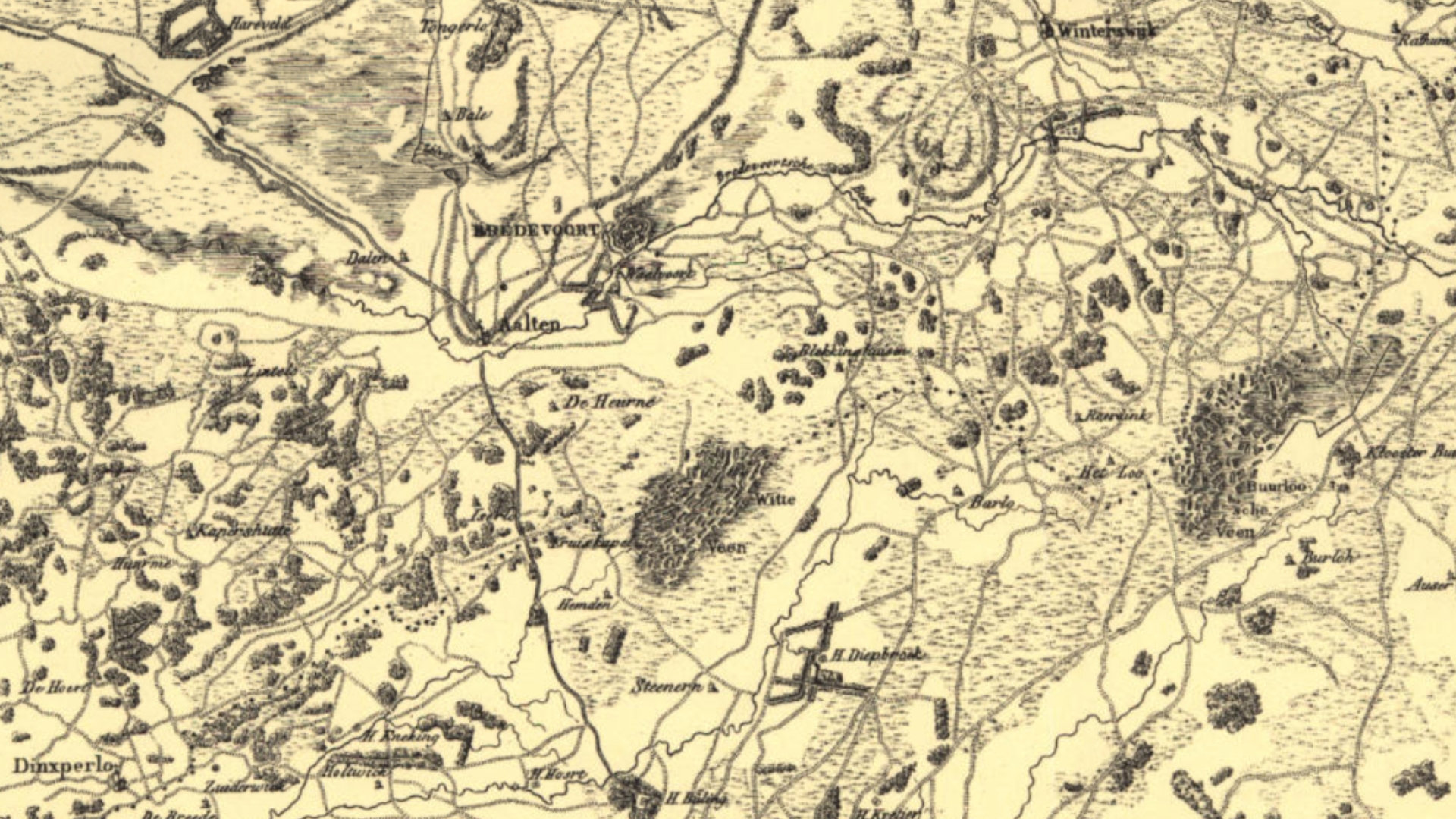
For centuries, the Lordship of Bredevoort formed the administrative territory around Bredevoort, Aalten, Dinxperlo and Winterswijk. Its history began around the medieval castle of Bredevoort and ended only when the old lordly system of government disappeared in the Batavian-French period. Over those centuries, counts, bishops, pledge-holders and princes succeeded one another, while day-to-day government usually lay in the hands of bailiffs, judges and other local officials.
From castle to lordship
The earliest reliable written reference to Bredevoort dates from 1188. A list of possessions mentions a castle at Bredevoort. How old the castle already was by then is unknown. Earlier references that have sometimes been associated with Bredevoort cannot be linked to this place with sufficient certainty.
The castle occupied a strategic position in the border region between Guelders and the Bishopric of Münster. During the thirteenth century it was connected with the Counts of Lohn and the Lords of Steinfurt. In 1238 Herman of Lohn and Ludolf of Steinfurt had the castle strengthened. The political situation remained complicated: several noble families and territorial rulers held rights in parts of the castle and the surrounding area.
In 1278 the castle was destroyed during a conflict with Count Everhard van der Mark. A few years later, a charter still referred to the site of the destroyed castle. It was eventually rebuilt, and Bredevoort remained an important military and administrative position in a region in which both Guelders and Münster sought influence.
A small settlement developed around the castle during the Middle Ages. Borgmannen — men tied to the defence of the castle and town in return for rights and property — occupied a distinctive position within it. In 1388 an official charter referred to Bredevoort as a town; no separate general charter granting town rights has survived.
The struggle for Bredevoort
When the last Count of Lohn died without a direct heir in 1316, the struggle over his inheritance intensified. Guelders and Münster in particular claimed rights in Bredevoort and the surrounding jurisdictions. During the following years the castle repeatedly became the subject of warfare and negotiation.
The conflict was finally settled by the Treaty of Wesel of 28 June 1326. Bredevoort remained in Guelders hands and the Count of Guelders received the jurisdictions of Aalten, Dinxperlo and Winterswijk as a pledge. Legally, this was therefore not an ordinary sale or an outright permanent transfer, but a pledge arrangement.
Münster could recover the pledged rights if the agreed sum was redeemed. That did not happen. In practice, the treaty of 1326 therefore laid the foundation for the Guelders territory around Bredevoort, Aalten, Dinxperlo and Winterswijk that later became known as the Lordship and District of Bredevoort.
A territory in pledge
The ruler of Guelders did not always administer Bredevoort directly either. From the late fourteenth century onwards the territory was repeatedly pledged. A pledge-holder advanced money to the territorial ruler and in return received the revenues and governing rights of an area for a longer period.
On 14 November 1388, William of Jülich, Duke of Guelders, pledged the castle, town and district of Bredevoort to Sir Henry III of Gemen. Two days later the pledge sum was increased. Through inheritance the rights later passed to Bentheim-Steinfurt. Bredevoort nevertheless remained Guelders pledge property: as late as 1520 Duke Charles of Guelders explicitly described it as his pledged possession. In 1526 the territory returned to direct rule by the Duke of Guelders.
In 1534 the Guelders commander Maarten van Rossum took a leading role in the government of Bredevoort; the sources describe him as bailiff and later also as pledge-holder. From about 1545 the outdated fortifications were adapted to warfare with heavy artillery. After his death in 1555, his rights passed through the Van Isendoorn family. On 19 September 1562, the town, castle and district of Bredevoort were pledged for 50,000 guilders to Diederik van Bronckhorst-Batenburg, Lord of Anholt. This marked the beginning of the so-called Anholt pledge.
Bredevoort in the Eighty Years’ War
The Anholt pledge coincided with one of the most turbulent periods in the region’s history. During the Eighty Years’ War, Bredevoort lay in the border zone between States and royalist territories. The town and fortress changed hands several times.
In 1572, Bredevoort was taken by troops of William van den Bergh. Later that same year it returned to the royalist side. In the years that followed, troops repeatedly moved through the District. People in the surrounding countryside in particular suffered from robbery, forced contributions, hostage-taking and billeting.
In 1597, Maurice besieged the fortress of Bredevoort and brought the town under States control. That control was briefly broken once more in 1606, when Spanish troops entered the town. Bredevoort was subsequently recovered by the States, with Frederick Henry playing an important military role. Thereafter the fortress remained a military strongpoint of the Dutch Republic.
For most inhabitants, the war was not primarily a story of famous commanders but of everyday survival. Farmers could lose horses, cattle or grain, inhabitants might be held for ransom and soldiers had to be accommodated in civilian homes. The surviving records make it increasingly possible to reconstruct that experience from the perspective of ordinary households.
The House of Orange as pledge-holders
After years of legal dispute with the Lord of Anholt, the States of Guelders took over the pledge in 1612. On 17 December 1612, the town, castle and district of Bredevoort were then pledged for 50,000 guilders to Count Maurice of Nassau.
From that point onwards Bredevoort remained closely connected with the House of Orange-Nassau. Frederick Henry succeeded Maurice. The pledge was later extended again and eventually came to William III. The Orange princes appointed officials and received income from their rights and possessions in the area.
The connection became still stronger in 1697. The States of Guelders transferred the castle, town, district and lordship of Bredevoort to King-Stadtholder William III in full ownership, in settlement of the 50,000 guilders still owed to him as pledge-holder. This transfer was not the final legal word: in 1709 the States of Guelders resolved to revoke the grant and to repay the pledge sum. In practice, Bredevoort nevertheless remained closely connected with the Nassau domains.
After William III died, a long dispute arose over his inheritance. In the settlement of the Orange inheritance in 1732, Bredevoort eventually passed to William IV. The lordship thereafter remained part of the possessions and administration of the House of Orange-Nassau.
Government from Bredevoort
The lord or pledge-holder usually did not live in Bredevoort. Day-to-day government and justice were therefore carried out by local officials. The most important was the drost or bailiff, who represented the territorial ruler or pledge-holder and had administrative, financial and judicial responsibilities.
Justice was administered by a richter or judge together with assessors known as keurnoten. Court days were held in Bredevoort, Aalten and Winterswijk; cases from Dinxperlo were heard in Aalten. Other officials included a land scribe, fiscal officer, stewards, wardens and deputy wardens. The surviving Old Judicial Archive of Bredevoort preserves many records of this system in practice.
The territory consisted of far more than the town of Bredevoort. The parishes of Aalten, Dinxperlo and Winterswijk each formed local administrative units made up of villages and rural districts. Landed stakeholders, guild and ward masters and other local officers helped organise taxation, poor relief, church property and the execution of government orders.
Farmers and manorial dependency
Some people and farms within the lordship were subject to a form of manorial dependency known locally as hofhorigheid. This meant that special rights and obligations applied, for example, to marriage, death and the transfer of a farm. The Bredevoort court books make these rules unusually tangible: people in Aalten who belonged to the Hof te Ahave had to present themselves at an annual court day.
The reality was more complicated than a simple contrast between ‘free’ and ‘unfree’. Free people could sometimes voluntarily enter a manorial relationship, while agreements could reserve freedom for one of their children. The court books of Aalten and Winterswijk are therefore among the most valuable sources for the history of ordinary farming families in the lordship.
Fortress and garrison
Bredevoort also remained a fortress for centuries. The fortifications were greatly expanded around the middle of the sixteenth century. After 1597 the States authorities modernised them again. Soldiers therefore remained a familiar presence in the town for a long time.
The military presence had two sides. The fortress offered protection, but a garrison also had to be housed and fed. Soldiers needed accommodation and provisions, and their presence affected trade, housing and everyday life within the town.
In 1646, the gunpowder tower disaster struck Bredevoort. Lightning hit the powder tower of the castle and caused a massive explosion. Much of the castle was destroyed and, later historical accounts suggest that approximately forty people died, although the exact number remains uncertain. The old administrative centre was lost. A new administrative building, the Ambthuis, was erected in Landstraat in 1699.
The disaster did not end Bredevoort’s military role. During the Disaster Year of 1672, Münster troops attacked and bombarded the town, which fell into Münster hands in June. The occupation lasted for almost two years; during the night of 26–27 May 1674 the Münster troops evacuated the fortress. The defences were subsequently improved again.
According to later accounts, in 1755 the Council of State decided to decommission Bredevoort’s fortifications and transfer them to civil administration. The original resolution has not yet been checked, however, so its precise legal significance remains uncertain. Walls, gates and bridges then gradually disappeared. An official inspection in 1784 found that much of the old defensive system had already been levelled or demolished.
The end of the lordship
The Batavian Revolution of 1795 ended the old Orange authority. The possessions and rights of the House of Orange-Nassau were confiscated and government was reorganised. The Lordship of Bredevoort thereby lost its old meaning as the personal governmental and property domain of a lord or pledge-holder.
Separate municipalities were established in 1795 for Aalten, Bredevoort, Dinxperlo and Winterswijk. When the old lordships were formally removed from the constitutional system in 1798, these areas were brought together again in the District of Bredevoort. Lichtenvoorde was also added to the district in 1798 and separated from it again in 1802.
Under French rule another administrative reorganisation followed. From 1811, the District of Bredevoort was divided into separate mairies for Aalten, Bredevoort, Dinxperlo and Winterswijk; the administrative winding-up continued into 1812. This ended the common administrative unit whose origins, in changing forms, went back to the medieval concentration of power around Bredevoort.
A history still visible today
The Lordship of Bredevoort no longer exists as an administrative territory, but its history remains visible in many places. The castle site, the surviving traces of the fortifications, the Ambthuis, old farms, court books, judicial records and the boundaries of former parishes all preserve parts of the same story.
Taken together, these sources show that the lordship was far more than a succession of pledge-holders and bailiffs. For centuries it formed the administrative framework within which the inhabitants of Aalten, Bredevoort, Dinxperlo and Winterswijk lived, worked, paid taxes, went to court, inherited farms and tried to survive periods of war.