
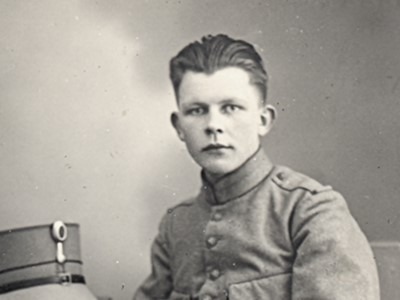
In May 1940, the young soldier Gerrit Herman Meinen from Aalten experienced the horrors of the Battle of the Grebbeberg. This personal account follows his experiences from being called up for military service in 1936, through the chaotic fighting and retreat at the Grebbeberg, to his return home and later life. The story provides the military context, but above all preserves Meinen’s own memories of this turbulent period in Dutch history.
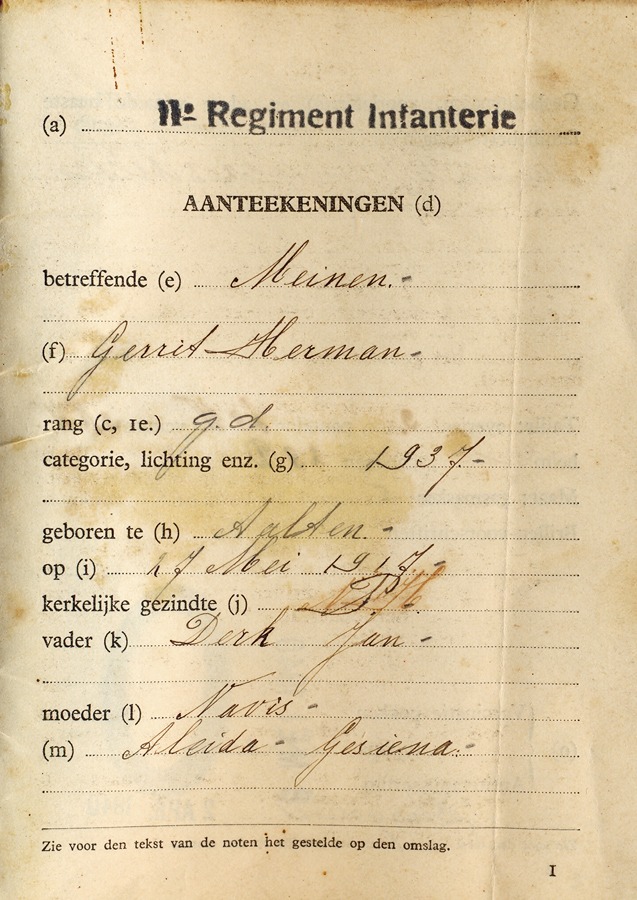
Gerrit Herman Meinen was born on 27 May 1917 at ’t Seins farm in Lintelo. After primary school he attended the lower agricultural school while also working, as the only son, on his father’s farm. It was a mixed farm with pigs, cattle, chickens and a large vegetable garden.
Military service
In September 1936 he was called up for compulsory military service with the 11th Infantry Regiment, nicknamed the zandhazen, at the Prins Hendrik Barracks in Nijmegen. The nineteen-year-old farmer’s son entered service willingly. “I did not regard military service as a punishment and was happy to go,” he would later say.
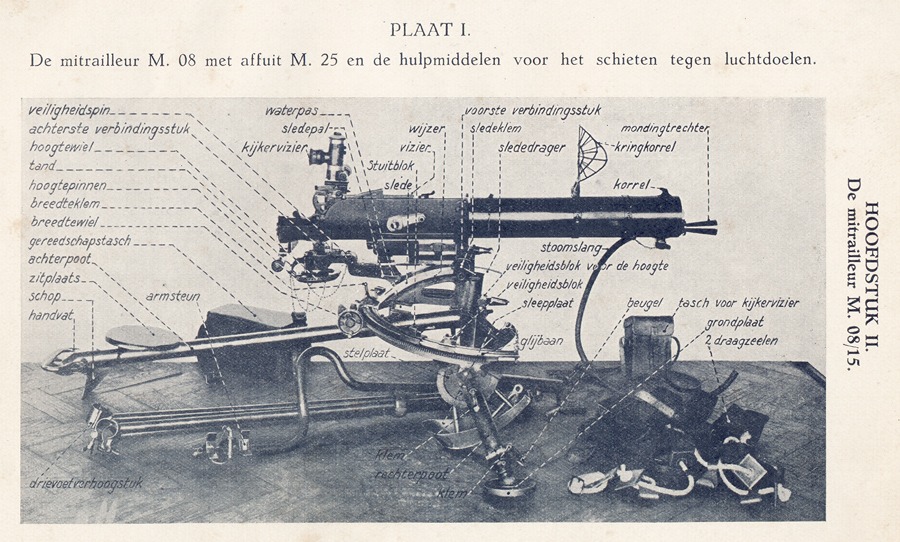
Gerrit completed basic infantry training. Before entering the army, Meinen had fired a light rifle almost every week at a shooting club in Aalten. His marksmanship was soon noticed during training, and he therefore received further instruction on the heavy machine gun, the Schwarzlose Model 08/15. As number two in the machine-gun team, he assisted the gunner and took over when necessary.
The first months consisted of the usual infantry training and exercises. Meinen also took part in the Nijmegen Four Days Marches; that year the event’s flag parade was held at his barracks.
After completing his military service in 1937, Meinen returned to the farm in Lintelo and resumed normal life.
Mobilisation
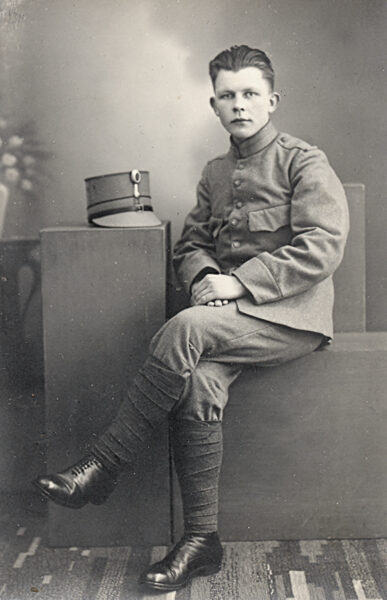
In 1939 the international situation deteriorated and the Netherlands prepared for the possibility of war. Gerrit Meinen was called up again in August 1939, this time for pre-mobilisation. At the end of August, just before general mobilisation, he had to report to Hotel “Neder-Veluwe” in Ede. He was assigned to the 4th section of the Machine-Gun Company of III-11 R.I., the 3rd Battalion of his old regiment.
During pre-mobilisation, Meinen helped prepare for the arrival of the large numbers of conscripts who would be called up under general mobilisation. He arranged accommodation, among other things. He himself was briefly billeted with a host family in Bennekom, a period of about ten days that he later remembered warmly.
General mobilisation followed soon afterwards, and Meinen’s unit was moved to Amerongen, where the men were billeted in a church and on a farm.
His father was by then 57 years old and Meinen was classified as the family breadwinner, which entitled him to agricultural leave. In practice, he only had to be with his unit in Amerongen two days a week; on the other days he was allowed to help on the farm at home. The leave had to be applied for each month and was always granted. He could remember only two occasions on which his leave was suddenly cancelled and he had to return urgently to Amerongen.
For the days on which Meinen could not work at home, his father received compensation of about four guilders a day to hire a farmhand. The man hired was Jan Scholten, known locally as “van de Hutte”, a young man from the neighbourhood.
For the journey home, Meinen took the bus from Amerongen to Rhenen, then the train from Rhenen to Arnhem via Kesteren, changing there for a train to Varsseveld or Aalten. The final part of the journey was made on foot or by bicycle. Meinen therefore spent many hours on trains during the mobilisation period.
The men received a great deal of theoretical instruction. Almost every day the machine guns were taken apart, cleaned and reassembled. They also made many marches through the area, always taking the machine-gun carts with them. These carts were kept in a shed beside their billet and guarded in the evenings and at night.
Meinen later recalled that contact with officers during mobilisation was almost non-existent. They were billeted elsewhere and were rarely seen. His own section commander was Sergeant-Capitulant Herman Huisman from Enschede, an NCO who did visit the group regularly. Huisman was a young man who got on well with the soldiers and liked to chat; Meinen remembered him as “a nice fellow”. The men had pooled money to buy a radio. Meinen also remembered that during training they had been issued two uniforms, but during mobilisation they had only one. Fortunately, it was sometimes possible to exchange an item of clothing with the quartermaster for a better one.
The 11th Infantry Regiment formed the reserve unit of the 4th Division. It could be used, among other things, to relieve troops in the front line or reinforce them when necessary. During mobilisation, Meinen’s unit was billeted in the requisitioned Grote Kerk in Amerongen.
War
On Tuesday 7 May 1940, Meinen was working on the farm in Aalten. Someone from the municipality drove around the town and rural districts announcing that all servicemen had to return to their units as quickly as possible, before nightfall. At that moment Meinen was not thinking at all about the possibility of war, and in that frame of mind he left for Amerongen. Later he sometimes thought: if only I had stayed at home.
During the night of 9 to 10 May 1940, war broke out. At about four in the morning they were woken by noise, searchlights and other activity. There was great uncertainty. The radio the men had bought together provided the answer: the first official broadcasts made clear that the situation was serious. German troops had crossed the Dutch border. The Netherlands was at war with Germany.
During the first two days of war, relatively little initially happened to Meinen’s unit. His section was sent to Leersum and positioned in an avenue beneath tall oak trees to fire at aircraft. The name Broekhuizen Castle still meant something to Meinen, although he no longer remembered the exact details of their assignment. What he did remember was that on the first day of war they fired repeatedly at low-flying German aircraft. Among the young soldiers, one after another claimed: “I hit that one, I hit that one!” The second day of war, 11 May, was comparatively quiet. Afterwards they marched back to Amerongen.
Towards the Grebbeberg
The order soon followed to advance towards the Grebbeberg to relieve or reinforce the troops in the stop line there. On the morning of 12 May, the heavy-machine-gun section moved towards Rhenen, which by then was already burning. They rested near the Koerheuvel, then moved eastwards past Ouwehand Zoo towards the stop line. Their unfamiliarity with the terrain, the gathering darkness and the far from encouraging words of retreating troops they met on the way could lead to only one thing: chaos.
Meinen remembered the machine guns being taken off their carts and set up on their mountings among the trees in woodland south of Heimersteinselaan. The four-man gun crew, including Meinen, lay beside the weapon without further cover. The carts were parked among the trees and the rest of the group was about ten metres behind them. In the darkness almost nothing could be seen, so their firing was limited to several bursts in the direction where they believed the enemy to be.
German breakthrough and retreat
At one point the gun crew was ordered to fire into the trees because Germans were firing from them at the Dutch positions. Meinen fed in the ammunition belt and the gunner fired several times through the treetops. Between bursts, Meinen heard men nearby saying that the fire was on target and that Germans were falling from the trees. After that, events unfolded so quickly that he could no longer fully grasp what was happening.
The retreat past the entrance to Ouwehand Zoo towards the viaduct made an enormous impression on Meinen. Dutch troops positioned west of the railway and viaduct opened heavy fire on Germans who were also advancing. Dutch heavy machine guns swept the road towards Ouwehand Zoo. Darkness and unfamiliarity with the terrain meant that many men ran in all directions in blind panic. Meinen saw soldiers running backwards and forwards and thought how dangerous it was: surely men must have been hit by their own side’s fire.
His section had broken and fled. Crawling through the woods with a few others, Meinen came across a narrow, shallow trench containing telephone wires. Seeking cover, heads down and moving sideways, they crawled through the trench towards the viaduct. “There were only a few of us from our section. You could not lift your head or you would be hit. Bullets were whistling around your ears.” They did not know whether to go left or right. Fortunately they chose the right direction, past Ouwehand and past houses that had been shot to pieces. It was every man for himself. Meinen thought of his parents and the farm: without him, the farm could not survive. He had to go with the others and get away.
Moving against Dutch fire with the Germans behind him, Meinen eventually reached the area beyond the viaduct with a small group, although he could no longer remember exactly how it happened or how long it took. During the retreat he injured his thumb and dressed the wound himself with an emergency bandage.
After the confusion near the stop line, Sergeant-Capitulant Huisman had suddenly disappeared. Meinen remembered the men calling out that “he had gone home long ago”. After his experiences at the Grebbeberg, Meinen never saw or spoke to Huisman again.
Meinen likewise remembered little about the period between reaching the viaduct and being sent home on extended leave. Chaos, exhaustion and above all hunger and thirst are quick to affect memory, something that appears in many accounts and diaries from the fighting. Meinen did remember refusing to have his injured hand treated at a first-aid post because he feared he might then be kept there for observation or recovery. He wanted to get home as quickly as possible. In one of the houses in Rhenen he found some food. Eventually he made his way back to Amerongen. He also remembered the dead soldiers and the large numbers of dead horses lying in different places. As a farmer, he knew how valuable those animals were, which made a great impression on him.
Extended leave
On 25 May 1940, Meinen left for Aalten on extended leave. Until then, his parents had been extremely anxious about his fate. In Arnhem he suddenly encountered his neighbour Bernard van Eerden, known as “van de Weversborg”, in the crowd. Shortly before Meinen reached home, however, his parents received news.
At three in the morning, driver Hendrik Wissink, known as “van de Vosheurne” and later Meinen’s brother-in-law, had arrived at their home with a message from Mayor J.J.G. Boot of Varsseveld that Meinen was unharmed. The relief was so overwhelming for his mother that she fainted. His father was waiting for him when he arrived home, but the emotion and strain of the previous weeks also took their toll on him; he then spent more than a week in bed recovering.
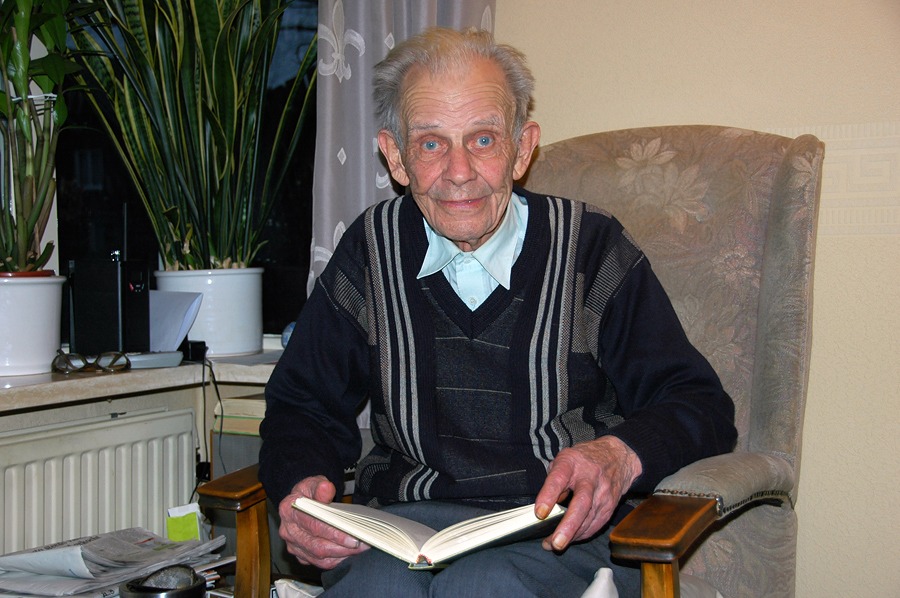
Although Meinen himself said that the days of fighting had left him with no lasting psychological effects, his family recalled one change. Slaughtering animals was a normal part of farm life, but after those days in May he never wanted to kill an animal again. From then on, someone else had to do that job.
Gerrit Herman Meinen died on 3 May 2011 at the age of 93 and is buried at Berkenhove cemetery.
Commemorative column
As part of the seventieth anniversary of liberation, a commemorative column was installed in 2015 at Aalten’s Old General Cemetery in memory of all soldiers from Aalten who fought on and around the Grebbeberg in May 1940. Seven Aalten servicemen lost their lives there. Their names and photographs are preserved on the column.