On 1 January 2005, the administrative map of the Achterhoek changed. The former municipalities of Aalten and Dinxperlo were dissolved and their territories were combined in a newly established municipality of Aalten.
At first sight this may look as if Dinxperlo was simply added to Aalten. Legally, however, the situation was different: both former municipalities ceased to exist. The new municipality was given the name Aalten.
A major municipal reorganisation
The merger formed part of a much wider municipal reorganisation in the Achterhoek, the Graafschap and the Liemers. The relevant Act was adopted on 1 July 2004. Aalten and Dinxperlo were only two of many municipalities in the region that were combined into larger administrative units.
The Act explicitly provided for the dissolution of the former municipalities of Aalten and Dinxperlo and the establishment of a new municipality of Aalten comprising both former municipalities.
Opposition in Dinxperlo
There was considerable opposition to the merger in Dinxperlo. During the reorganisation process, the municipal council had argued for retaining independence. During debate in the Dutch Senate, reference was made to 5,600 signatures from local residents opposing the proposed merger.
One important argument was Dinxperlo’s special position as a border village. It is directly connected with the German village of Suderwick and cooperated closely with the city of Bocholt in several areas. Opponents feared that this cross-border cooperation would receive less attention within a larger municipality.
The Dutch government acknowledged that support in Dinxperlo was limited, but gave greater weight to other considerations, particularly the administrative capacity of the new municipality. According to the government, the merger did not have to hinder cooperation with Suderwick and Bocholt. Aalten had in fact argued during the process that a larger municipality could be a stronger partner in cross-border discussions.
Dinxperlo remained Dinxperlo
The municipal reorganisation did not mean that Dinxperlo disappeared as a village. It remained a distinct centre within the new municipality. De Heurne, which until then had belonged to the municipality of Dinxperlo, also became part of the municipality of Aalten from 2005.
The municipality of Aalten thereby gained an area with its own history, identity and strong orientation towards the national border. The new municipality had to bring together not only two administrative organisations and systems of government, but also take account of differences between the two former municipalities.
A new municipal coat of arms
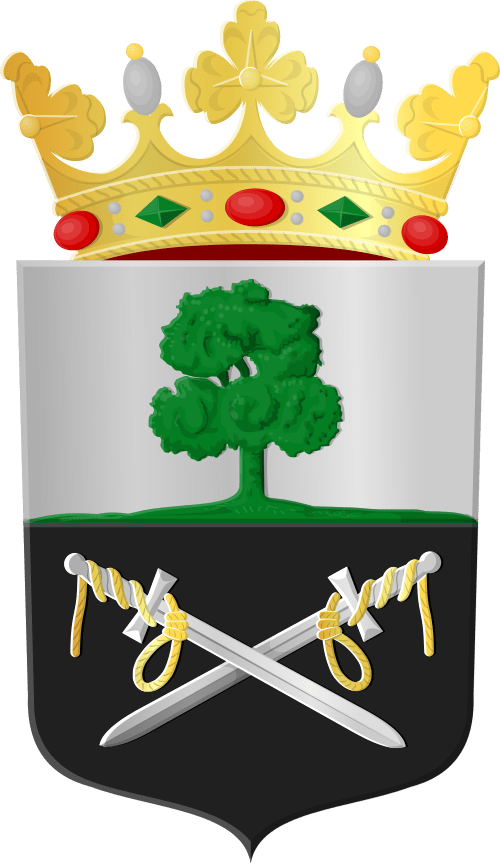
The administrative change later acquired a visible symbol. In 2010 a new municipal coat of arms was adopted, combining elements from both former municipalities: Aalten’s lime tree and the crossed swords from the arms of Dinxperlo.
Five years after the reorganisation, the heraldry therefore also showed that the municipality after 2005 was not simply the same Aalten municipality that had existed before 2005. Read more about Aalten’s coat of arms.
A new administrative chapter
The 2005 reorganisation is therefore a clear endpoint for a historical timeline of the former municipality of Aalten and, at the same time, the beginning of a new administrative chapter. Since 1 January 2005, Aalten, Bredevoort, Dinxperlo, De Heurne and the surrounding rural districts have formed one municipality.
For Old Aalten, the main historical significance is that the administrative framework changed from that date. Events before 2005 must be understood within the boundaries and relationships that applied at the time; from 2005 onwards begins the history of the present-day municipality of Aalten.