In the 1930s, the Rotterdamsch Nieuwsblad published a series of stories featuring a “reporter”, an “artist”, and the artist’s uncle and aunt: a former bailiff named Wolzak and his wife Koosje. The stories show that the Wolzaks lived on Voorstraat in Delfshaven. One day, “Uncle Wolzak” receives word that an unmarried aunt of his has died in Bredevoort. The group then sets off for the Achterhoek to visit a notary in Bredevoort — a place none of them knows — and accept the inheritance without having any idea what it contains.
The ten instalments reproduced below describe this “round-the-world journey” in great detail. Each instalment was accompanied by a fine drawing. Taken as a whole, it is above all a humorous and informative travel account of the south-eastern Achterhoek. The editors of Old Aalten have not yet been able to identify the author. For that reason, among others, we make no claim about how literally true the inheritance story itself may be. It is nevertheless well worth reading.
We Have a Lofty Purpose
We are travelling east in our little Ford in search of the Golden Fleece. Between ourselves, an aunt of Uncle Wolzak’s has died in Bredevoort and he is to inherit everything. A formal letter from a notary brought us this cheerful news.
“She’s dead!” Wolzak exclaimed, visibly moved. “I didn’t even know she was still alive.”
“And how much do you inherit?” Aunt asked.
“Everything,” replied the reporter, who had studied the notarial letter once more.
“Yes, I heard that, idiot. But what is everything?”
“It may be a lot, it may be a little, but in any case it is everything,” said the artist.
“Exactly, Johan. At least you talk sense.”
“In any event, the five of us will go there as soon as possible and find out what’s what in Bredevoort,” Wolzak decided.
“Bredevoort? Where’s that?”
No one knew, except of course the artist.
“Somewhere beyond Zwolle,” he muttered, waving vaguely.
“Give me an atlas and I’ll look it up,” said the reporter. An atlas! He might just as well have asked for a Greek dictionary.
“We haven’t got one. We don’t care where all those places and mountains are that we never go to anyway,” said Aunt.
“Then a railway timetable.”
Yes, there was one. It was last summer’s edition, admittedly, but it could still be used. No, Bredevoort was not in it.
“Not even on the railway!” Aunt cried. “What sort of place can that be? And I don’t much like the sound of that inheritance either. Such a remote little hole.”
“We’ll drive to Zwolle first and ask the way from there,” the artist suggested.
Fortunately, the reporter’s better judgement prevailed. He sensibly borrowed an atlas from the newspaper office, and after a tense quarter of an hour Bredevoort was finally found. It was a long way from Zwolle. So we all decided to motor to the village in the Achterhoek. There was no need to hurry: the notary’s letter had been wrongly addressed to an earlier home of Wolzak’s and had wandered around for quite some time before reaching Voorstraat. We would be too late for the funeral anyway.
“Then I’ll have four new tyres put on the car first,” Wolzak said.
“Four? All four at once?”
“Yes. As an advance on the inheritance. It would be too dangerous to drive that distance on the patched old rags we have now.”
Aunt had no objection.
“As long as we get there quickly. With inheritances you can never be too careful. There may be others after it, and then everything could be gone before we arrive.”
The rest of the evening was most pleasant.
An inheritance in prospect is a delightful subject of conversation. At the very least it is a lottery without blanks, and there is always a chance of a fortune.
“Maybe several fortunes,” said Aunt Koosje. “An unmarried lady in such a small place won’t need much for herself and can spend her whole life saving for respectable heirs like us.”
“Perhaps she lives in a fine old country house. A little castle,” the artist hoped.
“Quite possible. Good heavens, Wolzak, say something yourself. She’s your aunt. What do you know about her? Was she thrifty? Don’t you know any of that? A bailiff like you has yet to be born.”
“We are going to Bredevoort and we shall hear more there,” said Wolzak.
And so we are now on our way to Bredevoort. We had driven without mishap as far as Jutphaas when a tyre burst.
“Good heavens, we’re not even in Utrecht yet and already this happens,” Aunt complained. “If it carries on like this, we’ll be too late for the inheritance.”
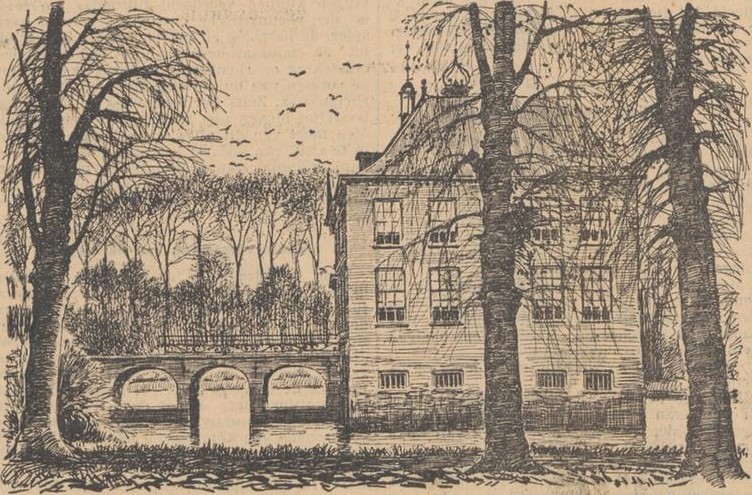
It was the reporter’s turn to change the tyre. In order to ignore him, the rest of the party went for a short walk to an old castle rising a little way off: Rijnhuizen Castle. The astonishingly handy reporter can perform such a job in a few minutes, so he was almost on the bridge of the castle at the same time as the rest of the Bredevoort party.
“My goodness, if your aunt has a house like that over there, you can be more than satisfied,” Aunt decided.
Her awe, and ours, increased once we had crossed the bridge and entered the park. Rijnhuizen is open to the public as a monument, and admission costs only ten cents.
The park is beautifully maintained. The house itself is entirely in the Louis XIV style and dates from the period when people no longer felt it necessary for a castle to look like a fortress. That judgement proved sound, for the present castle has never had to withstand an attack. We heard all this during our walk and were greatly impressed.
Only Aunt objected.
“If we inherit a castle in Bredevoort, we won’t let people in for ten cents,” she said.
That brought us back to reality. We were travelling in pursuit of an inheritance. So we climbed in again and glided farther east, the direction from which wisdom is said to come.
The Wolzaks Have Their ‘Angank’
What a motor journey it had been. Wolzak had allowed himself to be sold second-hand tyres — could such a thing happen to a good bailiff? — so we had spent more time changing tyres than driving and had got no farther than Arnhem on the first day. That was Friday. On Saturday it took us six hours to cover the sixty-five kilometres to Bredevoort, and by then the notary’s office was closed.
We decided to spend Sunday in Winterswijk, which is at least something like a town. It even has a cinema. Aunt was monumentally bad-tempered.
“You’ll see, the inheritance will be gone,” she snapped. “That notary will think you don’t want the money and he’ll have given it to someone else.”
“He can’t do that,” the artist reassured her.
“It’s just like an aunt of Wolzak’s to go and live so far away,” Aunt complained. “You wear out more shoe leather travelling to an inheritance than you gain from it. Why did we have to come at all? A notary can send money by postal order, can’t he?”
“A notary is not allowed to do that,” said Wolzak with legal authority.
“Perhaps there is so much that it won’t fit on one postal order,” the reporter suggested, and Aunt looked a little more cheerful.
Now Wolzak grew irritable.
“You should stop grumbling,” he told his wife. “You should be pleased. You may be about to acquire a castle and several fine estates in perpetual possession. You should keep quiet until we have seen the notary.”
“Oh indeed!” Aunt exploded. “You can stop calling me ‘madam’. I don’t want to be treated as though I’m some lady you have to put under arrest as a bailiff. You should have made sure you kept in proper contact with your aunt. They could put anything into your hands now, because you know nothing about it.”
“You should realise…”
The artist was now angry too.
“Come on, let’s go and look at Winterswijk,” he suggested to the reporter, who readily agreed. We left Uncle, Aunt and little Jonas behind.
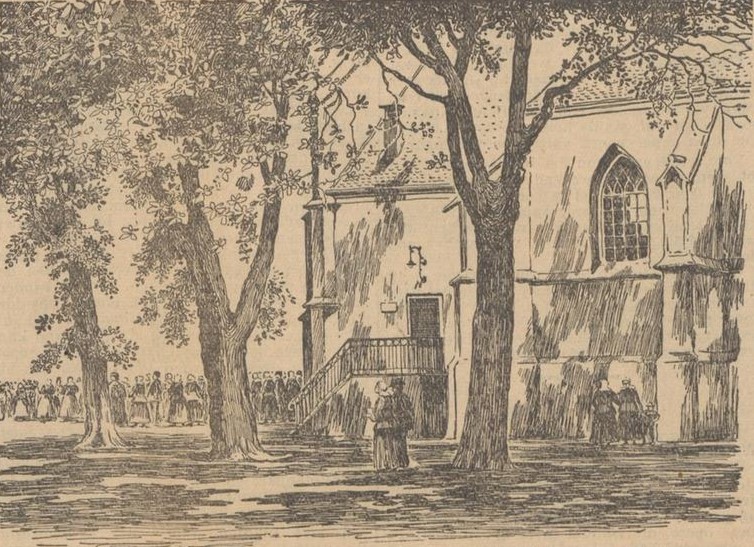
Winterswijk is a very pleasant little town. There is something ancient about it and something half-German as well. But we are not writing guidebooks; we are merely relating historical life experiences. One impression from our Sunday-morning walk stayed with us in particular, and I must tell you about it.
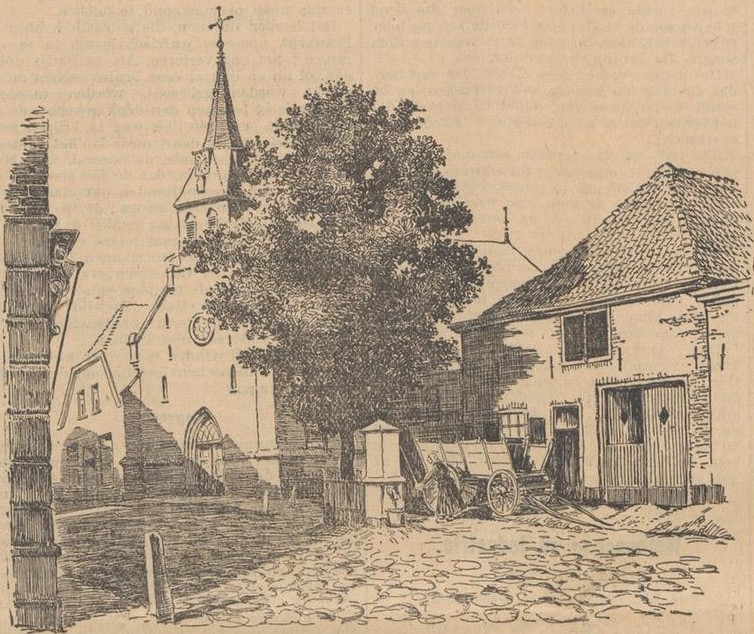
Winterswijk church is among the oldest in the country. From what we heard and later read, its foundation appears to go straight back to the time of Charlemagne. The pagan Duke Widukind, defeated by Charlemagne in 785 and baptised by Abbot Bernard, is said to have provided the land and protected the foundation. He greatly revered Ludger, the first Bishop of Münster and later canonised missionary among the inhabitants of our country. At his request, Saint Ludger is even said to have consecrated a church in Vreden, just across the present German border, built on the site where Widukind’s castle had once stood. The Winterswijk church, until then dedicated to St James, passed to the Reformed congregation at the end of the sixteenth century, in 1597, and has remained so ever since.
The beautiful square, with its old trees and even older church, is pleasantly busy, especially on Sundays. People do not go straight home after church. So many farmers come in from distant hamlets that there are always acquaintances with whom to discuss one thing or another.
In earlier days, farmers who had come from farther away also took home groceries and anything else that could not be bought in their own neighbourhood. During the church service, the horse and cart would be stabled with a blacksmith, carpenter, fertiliser merchant or a family they knew. That place would then become their angank: they left their hymn or prayer book there until the following week and, after church, first drank a little cup of coffee before beginning the journey home.
After conversations with acquaintances or business contacts on the church square, the friendly chat at the angank could easily continue for another half hour. Since this was virtually the only recreation available to farming families in the countryside, many eagerly awaited the Sunday when it was their turn to go to church. A farm could not be left unattended long enough for everyone to go. Those using an angank paid a small annual fee; nowadays it is about six guilders.
Much is changing, however. Sunday-closing laws make trading on Sundays almost impossible, so the pleasant bustle around the shops has disappeared. Cars and bicycles have replaced the old horse-drawn carts, while better roads have shortened distances. Many people therefore go straight home after church. Yet many others still honour the old angank tradition.
Our artist made a charming drawing of this Sunday scene and we returned to the hotel with it. Uncle Wolzak and Aunt Koosje were still “discussing”. The hotelier and his staff stood in the public room listening kindly to their conversation.
“That gentleman seems to have been very naughty,” the chambermaid said to the waiter, and they both shook their heads gravely.
“Not naughty at all! That gentleman has come to collect an inheritance,” the reporter explained.
The artist was indignant.
“You should not stand there listening. My aunt and uncle are merely having their angank. Is that no longer allowed in Winterswijk?”
We Explore Bredevoort
At breakfast in the hotel the next morning, the reporter entertained his attentive audience with the story of Neeltje Pater’s inheritance, which apparently still lay undivided somewhere with a notary: 9,500,000 old pounds, or 114 million good Dutch guilders.
Aunt Koosje smashed her soft-boiled egg so hard that yolk ran over her hands. Licking her fingers, she snapped at Wolzak:
“Why couldn’t Neeltje Pater have been your aunt, Wolzak? With an inheritance like that we’d have been set up for the time being.”
“Perhaps the inheritance from your Bredevoort aunt is just as large?” the reporter suggested.
“Do you think so?” Aunt sang hopefully. Then she became practical again. “Probably not. It doesn’t seem like Wolzak to have such a rich aunt. If it’s a mere hundred thousand we may count ourselves lucky.”
“A hundred thousand is never ‘mere’, and why shouldn’t there be more available in Uncle Wolzak’s family? In a small place like Bredevoort, aunts live frugally. They do nothing but save. If I were you, I’d reckon on a mountain of money — say half of Neeltje Pater’s,” the reporter went on.
“Would you like another nice cup of tea with lots of sugar?” Aunt asked sweetly. The reporter had suddenly risen very high in her estimation.
“Please, Aunt. No sugar and no milk. Just tea.”
So breakfast in Winterswijk that morning was a peaceful affair of eggs and cake, and by the time we climbed into the Ford to go to the notary in Bredevoort we were the best of friends.
“You lot had better wait outside,” Aunt said. “If you all come in, you may make the notary nervous. You’ll hear later how many millions Wolzak has inherited.”
We dropped the loving couple at the notary’s office, parked the Ford somewhere, put little Jonas on a lead and took our first walk through Bredevoort. It was an enjoyable outing. I shall let the artist tell you about it.
Bredevoort calls itself a town. Dutch law knows nothing of the popular terms town, village and hamlet; it speaks only of municipalities. Ancient privileges, however, do give some right to exceptions. This applies to Bredevoort, a small place scarcely known in “Holland” but one which played a very important role in the history of the Netherlands. It lies in a region that belonged alternately to the rulers of Gelre and Münster.
It is easy to understand why fighting repeatedly took place in this disputed area. It was not only the “Town of Bredevoort” but the entire “district” of that name, including Winterswijk, Aalten, Dinxperlo and Varsseveld, which shared to a greater or lesser extent the fate of the fortress. Had final jurisdiction in 1612, after a bitter struggle, passed not to Prince Maurice but to the Münster side, the eastern border of the Netherlands would surely look very different today.
Repeated attacks from both sides forced Bredevoort to remain constantly prepared and so it became a strong fortress. Times have changed greatly since then. Relations with our eastern neighbours have been peaceful for centuries. Bredevoort consequently changed in part. Half the ramparts were demolished and, on the same side, the moats were filled in. Where water once lay, the great Winterswijk–Aalten–Arnhem motor road now curves around the old town. Thanks to this road, some attention is once again being paid to the sleepy old guardian of our eastern frontier — and it deserves that attention.
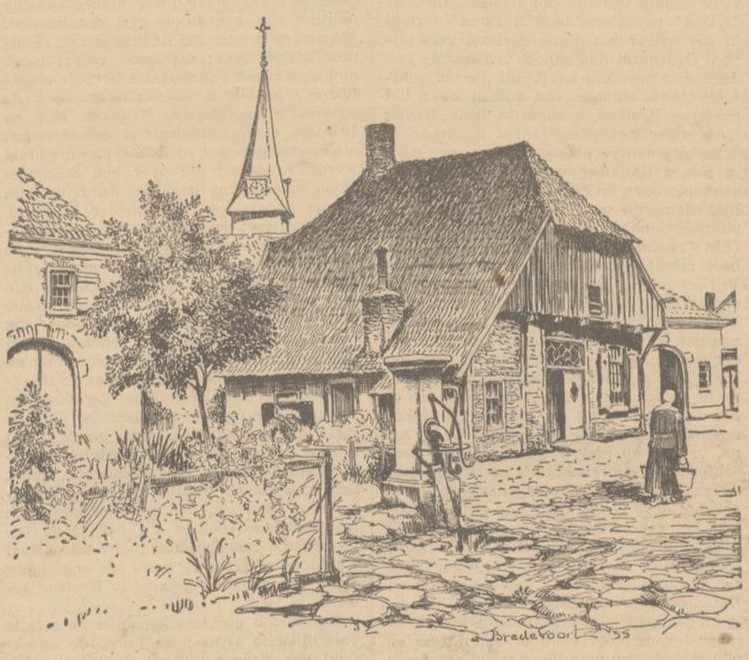
Here and there Bredevoort has preserved the peculiarities of a medieval town. The oldest houses are built in timber framing under strong Saxon influence. The streets are paved with rounded glacial stones, found in great quantities and all sizes in the surrounding area. There is an old pump and a lime tree. And then there is the old little church. Taken together, the place is an idyll: the old German song made real — Am Brunnen vor dem Tore, da steht ein Lindenbaum. Ich träumt’ in seinem Schatten so manchen süssen Traum…
That was as far as our artist got. At that moment Jonas pulled the lead out of my unsuspecting hand and ran as fast as he could towards the notary’s house. He is a sweet, faithful creature. With a few strong words on our lips, we ran after him, very worried about Aunt Koosje’s reaction if her precious pet disappeared.
Then we saw him leap into Aunt’s wide-open arms. She had sat herself down in the middle of the street to receive him. A car skidded dangerously as the driver swerved around her, and we heard a formidable old Dutch curse directed at the head of the lady responsible for this traffic offence.
Aunt took no notice. She kissed Jonas on the nose.
“And… did the inheritance turn out well?” the artist asked, remaining entirely impartial even though he himself is Koosje’s heir.
“A fortune, boy, a fortune! Three hundred thousand, five hundred and sixty guilders, ninety-three and a half cents!” Aunt rejoiced.
“Good heavens, Aunt!” the artist cheered. “That much?”
“Yes, Johan.”
But Wolzak, who had retained from his bailiff days the habit of spoiling every proper moment of joy, raised a warning finger.
“She’s talking nonsense,” he said grimly. “We don’t know anything yet. The notary is out of town…”
The Vehmic Court
With the notary away and us therefore obliged to spend a few days in the Achterhoek, we have every opportunity to appreciate this pleasant romantic countryside at our leisure. We regularly go out in our Ford and interview all sorts of people about Bredevoort customs and other local traditions.
Aunt does not make things easy. She constantly grumbles about the notary’s absence and repeatedly asks whether this is allowed and whether the inheritance can possibly be safe in an empty notary’s house.
And then there are the costs. Four people and a little dog in a guesthouse for so many days soon adds up. We maintain that the inheritance can easily cover it, but Aunt does not agree.
“Wolzak’s aunt didn’t save her whole life until she had a couple of hundred thousand so that two good-for-nothings” — by which she means the artist and me — “could spend all day loafing about on it.”
We let her talk and feel privileged finally to be somewhere other than the Dutch polder country, which we love dearly but are happy not to see for a while. The artist and I are unmarried, but we have heard that in marriage it does no harm if husband and wife occasionally spend a few days out of one another’s way.
“That is immoral talk,” Aunt says. “Wolzak would go pale and thin if he had to miss me for a single day. Isn’t that right, Wolzak?”
Wolzak did not look enthusiastic, though he answered politely, “Certainly, Koosie.”
“He would waste away without me,” Aunt assured us.
We did not disturb Aunt’s tender illusions. Instead, we admired Bredevoort’s attractions with fresh attention and listened to all sorts of historical details. One of the remarkable features of the place where Wolzak’s aunt had lived frugally for many years — hopefully leaving a healthy balance — is the old Vehmic court.
Parallel to the main Aalten–Bredevoort road, which replaced the former Landstraat or Hessenweg, a loose sandy track runs to the south. Deep cart ruts make it almost impassable in wet weather. They add to its picturesque quality but make it unsuitable for modern traffic and certainly for our Ford.
It is not a through road anyway. It is used only by farmers who have rye fields nearby. Heavy oaks stand on either side, and the space between this track and the Landstraat is completely filled by pine woods. A stream called the Koppel crosses the sandy road. In summer it is very low and narrow, but in winter, with all the pretensions of a great river, it sometimes bursts its banks.
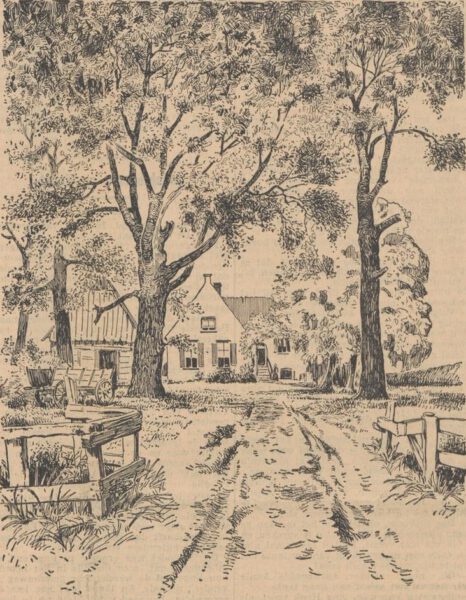
In recent years, the provincial water authorities have been putting a permanent end to the antics of Gelderland’s streams by means of embankments and sluices. Beside the Koppel lies a large piece of land, effectively left open within the pine woods. There we saw and heard alarming things.
Several colossal oaks stand on this ground, certainly four or five hundred years old. There used to be more like them.
“The tooth of time has gnawed at these oaks,” said the artist, with literary expertise, and he was proud of his phrase too.
This, an elderly and respectable resident of Bredevoort told us, was the patch of ground feared for centuries throughout the district. A prisoner brought here and faced by Bredevoort citizens acting as judges could be certain that a death sentence would be pronounced.
Aunt looked very respectful.
“The little farm you can see through the trees is what remains of the once notorious Walfort Castle, seat of the only Vehmic court in the Netherlands.”
Vehmic courts, where a form of summary justice was administered, played a major role in Germany, particularly during the Thirty Years’ War — given in the original account as 1618–1848. The German Vehmic courts were probably modelled on the one at Bredevoort, which was very likely older and had existed for a long time before its official seat was established at Walfort.
Bredevoort had long possessed a strong taste for rapid and final justice; later we heard many more details about this.
“Cases were dealt with here quickly and decisively,” the old Bredevoort man said approvingly.
Aunt, not considering that dividing an inheritance and operating a Vehmic court are rather opposite matters, remarked:
“I hope the notary here is still a real old-fashioned gentleman and doesn’t keep us hanging about before he pays.”
“Aunt, please stop talking about the inheritance for a moment,” the artist begged. “Do go on, sir, and tell us more about the Vehmic court.”
“I don’t care about those stories. That isn’t what we came here for. What do I care what happened here centuries ago? I’m bursting to count what Wolzak’s dear aunt saved up for us.”
The obliging Bredevoort man smiled warmly at Aunt, let her splutter and continued telling us about Bredevoort’s Vehmic courts.
Vehmic Court and Inheritance
“Tell us something about the Vehmic court,” we asked our friendly Bredevoort philosopher.
“Tell me something about the inheritance and about Wolzak’s aunt,” Koosje nagged.
“Let’s at least drink a cup of coffee while we listen,” said the artist. Once we had accepted this sensible proposal and were sitting round a cosy table in a Bredevoort café, Aunt Koosje was willing to listen too.
The origin of the Vehmic court is extremely obscure, our philosopher began. There are naturally no minutes of meetings or records of the sentences pronounced, at least not from the earliest period.
Born from the pressure of the times and as a reaction to the tyrannical rule of the lords to whom the area had been pledged, it met at night. The citizens who formed the court sometimes did not even know one another. They appeared masked. To prevent prisoners from revealing what had happened and where the sessions — or rather meetings — had taken place, the sentence was always death.
“That’s short and decisive,” Aunt said.
The easiest punishment to carry out was hanging.
To show passers-by that a hanging had been ordered by the Vehmic court, its symbol — the so-called wolf hook — was cut with an axe into the tree from which the condemned person hung. All this, our friend continued, seems extremely cruel to us today. But one should not forget that bitterness born of the hardships of the period led people to such measures.
The Vehmic judges directed themselves mainly against discharged soldiers from the many little armies serving the many petty rulers who were constantly fighting one another. These soldiers, respecting neither friend nor foe, roamed the countryside in larger or smaller bands. They stole cattle, chickens and food; also money, which was scarce among farmers of those times, as well as household goods and jewellery. Church treasures attracted them too.
They behaved shamefully towards women and children. Woe betide the farmer on an isolated holding who dared resist. His family might be beaten before his eyes while he was forced to watch, bound. His farm would be set on fire and he himself beaten to death last of all.
Hermann Löns turned the terrible atmosphere of such a court into a novel in Der Wehrwolf.
“It’s just like a serial,” Aunt decided.
The Vehmic court, composed of inhabitants of Bredevoort and Aalten, was later officially established at Walfort, where the judge, free count or president of the court was chosen from the Van Lintelo family.
In 1573 we find Arend van Lintelo in that role. An earlier judge, who was mayor of a small place near Bocholt and whose family name was Duiker, remained notorious in popular memory for his cruelty. Corrupted into the Gelderland dialect, the expression Den Duker zal oe haolen — “the Duiker will come and get you” — survived as a saying referring to that Vehmic judge.
“We had a Mrs Duiker in Voorstraat once,” Aunt said. “And now I hear all this, I’m convinced she was descended from that gentleman. She had a habit…”
“Quiet, Aunt,” the artist begged.
Unfortunately, our storyteller lost the thread, so we rose to leave.
He was going to show us Walfort. The artist made a fine sketch of it. What appears in his masterpiece is part of the old hall, beneath which lies the cellar. We were told there are seven separate vaults there. Formerly these cellars were used to keep prisoners before they were questioned and sentenced. Today, much more peacefully, they contain pots of butter and jugs of milk. One section is used for potatoes. The enormously thick walls keep the cellar completely frost-free.
“Then they’ll eat good potatoes here,” Aunt said.
An entrance that once led to another part of the cellar has been bricked up. All sorts of stories circulate about it. A tunnel is said to have begun there, running beneath the Koppel stream to Bredevoort Castle. There are also stories of people being walled up alive, and much more besides.
“Now we know enough about those horrors, Wolzak. Ask the gentleman about your aunt instead. Whether he knew her and what he thinks she may have left. Why not? If he knows so much about what happened here hundreds of years ago, he’ll surely know everything about your aunt, who has only just died.”
But Wolzak refused. We shook our guide’s hand gratefully and praised him for his splendid story.
“How can you enjoy yourselves,” Aunt reproached us afterwards, “playing at ‘isn’t-that-interesting’ over a few people walled up alive when you’re dying to know about the inheritance?”
“The notary isn’t at home,” Wolzak said for the hundredth time.
“Not at home? If we come for an inheritance, a notary ought to be at home. He should be glad they don’t have those old Vehmic courts here any more…”
A Tailor in Winterswijk
What do you make of the following domestic scene in our Winterswijk hotel?
“Dear Koosje, I fell yesterday and tore my knee. Would you put a few stitches in my trousers?”
“No! I won’t. I already put a plaster on your knee. You can patch the trousers yourself, Wolzak.”
“Two buttons have come off my waistcoat too, dear Koosje.”
“Then go to a tailor, Wolzak.”
“I can’t. If I go to the tailor with torn trousers and a waistcoat missing buttons, he’ll think we’ve been fighting.”
“Then let him think it. You’re the one who would have got hit, not me. You’re always talking about domestic atmosfear…”
“Atmosphere, Aunt!” cried three male voices.
“Same difference. I can’t play tailor. I didn’t bring sewing things to the inheritance aunt. Finished!”
Because the male part of our party thought Uncle Wolzak could not be allowed to go about looking scandalous, we went in search of a tailor. Aunt and Jonas came too. The notary was still away, so we were neglecting nothing serious.
The trip to the tailor turned out to be most interesting, not so much because of the walk itself as because of what we found, after being directed by a man neatly sweeping a Winterswijk street.
The excellent tailor lived on an old deel, the working floor of an old farmhouse in the middle of town. According to old Winterswijk custom, the deel, or rear part of the farmhouse, faces the public road. In fact, all the old farmhouses stand that way; the living rooms are turned away from the street.
This particular deel is especially interesting because old tools are still used there. It is only a “small farm”. The farmer who lives there earns his living as a tailor.
On our travels we had occasionally met a farmer who also shaved customers, but a farmer capable of measuring someone for evening dress was new to us. Perhaps measuring was as far as it went, for whether he could actually make such a suit was another matter. But he certainly was a tailor.
“I make clothes for farmers,” he said.
Uncle Wolzak stuck out his knee and asked whether it could be repaired. The craftsman put on his spectacles.
“Take them off,” he said.
Uncle Wolzak blushed.
“Here, in the middle of the stable?”
“You don’t do that, Wolzak. That’s immoral,” Aunt said, then turned to the tailor-farmer. “Sew it while it’s on his knee.”
“But what if he sews into my knee?” Wolzak protested.
“Then shout ‘ouch’,” Aunt reassured him warmly.
The tailor sat on a three-legged stool, pushed a foot-warmer into place and said — a little irritably, I thought — “Put your leg up here then.” As if the former bailiff were a horse and he a farrier.
While he worked with a very coarse needle and thick thread, the artist and I walked around the deel, asking question after question. The owner answered while he stitched.
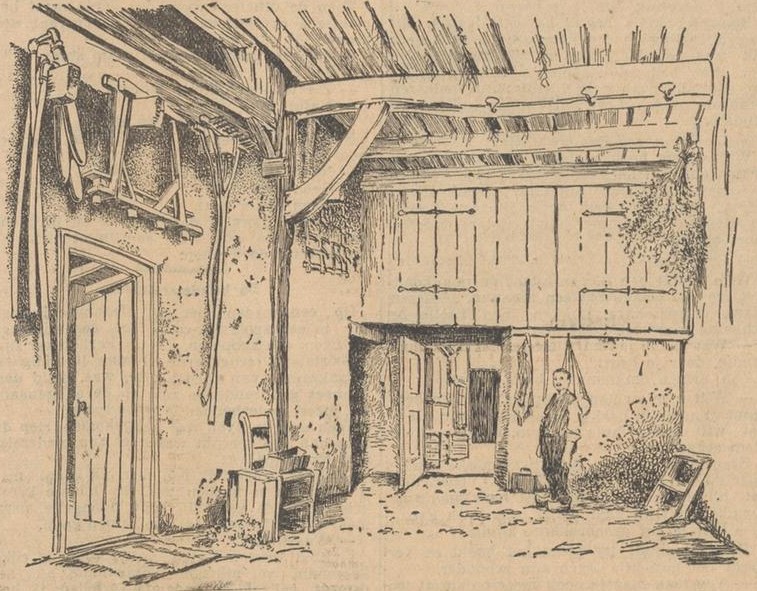
He does little farming, only enough for his own needs. Yet everything gives the impression that farming is the main occupation and tailoring merely secondary. Between the kitchen, which also serves as living room and can be seen through the open doorway at the back of our artist’s drawing, and the little tailor’s room at the front, a dark stable is reached through an opening at the left rear. At most four cows can stand there. In summer they are naturally out in the meadow.
Threshing flails hang at the front wall. Farms of any size no longer use them, because threshing has been mechanised for years.
“You won’t find a single flail in Winterswijk any more,” the tailor said. “Unless they come from outside.”
As he said this, he looked at Aunt in the most impolite fashion.
We discovered two more old-fashioned implements no longer used by larger farmers: a bean planter and a pea planter. Square blocks were used for beans, round ones for peas. The crosspiece at the top was held in both hands and the board with its blocks pressed into the soil, making holes into which beans or peas could be placed. The holes were then filled in and the farmer moved on.
Most people still know what rakes and harrows are, if only from the rebus puzzles once printed on cigar packets.
Above the whole house lies the hayloft, reached through the two large doors at the rear of the deel. Oilseed plants hang from the ceiling to dry before being sown again the following year. In former times an open fire burned in the kitchen beneath a hood, and a corner of the deel was used for storing logs. Today it contains small coal briquettes. Open fires have disappeared almost everywhere.
Modern life is represented here by a coal-fired range.
We discovered all these picturesque details while the farmer-tailor dealt with Uncle Wolzak. Wolzak cried “ouch” at least ten times.
“How terribly sensitive you are,” Aunt complained.
At last the torn trousers were whole again, and Aunt said the work looked very neat. And so cheap: twenty cents.
Uncle Wolzak limped rather badly on the way home. His knee was full of little holes, he said.
Worse still, the tailor had sewn his outer trousers to the red baize trousers beneath, so that the two now formed an inseparable whole. Until we returned to Rotterdam, Uncle Wolzak was therefore obliged to take both pairs off at the same time. He found this awkward and distressing and usually needed help from our respected artist.
A Motor Trip in the Fog
“The notary will be home tomorrow and can then receive the heirs of the widow Jacobine Cats.”
Uncle Wolzak brought this message back before coffee, so we once again had a free afternoon.
“Let’s go for a drive then. Sitting around here makes you dull,” said Aunt Koosje, and her suggestion met with general approval.
It was fine, spring-like weather. We had our Ford with us and we were in beautiful, romantic country where every walk or drive promised new and fascinating discoveries. We expressed our admiration constantly.
“I’m getting tired of all your chatter,” Aunt said crossly.
Our artist was at the wheel and repeatedly braked without warning whenever he saw something beautiful.
“If you are determined to send my head through the windscreen, just keep doing that,” I complained.
“Man, be grateful I didn’t drive past this,” the artist replied. “Look at this. I’m going to draw it.”
It was the farmhouse at Walfort. It is indeed remarkable that the farm, standing at the edge of the Walfort woods, has survived more than three hundred years of turbulent and difficult times.
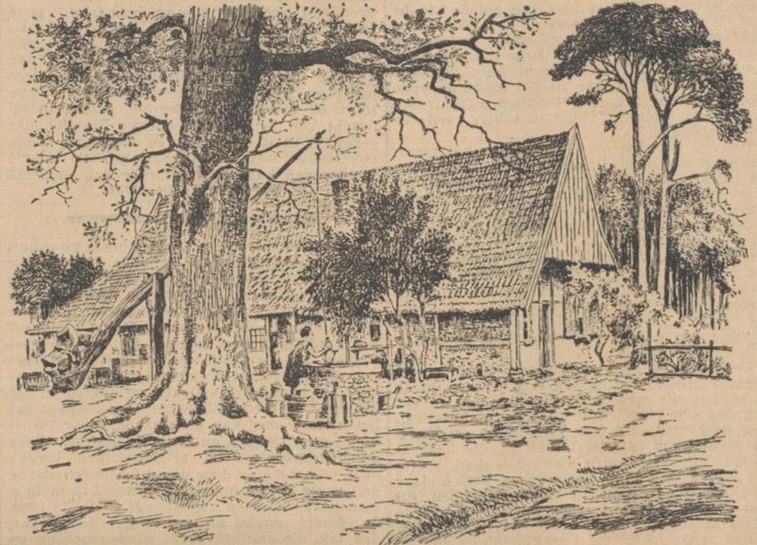
The great oak, the last — or if you prefer the first — tree of the avenue leading past Walfort has, like the farmhouse, seen a great deal. How many soldiers from Münster and Gelre, States troops and Spanish cavalrymen must have ridden along this avenue? How many condemned men from the Vehmic court hung from its branches?
How many times did men creep past these old trees to attack the fortress of Bredevoort, and how many wrongdoers were dragged away to be hoisted up? Yes, this is romantic country indeed.
The history of the Achterhoek is still far from complete. Mountains of documents containing fascinating stories remain to be examined in old archives. Above all, how much can still be learnt from the language spoken by monuments that have survived every disaster?
There may be a great deal. The sources from which the history of the western Netherlands has largely been drawn are well known, but eastern Netherlands still offers many possibilities. Like the region itself, they remain unknown territory to most people from “Holland”, the artist declared.
New roads, however, will soon open the landscape’s beauties to tourists as well.
“You’d better watch the road instead of admiring the beauties,” Aunt said. “Show us you’re a proper driver and get a move on.”
This appealed to a different form of the artist’s vanity. He wanted to show that he could drive, and I must say our Ford performed very well. It glided quickly and flawlessly over Gelderland’s fine roads.
We drove past Aalten and Varsseveld, Slangenburg Castle, Doetinchem, Laag-Keppel, Doesburg, Ellecom, along the Middachterallee, through De Steeg and Velp towards Arnhem. We thought it magnificent. Even Aunt fell silent.
Only occasionally, when a particularly beautiful country house became visible beyond a rolling lawn, would she sigh:
“Wolzak, I do hope your aunt had a little place like that in her estate…”
The artist and I decided to be generous and treated the Wolzaks and ourselves to a substantial lunch at a dairy restaurant on Velperplein.
“We’ll drive home via Zutphen, Deventer, Lochem and Ruurlo,” our driver suggested. We agreed. It would let us admire another beautiful stretch of the eastern Netherlands.
Yes, ours is a beautiful country, one to love and be glad to have been born in. We looked left and right, ahead and sometimes behind, but did not say too much for fear of distracting our driver.
The artist needed to keep his attention on the road so that the five of us would not break our necks.
“How do you think I’m driving?” he kept asking, and each time we praised him enthusiastically.
When we left Zutphen, however, something unpleasant happened. A wet mist, milky-white and soft, began to sink across the road and rapidly thickened.
“Johan, watch out! It’s foggy!” Aunt cried, quite unnecessarily, because watching was now all Johan did.
“Let me sit beside you,” she said a little later, an unkind remark to me, since I was already sitting beside the artist, peering ahead with all the eyes I possessed.
The fog became thicker. Our Ford was now doing barely ten kilometres an hour and I was working the horn diligently.
“You can’t see a thing, Johan. How are you driving at all?” Aunt asked.
“I’m following the rails. Leave it to me. Nothing can happen to us on the rails. There are no trees on the rails and no river runs across them.”
That was very clever of our artist. The safe road, clearly marked by two gleaming rails, lay before us despite the fog. Without a care we let ourselves glide towards Deventer.
“Stop!”
Suddenly we could go no farther. A tramcar stood in front of us.
We would simply wait until the way was clear.
“Johan, there’s another tram behind us,” Aunt said after a while. “You will make sure we don’t get crushed, won’t you?”
“Of course,” the artist replied irritably.
Several more minutes passed.
“Something must have happened on the road,” Uncle Wolzak suggested.
“An accident, naturally. We’d better wait quietly.”
I looked through the side window.
“Hey, look — there’s another tramcar on the left.”
“Left? You mean right,” Uncle Wolzak said.
“No, left. But you’re right — there’s one on the right too. Well, then the road really must be blocked.”
We stood there for a quarter of an hour, then twenty minutes.
“I’m going to have a look,” said the bravest man aboard the Ford, and the reporter jumped fearlessly out.
Two minutes later he returned.
“Well, this is something,” he cried. “We’re standing in the tram depot!”
Timber Construction and Breakfast
At ten in the morning the notary would be available. After breakfast, Uncle and Aunt Wolzak were to pay His Honour a visit — the former bailiff called it “an official visit” — and at last find out what Uncle’s aunt had actually left him.
We therefore enjoyed breakfast with greater spiritual joy than on other mornings. A Dutch hotel breakfast is never a small affair; ours could have fed ten cats.
The table was covered with every imaginable sort of slightly stale bread: rolls, split rolls, white bread, semi-white, brown, currant bread and rye. There were many well-filled butter dishes with neat ridges pressed into the butter; plates of ham, smoked beef, sausages and eel; pots of syrup, jam, aniseed sprinkles and chocolate sprinkles; eggs; a covered dish containing a quarter of a cheese; a plate of sliced Leiden cheese; gingerbread; a little tower of green sheep’s cheese; jugs of milk; pots of tea and coffee; and carafes of water with glasses. And even that is not the complete inventory.
What sort of simple Dutch stomach do provincial hotelkeepers imagine?
“Commercial travellers in this country are fortunately healthy people,” the Winterswijk waiter told us. “They start the day with a solid meal. Business goes more smoothly that way.”
“Then I’m a commercial traveller too,” Aunt said, and she took full advantage. She did so every morning, in fact.
“Are there any more eggs?” she asked her lord and master.
“You’ve already had so many. If you eat even more, you’ll have trouble at the notary’s,” the ex-bailiff warned.
“Leave that to me,” Aunt said as she buttered her third roll. At the same time she looked contemptuously at the reporter’s thin slice of bread with a soft-boiled egg.
“That’s not eating. That’s nibbling,” she said.
“And what you’re doing is stuffing yourself,” came the reply.
That morning, she certainly did. Wolzak ate with relish, the artist sampled everything, the reporter nibbled, and all four were in excellent spirits. The inheritance was finally drawing near.
The artist also had a drawing of which he was enormously proud, and he passed it around over the jam, butter and chocolate sprinkles.
“Have you ever seen such beautiful timber construction?” he exclaimed.
Aunt glanced at it and ordered Wolzak to pass her the head cheese. We looked with interest and listened to the artist’s lecture.
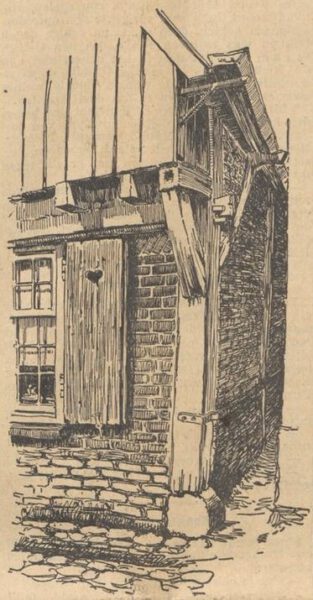
“Almost all old houses in Bredevoort are still built according to the Saxon-medieval method, using timber framing,” he explained. “The timber frame consists of a wooden skeleton. The supporting posts at the corners and wherever else needed do not stand in the soil — where they would rot — but on dressed or undressed glacial boulders, found in abundance and all sizes in the Gelderland Achterhoek.
“The heavy beams are joined by tenons passing into holes in the posts. These great beams, sometimes called mother beams, support the smaller child beams by means of notches. The smaller beams carry the ceilings and floors.”
“Johan, stop. I’m not a carpenter. What do I care about those beams?” Aunt cried. “Wolzak, pass me the pickled eel.”
“No, go on. I find it very interesting,” the reporter assured him, and the artist continued.
“The drawing shows very clearly how the different pieces of wood are stacked in a purely structural way and how rationally they support one another. In our age, which prides itself so much on the rationalisation of architecture, we could still learn from constructions worked out with such logic.”
“Good heavens, Johan, you’re ruining my appetite,” Aunt cried. “Wolzak, are there any eggs left? No? Then pass the roast beef, with the mustard and pepper.”
Pointing at his drawing, the artist explained further details.
“Once the wooden skeleton was complete, the spaces between the timbers were filled with brickwork. Every horizontal joint ends at the woodwork against a pair of iron or sometimes oak pegs that prevent the masonry from shifting. The upper courses were not laid horizontally but wedged diagonally against the underside of the upper beam.”
“Pass me a currant roll, with sweet-milk cheese. They always eat that in Friesland, and they know what they’re doing there.”
The artist remained admirably professorial.
“Some panels in the oldest houses, a few of which date from the fifteenth or sixteenth century, still contain a different type of infill. In origin it is closely related to the modern method of applying cement to mesh.”
“Wolzak, I could still manage half a roll with black pudding,” Aunt remarked.
“The old houses of Bredevoort,” the artist continued, “are all separated by a fire gap of thirty to fifty centimetres. Shared walls were unknown. The fact that some timber structures remain sound after more than four hundred years says a great deal for the strength of the method. Here and there, however, ironwork had to be added to prevent collapse.”
“One more rusk with chocolate sprinkles or jam, and then we’re going to the notary,” Aunt concluded, ending the artist’s gripping lecture on Bredevoort timber construction.
Closer to the Goal
“If you would come into the waiting room,” said the clerk at the notary’s office in Bredevoort, and Uncle and Aunt Wolzak walked solemnly into the indicated room. The reporter and artist followed.
“Are you members of the family too?” the clerk asked.
“Absolutely,” the artist replied.
Besides the four of us, about ten people were waiting. The notary had been away, so business had piled up.
“Do you think all those people have come for the inheritance?” Aunt asked anxiously.
“Impossible. I am the sole heir,” Wolzak said proudly.
“Then what are they all doing here at the same time as us? I don’t trust it. Wolzak, you read everything carefully before you sign anything, do you hear?”
“And count the money properly,” the reporter advised.
“You do not have to teach an old bailiff to sit up and beg,” Wolzak said.
“Why don’t we go in with you?” the reporter suggested. He could smell a story.
“No spectators. Wolzak and I with the notary, and no one else.”
We therefore sat in the waiting room with no duties and could calmly inspect the notary’s clientele, who had come about mortgages, wills, purchases and sales, advances and repayments. They examined one another, and us, with suspicious eyes.
The four of us in particular seemed to arouse suspicion. I noticed that several Bredevoort gentlemen, after looking at the artist, immediately felt inside their jackets to check whether their wallets were still there.
I warmly asked one of the local worthies whether he too had come about an inheritance.
“Young man, you should never ask questions about matters that do not concern you,” he replied at once.
“There you are!” Aunt laughed, and the whole room briefly took an interest in the reporter.
But he was not discouraged.
“How are the calves and piglets?” he asked another client.
“If by that you mean my pupils, your question is highly improper, young man. I am a schoolteacher.”
Once again Aunt Koosje was delighted.
“Forgive me. I took you for a cattle farmer,” the reporter apologised.
“No one has ever said that to me before. I shall refrain from telling you what you look like,” came the sharp reply.
At least things were becoming lively.
“What do you think of Abyssinia and the Negus?” the reporter asked the lady beside him.
She gave him a look so contemptuous and insulting that it startled him.
“I do not concern myself with matters that are none of my business, young man.”
The artist comforted his colleague.
“Never try to make ordinary conversation in a notary’s waiting room. People are not normal there. It’s like the dentist’s waiting room when you can hear a patient screaming through the wall and teeth cracking as they are pulled.”
“Let’s go and look around Bredevoort again,” I suggested. “Aunt can manage on her own. No notary can stand up to her.”
“It’s a weight off my heart that he’s finally pulling that nail out of my coffin,” Aunt said.
We wished the entire company “good luck, then” and wandered into the beautiful town.
It is remarkable: in Bredevoort you continually discover something new and unusual. The artist put it professorially:
“Observe how the whole situation breathes the spirit of the late Middle Ages and the Renaissance. Highly picturesque, it continually delights the eye because the harmony of the little streets and squares is never disturbed by modern buildings that would be out of place here.”
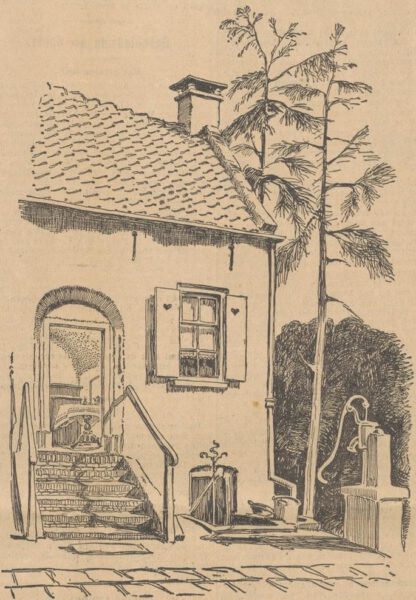
As he spoke, he took out his sketchbook and lovingly drew the little scene shown with the article. The graceful and remarkably attractive house is called the Vischmarkt. There was no fish in sight, but “that’s simply what it is called”, someone told us.
The name dates from the period when Bredevoort, as a fortress, lay amid extensive marshes. The present main road, which now curves around the town, then ran straight through it as the Landstraat, or Landstraote in Achterhoek dialect. Two gates, the Winterswijk Gate and the Aalten Gate, closed off the difficult-to-conquer fortress.
The marshes surrounding the town, including the extensive Swanenbroek, have since been drained, and the fishing waters have disappeared with them. The Vischmarkt therefore survives in name only. The old sandy Landstraote is now a good road for bicycles and cars through reclaimed land where large rye fields and substantial farms testify to the region’s present prosperity.
Every walk through Bredevoort taught us something new, and we were sorry that we would probably soon have to return to Holland. By now, however, the inheritance business seemed finally to be nearing its end.
Three hours later we walked back to the notary’s house and paced up and down until at last the door opened and the Wolzak couple appeared.
I have never been so shocked. Aunt’s hat was crooked. Her coat hung open. Jonas lay in her trembling arms with his tail rather than his head pointing forwards. Wolzak himself was the colour of a faded beetroot. His few hairs, normally treated with such care, stood on his bald head like reeds after a storm, and his lips trembled.
“Have you been fighting with the notary?” the reporter asked.
“Are you that happy? Was it that much?” the artist cried.
One hoarse answer rasped from two mouths at once:
“Into the Ford. Quickly. Home!”
At Last, the Inheritance
Mr and Mrs Wolzak were deeply offended and disappointed.
“Did we really have to travel this far, nearly bumping our noses against Germany, for that?” Aunt complained.
“But Aunt, we have seen such magnificent things in this region,” our artist exclaimed. “There is nowhere like it between the Dollard and the Scheldt. Look at what I drew only yesterday in Dinxperlo, right by the border, not ten metres from it — a Saxon farmhouse more than three centuries old. It looks nothing like a Dutch farmhouse, does it, Aunt?
“Haystacks standing separately from the farmhouse, as on farms in Holland, are unknown here. Nor is as much hay needed as in Holland. Pure cattle farmers hardly exist at all in the Gelderland Achterhoek.”
“I couldn’t care less,” Aunt snapped.
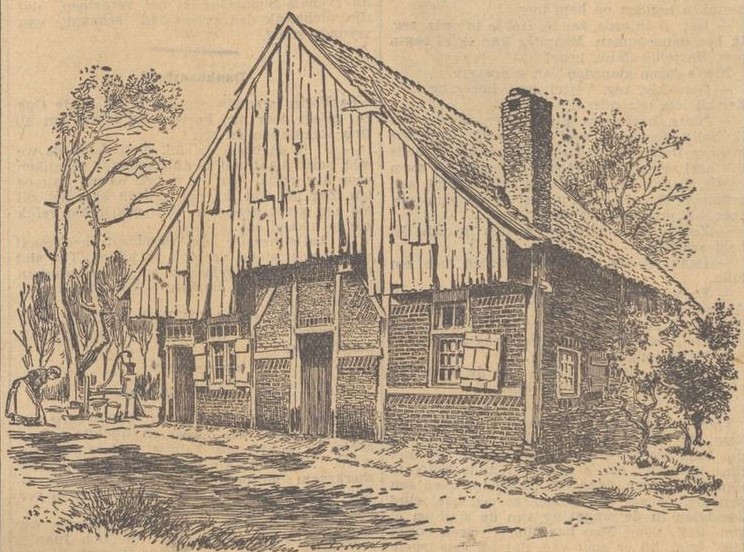
“Farming here is mixed,” our artist continued undisturbed. “Arable farming, horticulture and livestock. For the few cows a farmer must keep to provide manure for the poor soil, the large loft is big enough to store the hay. The rye harvest also has to go into the loft, because threshing is winter work.
“The living quarters in this old house are very small, as you can see, Aunt. Only the part at the farthest corner of the drawing. The door in the middle leads to the deel, where stalls for cows run behind the living room, separated from it by a wall, right to the back of the house. The deel itself also continues to the rear wall.
“The little side window on the right belongs to the wevekaomer, the weaving room. That was where the farmer’s loom once stood.
“In former times, farmers grew their own flax for linen. The women spun the yarn and the men wove it into linen for everyday use. Weaving and spinning, like threshing, were winter jobs. You can imagine how strong that home-woven linen was, Aunt.
“The weaving rooms that still survive now have completely different uses. Since factories began distributing textiles throughout the world, weaving and spinning at home have disappeared.
“Behind the weaving room are rooms for storing flour and preparing dough. Baking was not done in the house. A separate little bakehouse stood outside. Bread was baked at most once a week. The bakehouse belonging to the farm at Boesveld has disappeared. Isn’t all that interesting, Aunt?”
“It doesn’t interest me at all,” Aunt cried. “What a place this is. The sooner I’m out of it, the better.”
“And the inheritance, Aunt? How large is the inheritance?” the artist asked urgently. After all, he is Aunt Koosje’s closest heir.
“Don’t start celebrating too soon, Johan,” Aunt said.
The reporter turned to the former bailiff.
“Do tell us what you inherited, Uncle Wolzak.”
Aunt’s husband blew his nose with great emotion and then recited the famous lines of his very distant great-uncle Jacob Cats:
Who trusts an inheritance in advance
Builds, truly, on a bed of sand;
He dreams of riches, gold and gain,
And later finds there’s next to naught.
Or words to roughly that effect, if I remember correctly.
“How much?” the artist asked hoarsely.
The answer came in a sombre notarial tone:
“One hundred and seventy guilders, two and a half cents, together with an old child’s cot.”
We stared at one another in horror. Could this really be called an inheritance? ƒ170.02½ and a cot.
We fell silent and climbed into the Ford. In melancholy mood we drove home. Better not to describe the rest. It was a miserable journey.
Only one document need be submitted as evidence: the account Uncle Wolzak drew up at the end of the journey with the sworn precision of an accountant, setting out the costs of our trip to Bredevoort:
| Refreshments on the journey | ƒ 0.50 |
| Aspirin, plaster and laxative pills | ƒ 1.50 |
| One fine | ƒ 2.50 |
| 40 litres of petrol at 11 cents | ƒ 4.40 |
| Four new tyres | ƒ 100 |
| Toll at Bodegraven | ƒ 0.10 |
| 2 litres of oil | ƒ 1.50 |
| One chicken run over | ƒ 2.15 |
| Lodgings for four people and a little dog | ƒ 56.95 |
| Extra tips | ƒ 0.42½ |
| Total | ƒ 170.02½ |
And so, for the sake of an old child’s cot, we travelled all the way to the German border.