
The Reformation reached Aalten at the end of the sixteenth century. The capture of Bredevoort by Prince Maurice on 8 October 1597 was an important turning point, but the transition from the old Catholic parish to a Reformed congregation did not happen overnight. In the years that followed, both church government and the use of the Old St Helen’s Church changed.
The medieval parish
Aalten was already an independent parish in the Middle Ages. The church on Markt was dedicated to St Helena. For centuries the parish belonged to the Diocese of Münster. Following the ecclesiastical reorganisation of the Netherlands in 1559–1561, however, Aalten became part of the newly established Diocese of Deventer.
Catholic religious life was rich and varied. The well-known Aalten Stations of the Cross, made around 1530, date from this period. Their original location is not known with certainty.
1597: Bredevoort captured
Bredevoort was the administrative centre of the lordship to which Aalten belonged. When Prince Maurice captured the fortress in 1597, the area came under States military control. The seigneurial rights were not yet finally settled: Gertrud von Milendonck regained the lordship in 1602, and the Anholt pledge was not redeemed by the States of Gelderland until 1612. The capture of 1597 did, however, give the Reformed Church in the region room to organise itself.
During these years the church in Aalten was served by Father Theunissen from Bocholt. Local tradition holds that he resisted the Reformation and eventually left for Burlo Abbey or Rhede. Other historical sources show that clergy from Aalten were involved by the Classis of Zutphen in the transition to the Reformed Church in the years after 1597. The precise course of events surrounding Theunissen therefore cannot be established with certainty in every respect.
In 1598, clergy from Aalten and other places were summoned to a classical meeting in Zutphen. They were expected to conform to the Reformed church order. In 1602, the former Aalten chaplain Anthonius van Keppel is mentioned as the first minister of the new Reformed congregation. In 1603, representatives from Aalten, Winterswijk and Zeddam declared themselves willing to accept the conditions that had been set. In 1633, Aalten received its own church council.
The Old St Helen’s Church becomes Reformed
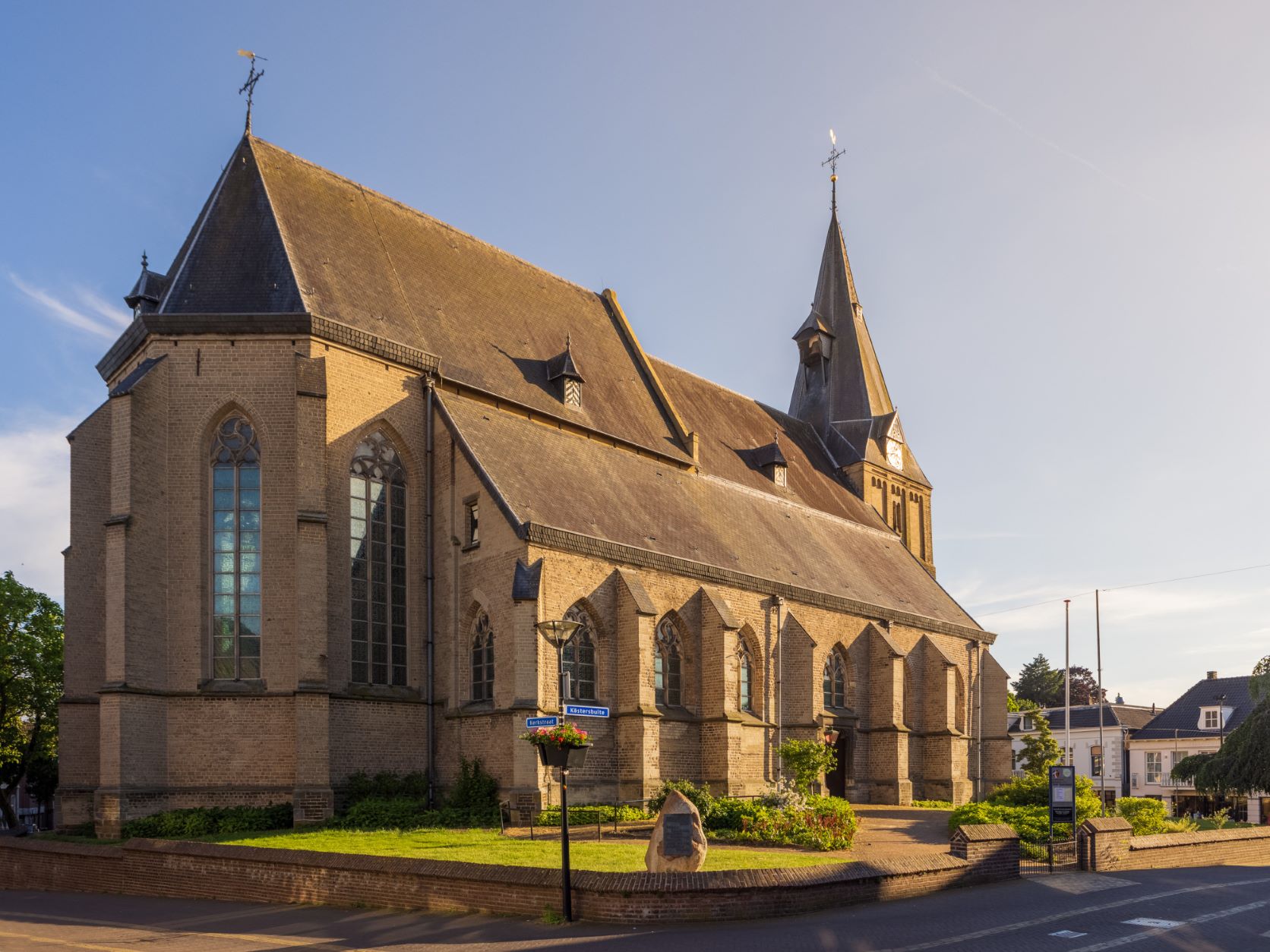
After the Reformation, the Old St Helen’s Church came into use by the Reformed congregation. Many objects and practices associated with Catholic worship disappeared from the church. The stone Stations of the Cross probably also disappeared from public religious life during this period. They were rediscovered only in the nineteenth century and are now held by Museum Catharijneconvent in Utrecht.
The Reformed congregation that emerged in the seventeenth century was the forerunner of the later Dutch Reformed congregation of Aalten. The name Dutch Reformed Church itself dates only from the nineteenth century.
Catholics across the border
The Roman Catholic population did not disappear from Aalten as a result of the Reformation, but for a long time it had no public church building of its own. Catholics attended Mass at chapels just across the border in the Diocese of Münster, among other places. One well-known destination was the Cross Chapel near Hemden, which was visited from the seventeenth century onwards by Catholics from Aalten and Bredevoort.
The situation changed temporarily during the Münster occupation of 1672–1674. For a short time the Old St Helen’s Church returned to Catholic hands; initially it was used jointly. After the Münster troops withdrew at Whitsun 1674, the building was again used by the Reformed congregation.
Catholic worship returns to Aalten
At the end of the eighteenth century, Catholics gained greater freedom to practise their faith openly. By the end of that century, Catholic services were once again being held in Aalten. In 1800, a barn on Kerkstraat was converted into a church beside a presbytery. Catholics in Aalten no longer had to cross the border for every church service.
The barn church remained in use for almost sixty years. In 1859, a larger Roman Catholic church was built on Dijkstraat. It burnt down in 1893 and was later replaced. The building history of these churches is covered in the individual Place profiles; for the history of the Reformation, the key point is that after roughly two centuries the Catholic community once again had its own church premises in Aalten.
A lasting change
The Reformation fundamentally changed religious relations in Aalten. The medieval parish church became a Reformed church, while Catholics initially had to practise their faith outside the village or across the border. At the same time, a Catholic community continued to exist. Aalten’s later church history — with different Protestant traditions, a restored Catholic parish and new church secessions — developed from the relationships established during this period.