
In a series about rivalries between towns and villages, Gijs Zandbergen wrote the following article about Aalten versus Winterswijk:
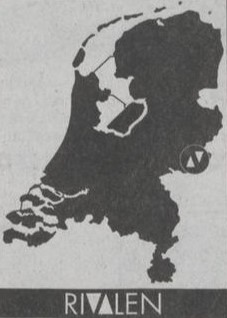
Two men are sitting on the terrace of Café De Zwaan on the Markt in Winterswijk. They are talking about the combative CDA Member of Parliament Wim Mateman from neighbouring Aalten. One says: “Wim Mateman, he’s a decent lad, because he comes from Aalten.” “Yes, yes, you may well be right.” At first hearing, this seems to be a dialogue open to only one interpretation. But anyone familiar with the Winterswijk variant of the Achterhoek dialect knows that precisely the opposite is meant.
A Winterswijk resident is not quick to say what he thinks of something. He would rather say nothing, because then he need not offend anyone. But if he really must say something, he does so cautiously and indirectly. There is therefore a good chance that he does not consider Wim Mateman a decent lad at all; at most he is a “fine” lad. But that is hardly remarkable, because in strictly Reformed Aalten they are almost all “fine”, in the sense of orthodox.
The village built on hills along the banks of the Slinge is not called the “Jerusalem of the Achterhoek” for nothing. Until the most recent municipal elections, the CDA held an absolute majority there. It lost several seats to the Christian People’s Party and now holds eight of the seventeen council seats.
Ten kilometres to the north-east, they are anything but orthodox. Winterswijk was once a left-wing stronghold, where the Labour Party at one time had an absolute majority. Those days have been gone for rather longer. Even after its latest defeat on 2 March, however, the social democrats still form the largest group. And the man on the Markt also means the opposite of what he appears to say. In Winterswijk dialect, “You may well be right” means: “I think I disagree with you.”
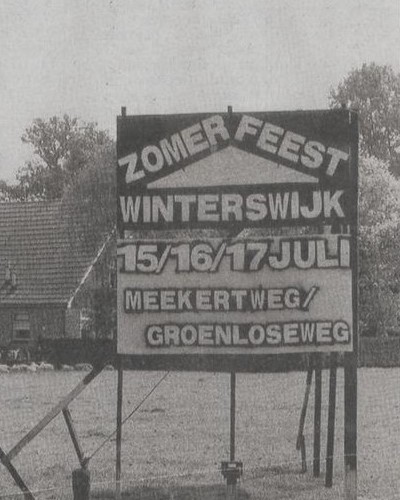
The relationship between the two municipalities in the far eastern Achterhoek is a complicated matter, mainly because there is no obvious reason for rivalry. For Winterswijk’s municipal spokesman, who speaks immaculate standard Dutch, the idea that the two villages are rivals is “completely new”. “And I am a native Winterswijker.” For his counterpart in Aalten, by contrast, it sounds very familiar. But what exactly is going on? “Difficult to say — it’s more of a feeling.”
The two villages are far enough apart not to be constantly in and out of one another’s houses; neither has ever dominated or obstructed the other, and both are reasonably prosperous. There have never even been fights between young people from Winterswijk and Aalten. How could there be? Winterswijkers are rather reserved and stiff, while young non-Reformed people from Aalten who go out at weekends do so in the “Las Vegas of the Achterhoek”, Groenlo, where the discos are.
It therefore takes some effort to discover what Winterswijkers have against Aalten. The answer is this: Aalten people are not bad, but a Winterswijker is simply better. So naturally they look down on Aalten. There is no beautiful countryside there, no centre, no shops and nowhere to go out. Billiards player Hans Vultink comes from there. Honestly, playing billiards in a village without pubs — you only do that when there is nothing else to do, don’t you?
They once tried to establish some textile industry in Aalten, but it never really got off the ground. Aalten’s textile industry therefore never made it onto school wall maps, unlike the industry of Winterswijk, which was mentioned in the same breath as that of Twente. Winterswijk is therefore a factory town. Well, it was. Or at least it intends to become one again. When the textile industry was flourishing, the Tricot factory employed 1,300 people. The fact that textile production has since moved to low-wage countries is another matter.
Winterswijk simply was and is the best. It has the most typical bocage landscape in the Achterhoek. The regional hospital: in Winterswijk. The music school: in Winterswijk. The Centre for Nature and Environmental Education: in Winterswijk. The surrounding villages are bursting with jealousy.
Aalten residents, on the other hand, think Winterswijkers have urban pretensions. Whenever the province of Gelderland has something to distribute, Winterswijk is standing proudly at the front: “We’ll take that facility.” But why is the regional hospital not more centrally located in the Achterhoek? And that Centre for Nature and Environmental Education — isn’t there already one in Doetinchem?
Winterswijkers are arrogant. They once thought their population would rise to forty thousand, and that is why they got all those facilities. In the end, it only became 28,000, barely ten thousand more than Aalten. Winterswijk a city? Don’t make an Aalten resident laugh. They are proud of Gerrit Komrij, but forget to mention that he fled the place when he was nineteen.
What Aalten people do admit is that Winterswijk is good for shopping. But only on weekdays, because every Saturday there is an invasion of Germans. It is as though the entire northern Ruhr area is strolling across the Markt. Market traders and shopkeepers address you in German, and the currency is the mark.
Perhaps there is some old resentment after all, because Winterswijk has a dark past. In the 1935 election for the Dutch parliament, the NSB received a record share of the vote there: 20.4 per cent of Winterswijk voters supported Anton Mussert’s party. Small tenant farmers and non-churchgoing shopkeepers saw in the 1930s that their counterparts across the German border appeared to be doing much better.
That does not mean all Winterswijkers were on the wrong side. After all, the national organisation for helping people in hiding was founded there. But still, it was hardly respectable. After the war, more than 750 Winterswijk residents were arrested for having collaborated with the Germans.
Nothing like that ever happened in Aalten. During the war years, the village was full of people in hiding. At one point, of the village’s more than thirteen thousand inhabitants, 2,500 were living there clandestinely. These were people trying to avoid compulsory labour in Germany.
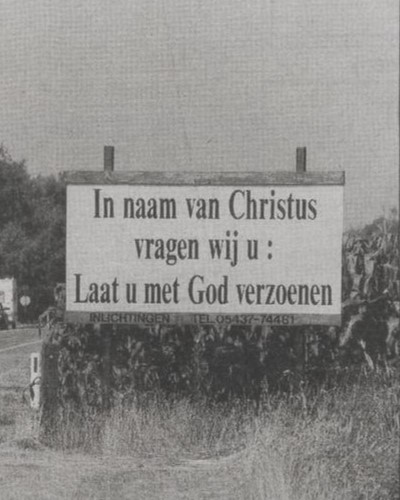
But Aalten residents are not resentful. Every Winterswijker heading west can read a large sign at the Aalten municipal boundary: “In the name of Christ we ask you: be reconciled to God.” That message also applies to the inhabitants of the nearby book town of Bredevoort, within the municipality of Aalten, who must take the same road west. One night, they turned the ornamental cannon in their town park so that it pointed towards Aalten. Why? For exactly the same reason Aalten residents look down their noses at Winterswijkers: they are too know-it-all.