
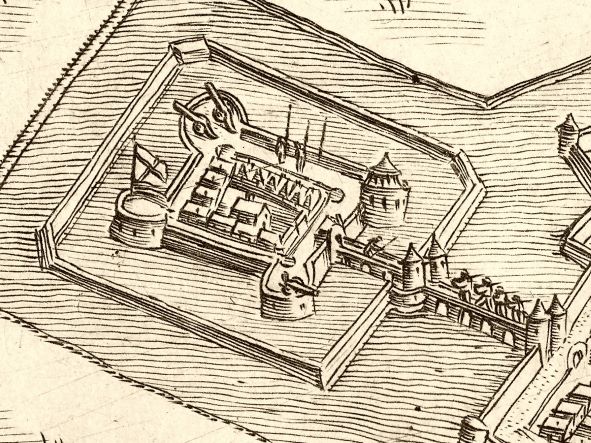
On Sunday 12 July 1646, lightning struck the gunpowder tower of Bredevoort Castle during a severe thunderstorm. The resulting explosion destroyed much of the castle and killed about forty people. That figure was already published in 1807 on the basis of Bredevoort’s Consistory Book.
The explosion
The gunpowder tower formed part of the castle complex on what is now ‘t Zand. When lightning struck the tower, the stored gunpowder exploded. A contemporary entry in the judicial register (ECAL 3017, inventory no. 415, folio 24v) confirms that the explosion occurred at about four o’clock in the afternoon, but gives no quantity of gunpowder. The often-repeated figure of 320 barrels of powder cannot be established from that entry. Nor does G. van Hasselt’s brief summary of the Consistory Book, published in 1807, give that quantity. The word tonnen refers to barrels or containers, not modern metric tonnes.
The force of the explosion shattered the tower and other parts of the castle. The contemporary administrative residence beside the castle was also destroyed. It should not be confused with the later Ambthuis on Landstraat, which was not built until 1699.
Damage throughout the town
The disaster was not confined to the castle grounds. Houses in the town collapsed or were badly damaged. Later accounts report widespread loss of roof tiles and window panes from the blast. People searched the rubble for victims and possible survivors for several days. St George’s Church was also damaged. According to the Dutch Cultural Heritage Agency’s listed-monument record, the church was repaired later in 1646 following the gunpowder explosion (monument no. 6869).
Archaeological and historical research confirms that the explosion of 1646 was a major break in the history of the castle. The badly damaged complex was never rebuilt as a fully functioning castle.
Victims and conflicting estimates
One of the most important early published accounts appeared in 1807, when G. van Hasselt reported information taken from the Bredevoort Consistory Book. It stated that about forty people died. Among the victims he named bailiff Wilhelm van Haersolte, his wife Catharina van Brakel and “eight children”. That final figure is problematic, however. Nederland’s Adelsboek stated in 1908 that Wilhelm and Catharina died with seven children, while their son Anthonie survived the disaster. The Bredevoort baptism register also confirms Gerrit (1641), Assuerus (1643), Arent (1644) and Lodwich (1645) as children of the couple. The sources therefore disagree on the number of children who died. Without consulting the original Consistory Book and further family records, it would be unjustified to choose between seven and eight.
Jacobus Craandijk later gave a total of forty victims, dividing them into nineteen people killed at the castle and twenty-one in the town. This is a later reconstruction, however. Van Hasselt’s 1807 summary of the Bredevoort Consistory Book speaks only of about or up to forty victims. Old Aalten therefore does not treat an exact total of forty deaths as a contemporary certainty. Other accounts give 49 victims, but this figure has not yet been verified against the original death and burial records either.
In 1938 G.H. Rots published a longer list of names. Besides the Van Haersolte family he mentioned, among others, Berentjen van Brakel, Lieutenant Johan van Langen, Jeanne van Sedan, Maria Glazen, sentry Hendrik Otterpoël and several townspeople killed when houses collapsed. The list is valuable, but not every spelling and identification has yet been checked independently against a contemporary record.
Burial in St George’s Church
The members of the Van Haersolte household who died were buried a few days after the disaster. Wilhelm, Catharina and deceased members of their household were given a grave in the chancel of St George’s Church. Their historic grave slabs were later made visible again.
Their son Anthonie van Haersolte survived because he was not in Bredevoort that day. Later sources disagree about exactly where he was staying. He continued this branch of the Van Haersolte family.
A new administrative centre
The destruction of the castle also removed Bredevoort’s old administrative centre. Government and administration had to be accommodated elsewhere. The judicial register shows that administrative business nevertheless continued: on 12 August 1646, one month after the disaster, legal transactions were again recorded under Joost ter Vile, described in the register as deputy and receiver (ECAL 3017, inventory no. 415, folio 25). In 1699 a new Ambthuis was built on Landstraat. The disaster of 1646 was therefore not only a human tragedy, but also a clear turning point in the spatial and administrative history of the Lordship of Bredevoort.