
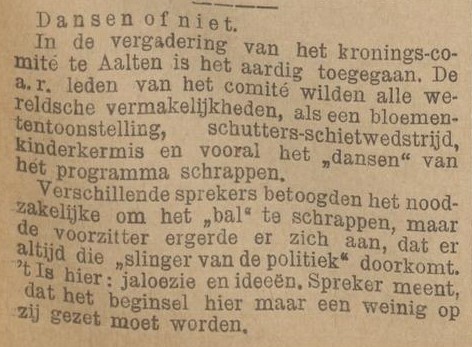
On 9 April 1896, Aalten municipal council considered a petition from the Christian workers’ association Patrimonium calling for the “abolition of public amusements (the fair, dancing in public houses on market days and similar occasions), thereby promoting morality and religious feeling”. A heated debate followed between supporters and opponents. The meeting was chaired by Mayor Tack.
De Graafschapbode reported:
Before the matter was discussed, a petition was read from a number of local tradesmen. Having learned that Patrimonium’s request was to be considered, they argued that their interests were at risk. Abolishing such amusements, they said, would deter many people from neighbouring places from visiting Aalten and would cause them considerable financial loss. They therefore asked the council to reject the petition.
The chairman supported the tradesmen’s petition. Abolition, he argued, would be highly detrimental to local businesses. Aalten was a peaceable municipality, known for good order and discipline and comparing favourably with many other places. Councillor Lammers agreed. The proposed measure, he said, would achieve nothing: any wrongdoing would simply move to private gatherings. He did not regard dancing itself as immoral.
Lammers referred to the parable of the Prodigal Son: when the son returned home, music and dancing were heard. If Jesus had opposed dancing, Lammers argued, He would not have included it in the parable. He cited other biblical examples to support his view that dancing was not sinful in itself. “A bow cannot always be kept strung,” he added; the same applied to young people. If all enjoyment were denied them, they would seek it elsewhere. Nor had he ever heard of exceptional immorality occurring in the municipality on such evenings.
The chairman said he had examined the police reports drawn up on such occasions and could assure the council that the number was very small. Councillor W. te Gussinklo was surprised to hear Aalten described as one of the places with the best reputation. He pointed to the ƒ25,000 in excise duty paid on gin in a single year. Many residents, he said, owed their misfortune to cheap gin. The council could not eliminate alcohol consumption entirely, but he wanted it to do whatever it could to combat the problem.
Te Gussinklo argued that police reports could not be relied upon as a complete measure of the problem. He could cite cases in which drunkenness played the leading role without any official report being made. He did not mean to accuse the police, but thought stricter supervision was needed. He dismissed Lammers’s biblical argument as misleading: the Word of God, he said, should not be used to excuse wrongdoing.
Councillor Pennings said much could be done to combat abuse by bringing forward the closing time of inns and public houses. Lammers objected to Te Gussinklo’s description of his biblical quotation as misleading, saying he might just as well apply the same label to Te Gussinklo’s argument. Te Gussinklo replied that he believed he had spoken clearly: he did not wish to use the Word of God to excuse wrongdoing, and he praised Patrimonium for taking the initiative.
Councillor Van Eerden found points in the petition with which he agreed, but also much he opposed. He did support earlier closing times for public houses. The chairman assured the council that the normal closing time would be enforced during the fair and the May and St Nicholas markets. Van Eerden added that he strongly opposed dancing on Christian feast days, such as had recently taken place at Weenink’s on Easter Monday, and believed permission for this should not be granted.
Councillor Ten Dam disagreed. He saw no harm in music being played on Easter Monday; the same happened throughout the country. Abolishing amusements would miss the real target. The intention was to curb drunkenness, but such a ban would also restrict the rights of others. He believed the matter should be left to the mayor. If young people were kept from every form of recreation, they might later find it harder to cope with temptation. Parents, clergy and teachers also had responsibilities in this respect.
W. te Gussinklo regretted that Ten Dam did not support the petition. He acknowledged that such measures would not eliminate the problem entirely, but argued that the council should not simply allow the existing situation to continue.
The council then voted. The proposal was rejected by six votes to five. Those voting in favour were W. te Gussinklo, S. Gussinklo, Pennings, Bulsink and Luiten.
This was certainly not the only occasion on which the subject arose. Two years later, preparations were under way for the coronation celebrations marking Queen Wilhelmina’s inauguration. At a meeting of the organising committee, “worldly amusements” again became a subject of debate. Once more, however, “the dancing festivities were retained on the programme by a large majority”.