
Dagblad Tubantia, 12 May 1969
No serenade allowed — but plenty of telephone calls
AALTEN — Every party on Aalten municipal council had repeatedly called for the rules governing Sunday observance to be reconsidered. There was general agreement — rightly so, the newspaper added — that something needed to change and that a fresher wind ought to blow through the municipality. One councillor had even described Aalten as “dead”. Yet nothing happened. Sunday observance remained as it had been for years, perhaps even centuries: quiet and undisturbed. Until yesterday.
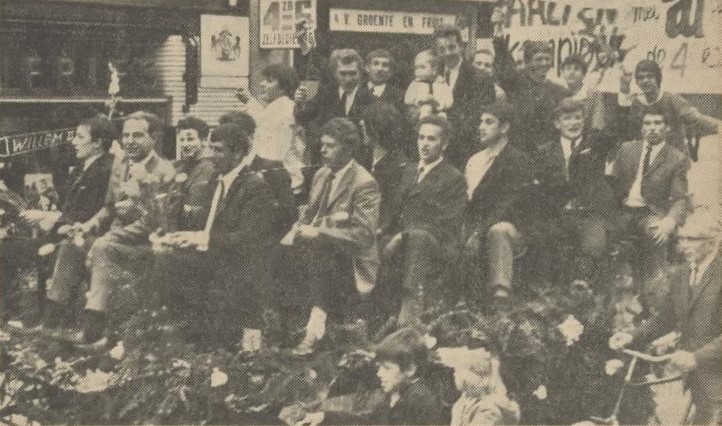
Football club Aalten had won the long-awaited championship in Beltrum, and the championship team had to be welcomed home in the village — preferably with music.
That had never happened before. But mindful of the council’s calls for change, Mayor H.H.H. Haverkamp apparently felt it appropriate to allow the Aalten Orchestra Association to meet the victorious team at the water tower and accompany it in triumph through the village to club premises Vultink at De Driesprong.
And so it happened. Mayor Haverkamp certainly heard about it afterwards.
“My telephone was red-hot,” he said that evening at the club’s reception.
For that reason, he said, he could not congratulate the champions on behalf of the municipal authorities and the whole community.
“So many people telephoned me,” he explained, “and said they were speaking on behalf of even more people who would also be calling later in the evening. They all strongly reproached me for giving permission for music to be played in the public street on a Sunday. Under those circumstances, I could hardly claim to speak on behalf of the entire municipality.”
His personal congratulations were no less warm for that.
Because so many further calls had been announced, the mayor eventually took the receiver off the hook so that at least his children could enjoy their Sunday night’s rest.
“I had expected rather more tolerance,” Haverkamp sighed the following morning at the town hall, where he could still be reached by telephone.
“And suppose I had refused permission? What then? Other people in Aalten would have been up in arms and would have complained that nothing ever happens here.”
He did not say it aloud, the newspaper remarked, but one could almost hear him thinking: whatever you do, it is wrong.
Two days later, Dagblad Tubantia reported the following:
Sticker Campaign for Mayor Haverkamp
“Not for one, but for everyone”
AALTEN — “Really, I ought not to be standing here for one group, but for everyone.” That was what Mayor H.H.H. Haverkamp had said on Sunday evening at the reception for football club Aalten after it became champion.
Yet the mayor had indeed been unable to speak for everyone. As already reported, he had received so many telephone calls from people protesting that Sunday rest had been violated by his permission for the celebrating team to be welcomed with music that he eventually took the receiver off the hook so that at least his children could sleep.
But once Aalten was stirred into action, the newspaper observed, it stayed in motion.
During the following night, unknown people pasted countless strips or stickers around the town in support of Mayor Haverkamp. They appeared on shop windows, lampposts, fences and the rear windows of cars parked outside overnight.
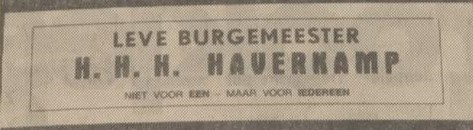
The wording read: “Long live Mayor H.H.H. Haverkamp — not for one, but for everyone.” It deliberately echoed the mayor’s own words and was clearly intended as a show of support.
A Pity
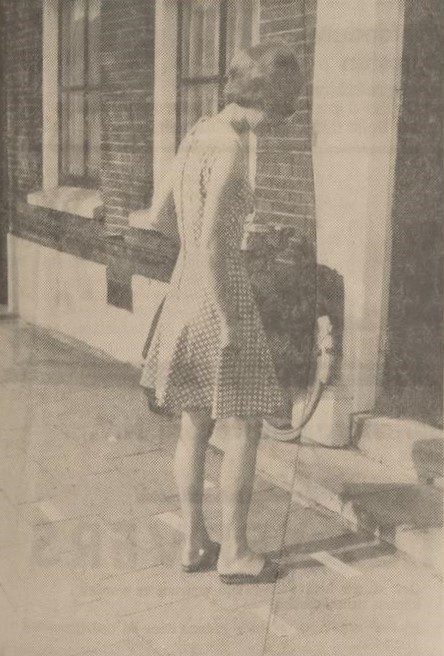
The only person the newspaper saw removing stickers that morning was the municipal messenger. He was on his knees on the pavement outside the town hall, scrubbing away the many strips pasted there.
After all the commotion, the paper joked, there was now even a public “strip-tease” on the Markt. The removal had been ordered by the mayor himself.
Asked for comment, Haverkamp said that, being only human, he naturally appreciated people standing up for him personally. On the other hand, he regretted the campaign because it could unnecessarily sharpen divisions.
Sunday observance was an extremely sensitive issue, he said, and change required gradual adjustment.
He therefore found the gesture pleasant in this particular case — but, as he added with a reference to his own earlier words, not necessarily for everyone.