Profile
- Type
- Business
- Founded
- 1936
Locations
Overview
With more than 500 employees, Kaemingk Season Decorations is one of Aalten’s largest employers. The company describes itself as an innovative supplier of decorative products for festive occasions such as Christmas, Easter, Valentine’s Day and spring. Its range comprises more than 19,000 items, supplied to over 73 countries worldwide.
It all began in October 1936 with the partnership B. Lusink & Co. This wholesaler of yarn, tape, toiletries, sponges, chamois leather and other goods was taken over in 1937 by H.A.J. (Johan) Kaemingk. He rebuilt the business from the ground up and expanded the range to include toys, festive and household goods and luxury leatherware.
Hogestraat
On 1 June 1941, H.A.J. Kaemingk became a general partnership. The partners were Johan Kaemingk and his younger brother Johan Wilhelm (Wim), with Wim acting as the salesman. The business was described as “a wholesale trade in brushware, fancy goods and stationery and everything belonging to this line of trade in the broadest sense” and was located at Hogestraat 1 in Aalten. Its establishment date was given as 1 January 1939.
In 1942, Kaemingk commissioned Aalten architect Willem Hebly to design a warehouse. Kaemingk had taken an option on a vacant plot to the left of Aalten railway station. Although the plans were completed, the project did not go ahead — probably because of the war — and further expansion was delayed for years.
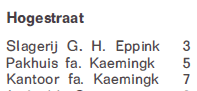
By 1948, business was going well and preparations were made for expansion. On 23 January 1950, Kaemingk bought the properties at Hogestraat 5 and 7: the shop with the house behind it at number 7 and the warehouse at number 5.
Hogestraat 7 had initially been occupied by grocer Prinsen, who emigrated to Canada after the war. He was succeeded by Wim Brethouwer, also a grocer. When the shop proved unsuccessful, Brethouwer soon left and Johan Heideman opened a branch of Hölscher dry cleaners there. He later moved to Landstraat, where the dry-cleaning business remained for many years. Number 5 was returned to use as a warehouse, with an office created upstairs. After Heideman moved out, the office was transferred to the former shop.
At the beginning of 1954, Kaemingk officially moved to Hogestraat 5. Its former premises at Hogestraat 1 — the house of the ‘Hook Jödde’, which Kaemingk rented from Van Lochem — were demolished.
Industrial estate
After the expansion at Hogestraat 7, construction began in 1962 on a warehouse at Tweede Broekdijk 9, again designed by architect Hebly of Aalten. It was a brick warehouse incorporating a secure fireworks store. Regulations no longer permitted fireworks to be stored on Hogestraat.
Kaemingk was now spread across two locations. Another twenty years would pass before the office was also moved to the industrial estate. In 1981, Kaemingk moved to Broekstraat 13. The office was subsequently extended several times, and a second showroom of 400 square metres was soon added.
From then on, goods were dispatched from the warehouse on Tweede Broekdijk. At the time, the warehouse was not allowed to be built very high: everything had to remain within reach, because forklift trucks were not yet in use. Whenever Johan Kaemingk visited the warehouse, he would look at the shelving and remark: “A pity about all that air still left above it.”
Rented storage sites
In the early years, all Kaemingk’s goods arrived through the port of Rotterdam. They were loaded into railway wagons there and transported to Aalten station. Once they arrived, staff needed two days to sort everything. The goods were then moved to storage by van and trailer.
When Kaemingk initially had only the Hogestraat premises, the building served as both office and warehouse. Storage capacity was limited and dispatch also took place from the same site, which created obvious logistical problems.
To handle large quantities of seasonal goods over short periods, outside storage space was soon rented. At times Kaemingk used as many as fifteen to twenty different locations, often simply empty houses. Employees were asked whether they knew of any vacant properties.
When a Kaemingk employee living opposite on Hogestraat had to move because the house had been declared unfit for habitation, Kaemingk rented the property for storage. Goods were unloaded from lorries and passed into the house through a window.
Another storage site was the former convent on Dijkstraat. Kaemingk rented a room at the rear of the building. Because there were no mechanical aids, everything had to be carried by hand through the building. One hall served as a chapel of rest. On one occasion staff arrived with goods only to discover that a deceased person had been laid out there. One colleague was so startled that he dropped everything on the spot and ran outside as fast as he could.
Other storage locations included the attic of Voskuil seed merchants and garden centre, the premises of RATEWA, which sold electrical goods, and the building of contractor Jansen opposite the unloading area of the warehouse on the Broek. The RATEWA building no longer exists; Karpi was later established on the site, while Avista Polarit later occupied the Jansen premises.
Romney huts
Kaemingk continued to grow and increasingly specialised in Christmas goods, Christmas decorations and small fireworks. It proved a sound decision, because growth continued. By the 1980s, the company urgently needed more storage space and therefore built several Romney huts on Broekstraat. They could be erected quickly and relatively cheaply.
The intention was to replace the huts with another building after a few years, and planning permission was initially granted for only five years. Instead of demolishing them, however, another section was added every few years.
At first the huts were not insulated. In very hot weather, candles inside the boxes could soften and collapse like pudding. To prevent this, water was sprayed over the roof through garden hoses pierced with small holes.
In winter the problem was the opposite. It became bitterly cold inside, and staff prepared orders wearing thick winter coats and gloves. When conditions became almost unbearable, some colleagues would have a small drink to warm themselves up. At times it was actually warmer outside than in the huts. Heaters were later installed, and several years after that the buildings were fully insulated.
Sale and growth
In 1992, the Kaemingk family sold its shares in the company. The Aalten business had become so successful that companies from abroad were also showing interest. In 2001, Kaemingk was sold to an American investor, giving the company greater opportunities for growth and purchasing and access to the US market.
At the beginning of 2006, Kaemingk returned to Dutch ownership. Expansion then accelerated. The company was already active in Germany, France and Belgium, and the United Kingdom followed.
Today, the company operates from several locations on Aalten’s industrial estate.
Images