
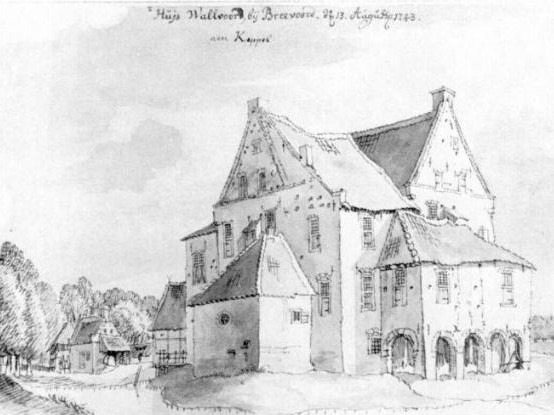
Near the ‘t Walfort manor house outside Aalten, a so-called Vehmic court was established in the Middle Ages. The word veem is Low Saxon for ‘punishment’. It was a special court whose hearings took place outdoors beside a small wood known as the “Sleehegge”. Justice was administered here four times a year at sunrise.
The court was presided over by a free-count, a judge after the old Westphalian model. A free-count represented a so-called free seat. A free seat covered a certain area, usually similar to the gauges of Carolingian times. The free-count has its origins with the Saxons. After the subjugation of the Saxons by Charlemagne, the old vehmic courts continued to exist for a long time.
This free-count and a number of free vehmic jurors or assessors ruled on the charges, after summoning the suspect. The vehmic court would have intervened if there were concerns that a privileged person could not be brought before a regular court, thus filling a gap in the legal system.
The Dücker will get you
The best-known and most notorious free-count at ’t Walfort was Berend de Dücker, who was also mayor of Bocholt. He was appointed at ’t Walfort in 1430 and was greatly feared, as his judgments often ended in death. The condemned person was hanged by three anonymous Vehmic jurors using a noose made of willow twigs. De Dücker presided over the Vehmic court for 61 years. Well into the twentieth century, parents still warned disobedient children: “De Dücker will come and get you.”
Because the vehmic courts undermined the government’s monopoly to impose punishments, the Duke of Guelders forbade his subjects to comply with a summons to the vehmic court. At the end of the sixteenth century, the vehmic court on ‘t Walfort disappeared. It is the only place in the Netherlands where it has been proven that there was a vehmic court.
In 1936, the Rotterdamsch Nieuwsblad wrote about the vehmic court at ‘t Walfort:
Arising from the pressure of the times and as a reaction to the tyrannical domination of the Pledgers, it [the cattle court, ed.] met at night. The citizens, who formed the court, sometimes did not know each other. They appeared masked. To prevent the prisoners from revealing what had happened, and where the hearings, or rather the meetings, were held, the sentence that was passed was always the death penalty. The easiest punishment to carry out was that of the noose.
In order to show the passing that they were dealing with a vehmic sentence, the sign of the vehmic court was cut in the tree on which the hanged man had been sentenced with an axe, a so-called ‘Wolfshaak’ [or Wolfs’ Hook, ed.]. All this seems to us, at the present time, very cruel. But it must not be forgotten that the bitterness in connection with the need of the times has led to these measures.
For chiefly the majesties turned against the dismissed soldiers of the many armies of the many little armies of the many little potentates who were constantly fighting each other.
These warriors, who spared neither friend nor foe, scoured the countryside in larger or smaller troops. They stole cattle, chickens and food. Also money, which was scarce among the peasant population of those ancient times, as well as household goods and jewellery. And church treasures were to their liking.
These people behaved shamefully towards women and children. And woe betide the farmer who lived on a lonely farm dared to resist their crimes. His family was abused in front of his eyes, while he watched, bound. His farm was set on fire, and he himself was the last to be beaten to death.
The vehmic court, which was composed of residents of Bredevoort and Aalten, was later officially established on the Walfort, where the van Lintelo family, the judge, free-count or president of the court were elected. In 1573 we find Arend van Lintelo as such.
Also read “A vehmic court on Dutch soil”, by Dr. H. Kits Nieuwenkamp (1938):