
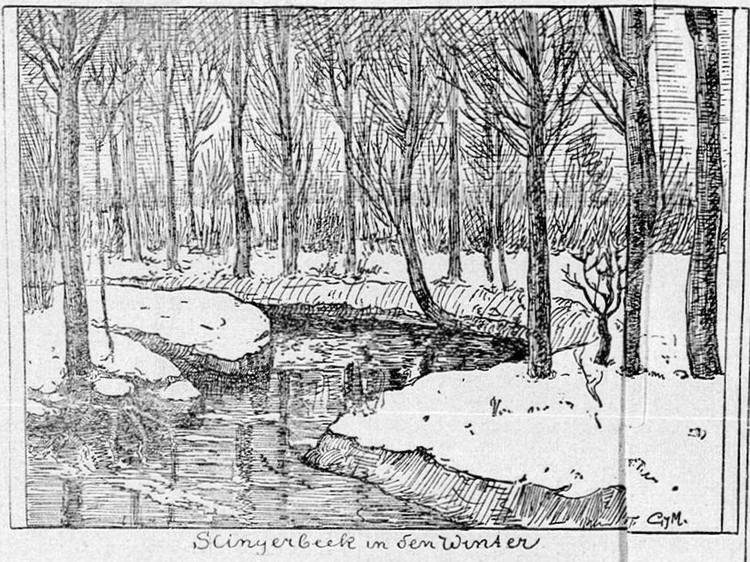
De Graafschapbode, 16 September 1924
Many beautiful spots can still be found along the banks of the Slingerbeek, alive with birds, butterflies and flowers, though it would be impossible to describe them all in detail. Around Miste, its banks are relatively sparsely wooded. There the stream winds mainly through open country, past arable fields and lush meadows.
In several places, bends have been cut off and the channel widened and deepened. Small embankments are also used in an attempt to contain the stream, because in wet weather it can quickly swell into a turbulent watercourse and flood the surrounding land.
Near Bredevoort, the landscape is dominated by poplars. Everywhere stand old, stately trees and newly planted saplings, all slender and arranged in long rows along the banks of the stream, beside ditches, embankments and roads. Their moving foliage creates a constant rustling sea of green.
In autumn, when yellow leaves already cover the ground and the crowns have begun to thin, the poplars lend the landscape a melancholy air. The wind sighs through the drying leaves on branches that grow barer by the day. The old town then seems lonely and forgotten between marshy lowlands and flooded meadows. Part of this low-lying area has already been drained, and further drainage work is now under way.
In earlier centuries, Bredevoort owed much of its importance as a fortified town precisely to its position amid the marshes. Dutch States and Spanish armies fought here for possession of the stronghold and its formidable castle. Bredevoort has witnessed worldly splendour, endured much misery and suffered disasters. Now it lies quietly beside the Slinge, partly hidden behind the last remnants of the old rampart and half encircled by the former moat, filled with reeds and rough vegetation, among long rows of poplars — dreaming of its grand past and of the futility of human plans.
About fifteen minutes farther downstream lies Walfort, or Walvoord, an old manor whose past, too, was more glorious than its present. It was once the seat of the free count, the presiding official of the mysterious Vehmic court, which survived well into the Middle Ages. Sleehegge was the name of the place where justice was administered in the open air at sunrise, without regard to rank. One of the free counts, Bernd de Dücker, was notorious for his severity, and his name survived in local speech into modern times.
At Walfort, the Slingerbeek is joined by a small tributary, the narrow and unassuming Schaarsbeek. There are plans to widen and deepen it in order to improve drainage from the Groote Goor. The Schaarsbeek has much natural beauty along its banks. It rises in the Korenburgerveen and for a time follows the boundary between Klooster and the Groote Goor.
The Slingerbeek approaches Aalten and reaches the village near De Pol, once one of the most powerful manor houses in the area but by then a faded remnant of its former importance. Aalten is a very attractive village, built against the slope of a hill. Urns found in the surrounding area indicate that it is an ancient settlement, like Varsseveld farther to the west. Some have even linked the name Varsseveld to the Roman commander Varus.
Between Aalten and Varsseveld, the banks of the Slingerbeek become fairly wooded again in places. Picturesque spots are plentiful, including near the Bleekerij and farther into Elshoek. Not far from Varsseveld once stood the extensive woods of the De Breukelaar estate, although most of the trees had already been felled. Beyond that lie the wooded Noorderbroek and, eventually, the forests of Slangenburg, where one can wander for hours beneath tall trees and through dense undergrowth, amid the scent of flowers and birdsong.
By this point, the Slingerbeek has divided into two branches. The main, southern branch continues under the name Bielheimerbeek, winding close past Slangenburg Castle with its towers and outbuildings, deer park and farms, and its shady woods crossed by broad avenues.
Most of the Slingerbeek’s water is carried away by the Bielheimerbeek; the remainder flows towards Doetinchem. The Bielheimerbeek probably takes its name from the former Bethlehem monastery at Gaanderen. It was founded there in the late twelfth century by a man named Franco together with a hermit, Gijselbrecht. The wooden church was consecrated personally by the Bishop of Utrecht. The foundation prospered greatly, and the monastery expanded until it enjoyed considerable wealth, power and standing, with influence extending far across the surrounding area. Decline followed. During the Reformation, the monastery was robbed and plundered, and the once splendid estate gradually fell into ruin. A rich archive is all that remains.
In 1659, a Rotterdam merchant received permission from the States to build a watermill on the Bielheimerbeek. Its clattering wheel turned year after year for centuries, until relatively recent times. By 1924, the wheel had disappeared and the puffing sound of machinery could be heard there instead. Gaanderen lies among sandy hills and river dunes, from which attractive views can often be enjoyed.
And so we have followed the Slingerbeek once again. It is, after all, only a modest little stream. Yet it is beautiful: in spring, when primroses and white anemones are in flower; in summer, when ferns and umbellifers are reflected in its water; in autumn, when oaks glow bronze and beeches turn yellow and copper-red; and in winter, when snow covers the fields and everything falls silent.
G.J.M.