
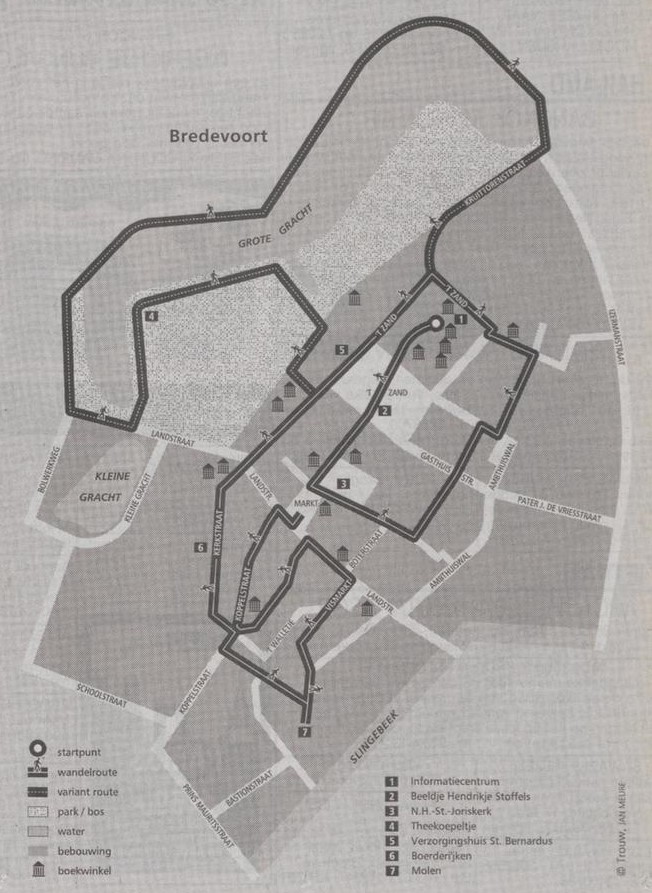
Surely no sensible person goes walking in weather like this? Much better to curl up by the stove with a book. All right then, just a short stroll. And short it is, because Bredevoort is small. However energetically it promotes itself as a book town, there is no disguising the fact that you can walk through it in an hour. Excluding the bookshops, of course — those can take as long as you like.
This is Bredevoort’s third year as a book town. Patron Jan Terlouw formally opened the project in August 1993. This winter season the traders are having to contend with something of a downturn. The initial novelty has worn off and subsidies are drying up. But three years is a short time. “You have to give it at least five years. We started with six bookshops and now have more than twenty,” says the indefatigable Henk Ruessink of the Bredevoort Book Town Foundation. “No one has stopped. In fact, there is not a single empty house left here.”
The great example is Hay-on-Wye in Wales, which attracts around 700,000 visitors a year — another historic little town in a quiet border region. Last year, between 50,000 and 60,000 people browsed around Bredevoort. The town’s three guides had their hands full.
Bredevoort has long been accustomed to the world of letters. The archives show that in the middle of the seventeenth century no fewer than eight university-trained lawyers were working here. The Lordship of Bredevoort served as the administrative centre for a sizeable part of the Achterhoek; Aalten and Winterswijk, for example, belonged to it. And with its position on the route between Gelre and Münster, it was an important fortified town.
Little remains visibly medieval apart from the pattern of narrow streets. At the starting point of this walk once stood Bredevoort Castle. Today the site is occupied by Boek op ’t Zand, a former school building now used, among other things, by the Bredevoort Book Town Foundation and the regional documentation centre. Where ’t Zand now lies, there used to be a broad moat. On the far side was the outer bailey where the castle’s retainers had their homes. Half the town was wiped from the map in 1646 — Bredevoort’s year of disaster — when the powder tower exploded. Bredevoort then began its second life as a garrison town on the medieval foundations.
On the Markt, a former bakery has been converted into an antiquarian bookshop. Around the corner from the Protestant St Joris Church, on Boterstraat, the owner of Het Oplettende Lezertje — the first antiquarian bookseller to take the plunge and move to Bredevoort — has found premises in the former butter factory. And so it goes on. On Hozenstraat, the number of antiquarian bookshops visited, including those in the Book Centre, has already risen to eleven. “Yes, you are all packed together. But that has advantages for trade as well,” says one bookseller. Another adds: “Besides, antiquarian booksellers always have to sit together — otherwise they think they’ll die.”
Anyone wanting a break from all that browsing can walk around the outside along the former bastion. Then head back through town, past the little tea pavilion in the garden of the St Bernardus care home, formerly the steward’s house. Next to St Bernardus is Emergo, with a branch of the Amsterdam women’s bookshop Vrouwenindruk. Further along, on Prinsenstraat, the bicycle repairman has filled his house from top to bottom with books. Both types are therefore well represented: the more market-oriented second-hand booksellers, and the established antiquarian shops, such as Bucher Mammut with its fine collection of German Bibles, which rely mainly on catalogues and more targeted customers.
At a junction of little streets near the Roman Catholic church, one alley narrows into a path leading to a remnant of the overgrown fortifications. The corn mill rises above the town. By the time you reach Koppelstraat, you have, roughly speaking, found your sixteenth antiquarian bookseller: Ovidius, specialising among other things in Biggles books.
Enough for today. Quickly back to the warm stove — though “quickly back” is something of a euphemism for anyone who arrived by public transport. The situation is poor, and rightly high on the agenda of Bredevoort Book Town.