
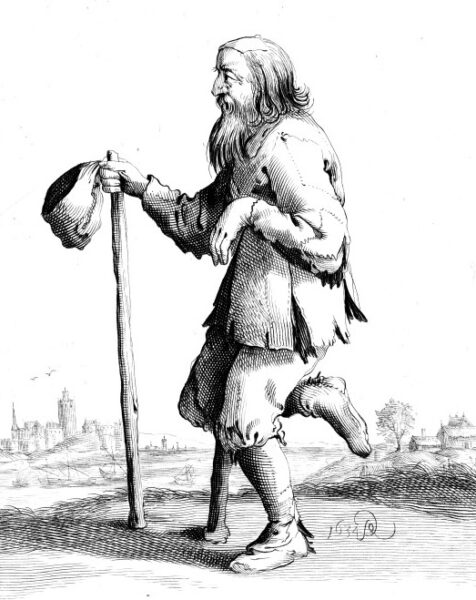
In an era when the government provided little to no poor relief, many people were left at the mercy of begging. They roamed from place to place, struggling to make ends meet. During the eighteenth century, the number of vagrants increased significantly. Because these individuals were often regarded as a nuisance by the authorities, and churches lacked the resources to offer them a chance at a better life, the office of the ‘armenjager’ (‘vagrant hunter’ or ‘parish beadle’) was established. This ‘official’ was employed by the local government but often led an impoverished existence himself.
Appointment of Vagrant Hunter Willem Hondarp in 1768
The image below is a fragment from the deed in which, following the death of Antoni Freriks on 5 January 1768, the appointment of Willem Hondarp as vagrant hunter was recorded. The deed also outlines the duties of the office. A complete translation of the transcription follows:
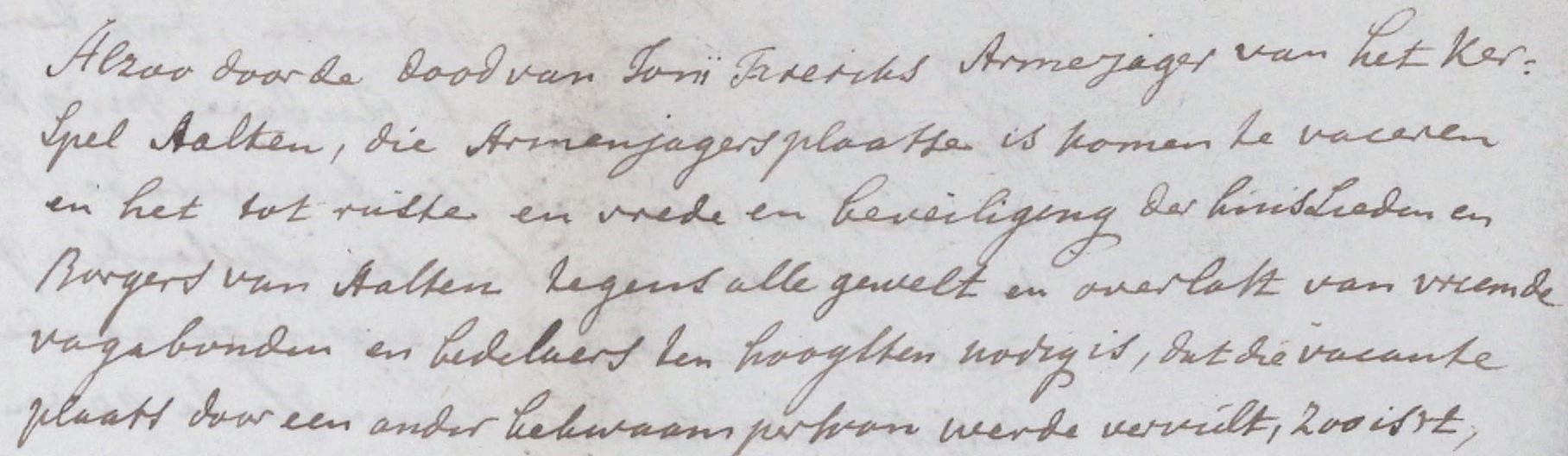
“Whereas, due to the death of Toni Frederiks, Vagrant Hunter of the parish of Aalten, said position has become vacant; and whereas it is of the highest necessity for the peace, quiet, and security of the husbandmen and citizens of Aalten against all violence and nuisance from foreign vagabonds and beggars that this vacant position be filled by another capable person: I have, upon the good testimony given to me of the fearlessness of the person of Willem Hondarp, appointed the same Will. Hondarp, as I hereby appoint him by virtue of these presents, as Vagrant Hunter of the parish of Aalten, upon such emoluments as have been given from of old and are still given. Commanding the aforementioned Willem Hondarp to cause all foreign beggars, vagabonds, and tramps to depart forthwith from the parish of Aalten and indeed from this Lordship; and should any be found who commit any violence or protest, to resist them with force and, if possible, to bring them to the Lord’s prison within Bredevoort.
Further commanding him that he shall tolerate no collections, whether by strangers or residents, unless they be provided with a proper note or attestation from the officer or, in the absence of the stadtholder of this Lordship; and to allow those so provided to pass and repass freely and unhindered. Furthermore, in the event that the voogd [warden] or deputy warden should require him, Willem Hondarp, in any exploit and should call or have him called for that purpose, he shall immediately go with said warden or deputy warden and obey and assist him to the best of his ability. Furthermore, to pass through the neighbourhoods from time to time and take care that no nuisance is caused to the husbandmen by any person; further to apprehend and bring in, if possible, all foreign and unauthorised hunters hunting in this Lordship, and should he know any whom he could not bring in, to report them to the officer or his stadtholder, and further to do all that a faithful and orderly Vagrant Hunter is obliged to do, and to take care as much as possible that no complaints arise from the husbandmen.
However, should it happen that the same Willem Hondarp should fall short in any matter and should request proper assistance from the husbandmen, and such assistance be refused him, he shall give notice of that refusal to the officer or to his stadtholder.
All this until our revocation. Given at Walfort House, the 10th of March 1768, and signed by my own hand as Drossard of this Lordship and confirmed with my customary seal.
Signed: Ad. de Pallandt”
Legal Proceedings
On 20 February 1804, a court case was held in Bredevoort against Jan Willem Brusse(n), vagrant hunter. On 23 December, at the house of Goormans in Barlo, he had ‘murderously assaulted’ Willem Beskers. Brusse had struck him on the elbow with a sabre, wounding him so severely that he could no longer use that arm. Brusse confessed but claimed that when he asked Willem Beskers for proof that he was permitted to collect alms, Beskers attacked him. Brusse maintained he had acted only in self-defence. Fine: 25 guilders.