
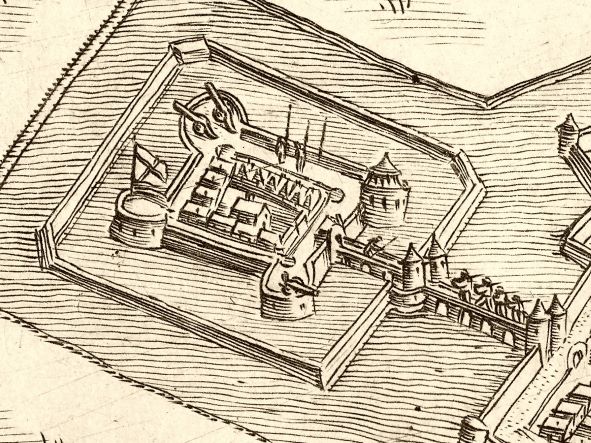
Op zondag 12 juli 1646 rond vier uur ‘s middags werd de kruittoren van het kasteel Bredevoort, met daarin 320 vaten buskruit, getroffen door de bliksem. Bij de daaropvolgende explosie vielen veertig doden en een onbekend aantal gewonden.
Bij de inslag vloog de toren in brand. De explosie was zo hevig dat daarbij ook het Ambthuis instortte. De stad ondervond veel schade van de explosie en bijna alle huizen verloren hun dakpannen en ruiten. De huizen rondom het kasteel waren ingestort. Er is met gebruik van schoppen en houwelen drie dagen lang onder de puinhopen naar overlevenden gezocht.
In 1938, G.H. Rots wrote a series of articles in the Aaltensche Courant about the history of the municipality of Aalten. Regarding the gunpowder tower disaster in Bredevoort, he wrote:
“The year 1646 was once again a disastrous year for Bredevoort. It was the 12th of July, and an oppressive heat hung over the town. Dark clouds gathered, and everything indicated that a severe thunderstorm was imminent. And indeed, lightning soon cleaved the sky, followed by heavy claps of thunder. And suddenly, a terrible blow, followed by a dreadful sound.
Lightning had struck the gunpowder tower, causing the gunpowder present (320 tons) to explode. The entire tower was blown apart, as was the nearby Ambthuis; tiles were torn from almost all houses, and windows were blown in by the air pressure. The number of deaths in that disaster amounted to 19 at the castle and the Ambthuis alone. There were also numerous deaths in other houses in the town.”
Victims
“Tot de dooden behoorden o.a. de Gouverneur van de stad Willem van Haersolte en zijn echtgenoote, de Drostinne Cathrijne van Brakel en hare acht kinderen, haar nicht Berentjen van Brakel. Voorts Joh. van Langen, luitenant van Georg Ernst Graaf van Bronkhorst, en dan nog zijne Fransche Maitresse (sic) Jeanne van Sédan. Een oude vrouw, daar aanwezig, Maria Glazen, met de knecht en de meid behoorden ook tot de slachtoffers.
The sentry on duty, named Hendrik Otterpoëll, was buried under the ruins. In other parts of the town, the house of Jan Stenneken was destroyed. He and his wife Marycken van der Halle were killed. The names of the dead in other parts of the town were Derk Trix, ensign, Harmen ter Male, F. zum Moorelagen, Bailiff of Winterswijk, and his wife Janne Beerninck, with her sister Christine Beerninck, widow of the late N. Brinkhorst, judge of Haaksbergen.
The house of Berent Grimme was destroyed; his wife and four children lost their lives. The house of Casper Evers was hit, under which three people were killed, named Arent Hamaeker, a child of Berent Maes, and a child of Herman Broekman. Under the house of Derrick ter Woerle Wiltschut, three of his children were killed, as well as the soldier Gerrit Jansen and Jan Schulten.
We have specifically mentioned these names because one might perhaps derive names of those living today from them.”
De doden die onder het puin van het Ambthuis lagen, werden op 15 juli opgebaard in het huis van de weduwe van de overleden predikant D.J. Verhagen. De drost met zijn vrouw en acht kinderen werden op donderdag 16 juli in de voormiddag begraven in het koor van de Sint-Joriskerk. Het is niet duidelijk hoeveel mensen onder het puin gebleven zijn. In totaal stierven die dag veertig mensen. Over het aantal slachtoffers dat gewond raakte, maken de bronnen geen melding.
One son of Drost Wilhelm van Haersolte survived the disaster. Anthony, as he was named, happened not to be home that day: he was staying in Zwolle. He continued the family line in Zwolle and founded the Haersolte Almshouse there, which is assumed to be connected to the disaster in Bredevoort.