
The text below is a transcription of the original handwritten regulations, as literal as possible, including variations in spelling, but with added punctuation to improve readability. The text contains a number of words or concepts that we did not recognize (highlighted in yellow) and may have been misinterpreted. Therefore: errors excepted and corrections are welcome.
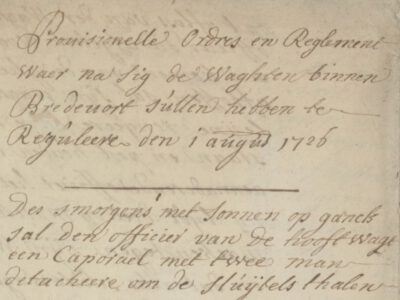
Provisional Orders and Regulations according to which the guards within Bredevoort shall regulate themselves, August 1, 1726.
- In the morning at sunrise, the officer of the main guard shall detach a corporal with two men to fetch the keys.
- When the keys arrive, the officer shall arrange the guard under arms, have the march beaten, and detach the sergeant and as many men as shall be necessary. And at the Munsterspoort, the sergeant shall detach the corporal so that every time a drawbridge is lowered and the keys have passed, it is raised again until the field is scouted and the posts are set out.
- The gates being opened, the keys shall be returned in the same manner as they were fetched.
- Upon the changing of the guard, the officer being relieved shall, upon the arrival of the one who is to relieve him, arrange his guard in a line and have the march beaten and hold post until the approaching officer has the body of men he leads1 march up and form a front opposite his guard, and ensures all sentries are relieved and inspects whether anything is missing from the cannons and batteries2 and whether the guardhouses, sentry boxes, and the rampart are cleared of all filth and found in a state fit for duty, and whether the patrol sticks and whatever else is required for the guardhouses are present with the guard, and that the officer being relieved has handed over the orders observed at his post to the relieving officer. When all this is done and the sentries are relieved and have joined the guard, the relieved officer shall march off to the market and there thank the men; at the same time that the relieved troop marches off, the relieving officer, having arranged his men in a line, shall beat the march and take up post in the same place.
- The sergeants of the guard shall remain at their posts for 24 hours. From the main guard only two men, and from the Munster Gate only one, may be given leave to fetch food, but from the opening of the gates in the morning until eight o’clock, as well as during the time when the sentries are relieved, none.
- No soldiers are to be allowed outside the gates without a gate pass, written or signed by the Commander; the gate passes shall be held by the officer and, when the soldier returns, given back; if they do not return and the passes are collected, they shall be brought to the Commander with the evening report. The sergeant of the Munster Gate shall send the collected passes to the main guard.
- The guards and sentries shall take good care that no damage is done to the timber or palisades on the national fortifications, nor any fishing done in the moats around, or grass mown on the ramparts or counterscarps, without a note or order from the Commander. Also, the sentries and patrols shall ensure that no elevation occurs on the excavated grounds around the fortifications, nor any trenches shifted, and that no filth is made on the ramparts.
- The commanding officer of the main guard shall have all foreign passengers brought to the commander. The sergeant of the Munster Gate shall have the same brought to the main guard, but for persons of quality, he shall ask the servants for their names and status and where they are staying, and if they have no servant with them, he shall ask them directly and immediately inform the Commander.
- In the afternoon from twelve to one o’clock and on Sundays during the sermon, the outermost drawbridges at the gates shall be raised.
- The officer shall provide a written report to the Commander at twelve o’clock in the afternoon and in the evening after the closing of the gate. The parole and orders that may have been given to the guards that day residing there in the morning when relieved shall be reported verbally. The sergeant of the Munster Gate shall have a report made to the officer of the main guard at half past eleven in the morning, in the evening before the gate closes, and in the morning after the opening of the gate.
- The sentries both at the barriers and on the ramparts shall call out to and warn one another when they see more than two or three men with arms, or more people than usual, approaching from outside. The sentries at the barrier shall immediately close it and raise the bridge, calling to the nearest sentry to have the guard come to examine the situation and report to the Commander as found. The guard shall ensure that a capable man is always stationed at the barriers.
- No foreign passengers shall be allowed on the ramparts or works without special order from the Commander. The sentries shall also take heed that no one enters the faussebraye, and also that no disorder occurs outside or near their posts, such as the breaking of lines placed in the gardens, and they shall always carry their arms while walking and not smoke tobacco.
- No foreign beggars shall be allowed into the city, and if any deserters should arrive very early in the morning, they shall remain in the main guard until they have been examined by the Commander.
- The sentries shall not allow more than one at a time of the carts or wagons coming from outside to pass over the bridge. Also, no carts or wagons may be left standing before the guard or inside the gate, but a clear space must always be kept, both before the guard and the gates; care must also be taken that the national boat lies locked, inspecting it before the closing of the gates.
- No beasts or horses are to be allowed on the fortifications; if any are found on the national works, they shall be brought to the guard and the release fee paid, according to the order of their Noble Mightinesses.
- The Ceremonial is to be observed according to the Regulations.
- In the evening at sunset, the officer, as a warning to the people who still wish to go out or in, shall have the roll-call beaten and detach a corporal with two men to fetch the keys. And when they arrive, the officer shall arrange the guard under arms, have the march beaten, and continue this until the gates are closed, and then set out the night posts and send the keys back to the Commander. Just as they were fetched when the gates were opened and closed, the officer himself shall be present to ensure that the gates are properly closed.
- If a gate is opened at night, the officer shall take care that nothing other than the wicket of the barrier is opened and that once the keys have passed, it is closed again, just as as soon as the keys are over the drawbridge, it is immediately raised again, detaching the necessary men for that purpose. The wicket of the outermost barrier being opened, he shall have it inspected who is outside the gate and, if found to be in order, shall allow those for whom the gates were opened to enter, but taking care that no barrier is opened nor drawbridge lowered before the outermost is well closed and the officer is informed of what has occurred. For the Munster Gate, a corporal with four men from the main guard shall come.
- The tattoo shall be beaten at half past nine in the summer and at nine o’clock in the winter.
- In the evening, the officer shall have a corporal and two men inspect the inns and have the soldiers of the garrison go to their quarters; half an hour later, he shall inspect them again to see if any had dared to come there, and if so found, they shall be brought to the guard under arrest.
- The corporals shall bring their sentries to their posts themselves by day and by night and ensure that the orders given are properly handed over at their posts; to that end, the corporals of the main guard shall inspect the sentry at the bastion, marching up as the sentries of his guard are relieved around the rampart, ensuring that everything is in good order and that no damage is done to the national works. The corporal at the Munster Gate shall march up with the sentry at the Mill Bastion and so forth, observing the rampart all around. What is mentioned in this article, and especially that the sentries of the Munster Gate are relieved at the stroke of eleven, they shall for that purpose stand the first posts from nine to ten o’clock in the morning and then relieve every two hours, namely from ten to twelve and so on.
- The officer of the main guard shall send a man around the rampart every two hours, namely at half past ten, half past twelve, half past two in the morning and subsequently every two hours by day and by night, to ensure that no damage is done to the national works, whether by children whom he shall order off the rampart, or dogs or chickens or other harmful creatures which he shall shoot dead. This article shall also be observed by all corporals and sentries performing relief. The sergeant of the Munster Gate shall send a man around the rampart every two hours by day and by night, namely at half past eleven, half past one, half past three in the afternoon and subsequently every two hours.
- The officer of the guard shall be responsible for ensuring that every sentry at his post knows all the orders that have been given so that they are properly executed3. To this end, the officers of the main guard shall inspect the posts of both the main guard and the Munster Gate and instruct them on all orders, just as the sergeant of the Munster Gate shall instruct his sentries and visit their posts, for which he shall be held accountable.
- The officer on guard shall perform the grand round before twelve o’clock at night. The sergeant of the Munster Gate shall perform the visiting round between twelve and three, and the sergeant of the main guard shall perform the day round before the reveille.
- The Commander or major, wishing to inspect the posts by day or by night, shall not need to go to the guard first but shall take with them the sentry for the Commander, who may be relieved for that time.
- In case of alarm or fire, the Commander is to be informed immediately, and in the meantime, the officer of the guard shall detach the sergeant with six men there. The guard that is to mount shall first report to the main guard and the Company at the parade ground on the Sand.
- All further orders not specified herein shall be regulated according to the ordinances and regulations established of old.
- Article 21 of the guard is to be changed in so far that the sentries shall be relieved every hour at night and this shall continue until the guards are relieved in the morning; at the Aelterpoort to begin at eleven o’clock in the evening, until 12, until 1, until 2 and so on from hour to hour; at the Munster Gate to begin at half past ten in the evening, half past eleven, half past twelve and so on from hour to hour.
- The officer of the guard shall ensure that the corporals themselves bring the sentries to their posts. And the corporals of the guards shall keep their route around the rampart from each gate, as ordered in Article 21, taking care that if a sentry is not found alert at their post, they shall be relieved and placed under arrest.
Finis Coronat Opus
Footnotes
Sources
- Archive ‘Bailiff and Heritage of Bredevoort, 1608-1794’ (Heritage Center Achterhoek and Liemers), transcription: Remco Neerhof