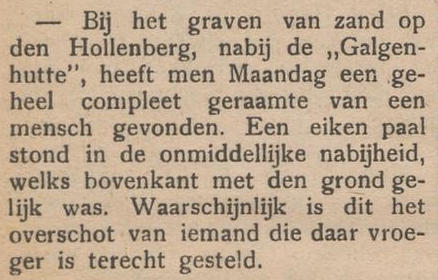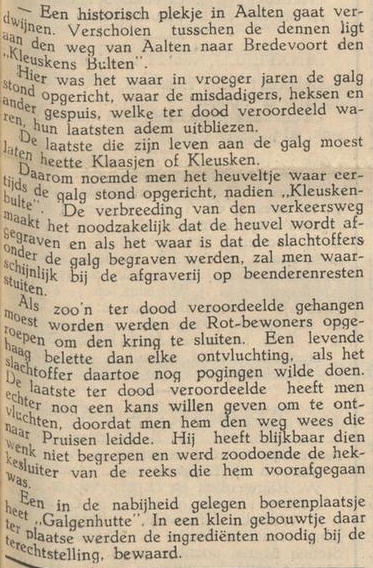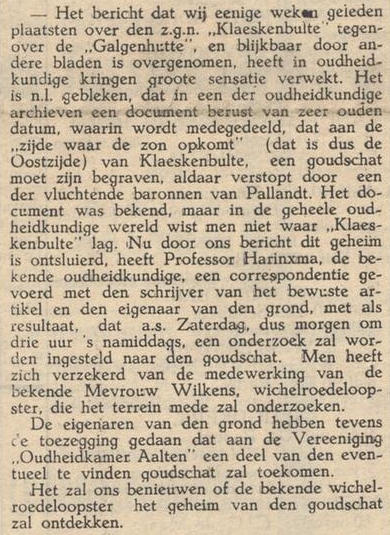
The Galgenbulte (Gallows Hill) on the Hollenberg, also known as Klaeskesbulte, was formerly the site where the gallows were erected. This was where condemned criminals, witches, and other scum drew their final breath.
The execution site was strategically located along the road from Aalten to Bredevoort. The hill was excavated in 1939 to widen the main road.
Approximate location
Vehmic Court
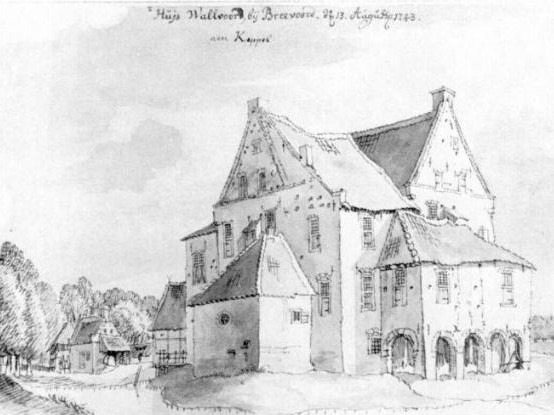
During the medieval period, a veemgericht (Vehmic court) was established on the Hollenberg, near the ’t Walfort manor. This was a special court whose sessions were held in the open air near a thicket known as ‘Sleehegge’. Four times a year, justice was administered here at sunrise. A nearby small farmstead is called Galgenhutte. It is said that the equipment for the executions was stored there in a small building. According to local lore, those sentenced to death were permitted to eat their final meal there.
Berend de Dücker
In 1430, Free Count Berend de Dücker, then the mayor of Bocholt, presided over the court here. He led the Vehmic court for 60 years. This Berend was notorious for his severe sentencing, frequently condemning individuals to hanging. The condemned person was hanged with a noose made of willow withes by three anonymous veemschepenen (Vehmic jurors).
A well-known threat used by parents for disobedient children, which persisted until the 20th century, was: ‘De Düker zal ow halen‘ (The Dücker will get you).
Records from the ‘Administrative Organisation of the Lordship of Bredevoort’ indicate that the residents of Kempink and Goorhuis in Heurne were responsible for transporting the convicted criminal to the Hollenberg after the sentence had been read at ’t Zand in Bredevoort. By order of the officer, they were also required, without exception, to transport the gallows, wheel, cross, and other instruments of execution to the site.
By the end of the sixteenth century, the Vehmic court at ’t Walfort had disappeared. It is the only location in the Netherlands where the existence of a Vehmic court has been proven.
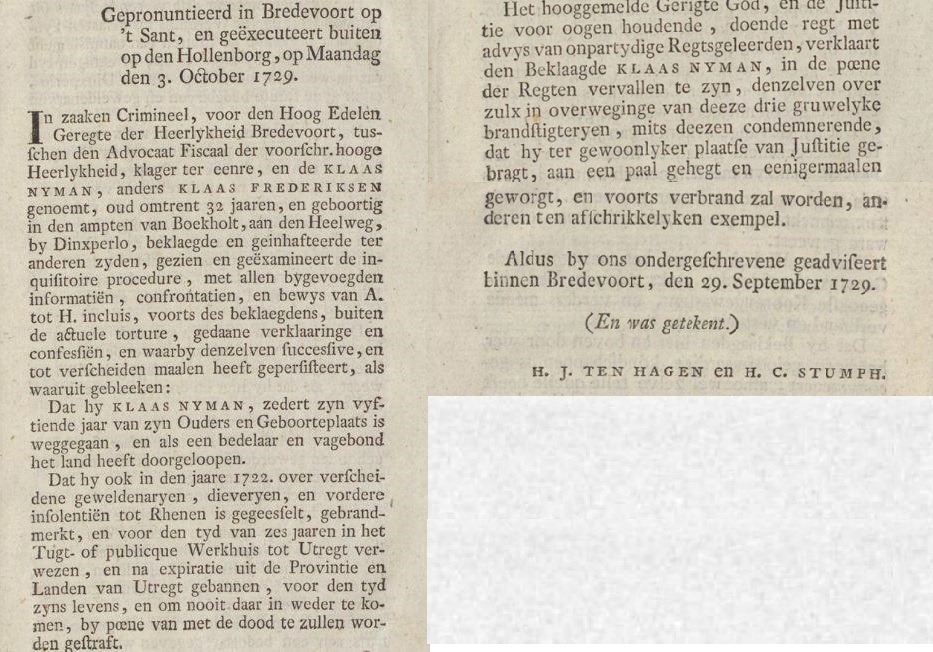
Klaas Nijman
On 3 October 1729, following a trial in Bredevoort and sentencing at ’t Zand, Klaas Nijman—32 years old and born in the district of Bocholt—was executed on the Hollenberg. He was a ‘beggar and vagabond’ accused of violent theft, arson, and other offences. Although he had been banished from various places, he continually returned. As a deterrent to others, he was strangled on the Hollenberg and subsequently set on fire.
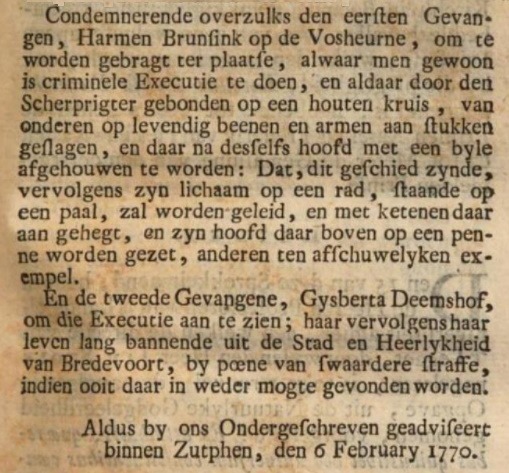
Harmen Brunsink
On 12 February 1770, Harmen Brunsink was executed on the Hollenberg. He lived at the Vosheurne farm in Lintelo and had murdered ‘Aunt’ Hendersken Tannemaat. Harmen did not get along with this live-in aunt of his wife. He claimed to alerted neighbours that she had fallen, but the number and nature of the injuries made his story unbelievable.
Harmen was sentenced to death. The executioner bound him to a wooden cross; first his legs and then his arms were broken. He was subsequently beheaded with an axe. His body was placed on a wheel atop a pole and secured with chains. His head was placed on a stake above it to deter others.
The Last Execution
In 1938, G.H. Rots wrote:
“The fact that death sentences were carried out even after the time of the Vehmic court proves that the end came for many a condemned soul in the vicinity of ’t Walfort. To the right of the road to Bredevoort, hidden under brushwood and trees, is a small mound. That is where the gallows were erected. When someone was to be executed, a number of men were officially summoned to form a circle around the place of execution. This was in case the noose should break or the condemned should break free; the circle of men stood hand-in-hand to prevent escape.
After a long period in which no more death sentences were passed, the last gallows is said to have been erected at the beginning of the last [19th] century. The condemned man was named Klaësken, and surrounded by the circle-closers, he went in procession to the gallows. It seems, however, that they wanted to give the man a chance to flee, for when they reached the Walfortallee, they said to him: ‘That is the road to Prussia.’ The man did not take the hint, and on the hill, as the last in a line of condemned men, he met his end on the gallows. That is why that small mound is still called the Klaëskesbulte.”
Other references